







3 Painful Blows: Thibaut Courtois Injury Casts Doubt on Belgium Future
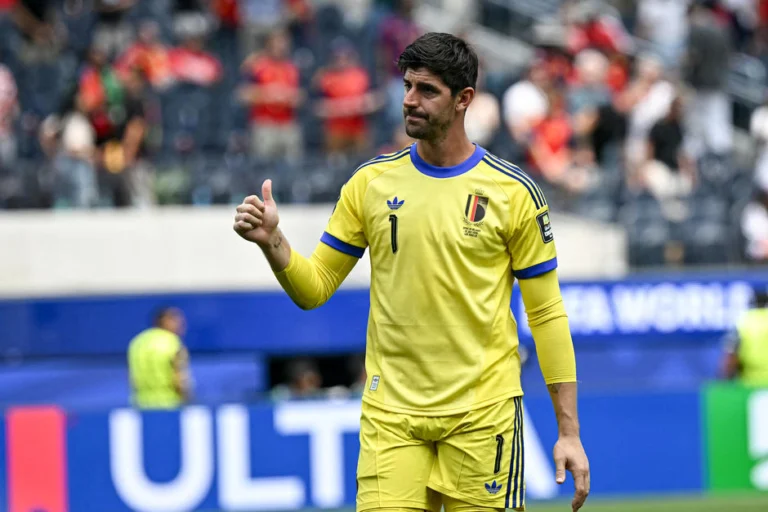
Thibaut Courtois injury in the 71st minute of Belgium’s quarter‑final against Spain forced an early substitution, raising doubts about his short‑term future with the national team.
July 11, 2026 Hour: 3:19 pm
🔗 Comparte este artículo
Thibaut Courtois injury against Spain raises doubts over his Belgium future, as the 34‑year‑old considers a break from national duty to focus on his club career.
Related: Spain Defeats Belgium to Reach World Cup 2026 Semifinals
Thibaut Courtois injury has opened a new and uncertain chapter in the career of Belgium’s veteran goalkeeper, who now questions his immediate future with the national team. The 34‑year‑old Real Madrid player was forced off in the 71st minute of the 2026 World Cup quarter‑final against Spain with sharp muscle pain, and later hinted he may ask for a pause from upcoming Belgium call‑ups to protect his club form.
Thibaut Courtois injury and his World Cup exit
Thibaut Courtois injury occurred during one of the most intense matches of Belgium’s World Cup campaign, the quarter‑final clash against Spain in North America. The keeper felt acute discomfort after executing a long clearance, and quickly realised he could not continue at full capacity.
The Belgian number one asked to be substituted in the 71st minute, visibly limited by a sharp muscular pain following the long‑distance clearance. For a player who has built his career on reliability and command of the penalty area, leaving a knockout match at such a crucial stage represented more than a tactical change; it was a moment of personal frustration and concern.
Speaking later in the mixed zone at the World Cup venue, Courtois explained that he is considering a break from upcoming international call‑ups to the UEFA Nations League, with the aim of prioritising his performance with his club in the Spanish league. In his own words, he wants to focus on institutional consistency with Real Madrid, especially as he enters what is often described as the latter phase of a goalkeeper’s career.
The Thibaut Courtois injury thus becomes a turning point: it is not only a physical setback, but also a trigger for reconsidering how much strain he can carry between national and club duties. For Belgium, the potential absence of such a cornerstone figure in goal would force an acceleration of generational transition in a key position.
Courtois has made clear that any final decision will depend on medical results. He said he will wait for magnetic resonance imaging tests to determine the exact extent of the muscle damage. From there, he will start a rehabilitation process under his club’s supervision, fitting into Real Madrid’s pre‑season plans.
Real Madrid’s medical staff have coordinated his transfer protocols back to Madrid, where he is expected to join the pre‑season under new head coach José Mourinho. For the Spanish club, the Thibaut Courtois injury raises immediate questions about early‑season availability and goalkeeping rotation, but also reinforces their need to manage his workload carefully.
Defensive impact and Courtois’ view on Belgium’s future
Once Thibaut Courtois injury forced him off the pitch, Belgium’s defensive structure felt the change. The entrance of substitute goalkeeper Senne Lammens altered the team’s chemistry in the final stretch of the elimination match, precisely when concentration and experience are most needed.
Lammens, a young keeper currently at Manchester United, came on under immense pressure. His technical response in one decisive action proved insufficient, and a rebound in the six‑yard box led to the tournament‑defining goal scored by Spanish midfielder Mikel Merino. In that moment, the fine margin between a safe catch and a loose ball decided Belgium’s fate in the World Cup.
Despite the criticism that quickly emerged from some local analysts, Courtois chose to publicly defend the young goalkeeper’s performance. He attributed the rebound and the subsequent goal to the dryness of the playing surface and to the inherent dynamics of high‑level competition, underlining that any goalkeeper can be exposed in such conditions.
By backing Lammens, Courtois used the Thibaut Courtois injury episode to send a message: responsibility in elite football is shared, and young players need support, not scapegoating. His words fit into a broader reflection he offered after Belgium’s exit.
Although the defeat ended Belgium’s World Cup campaign, the experienced keeper praised the team’s competitive level and tactical discipline. He argued that his side held its own against one of the most offensively powerful squads in the North American tournament, indicating that the group showed resilience even in adverse circumstances.
Courtois also looked beyond the quarter‑final, projecting that the winner of the semi‑final between France and Spain will assume the role of absolute favourite to lift the World Cup trophy. In his analysis, both teams possess the depth and attacking quality needed to go all the way, and their clash will likely define the competition’s hierarchy.
At federation level, the keeper used the moment to call on the Belgian Football Association’s leadership to consolidate processes of generational renewal, drawing on emerging talents from the domestic youth ranks. In his view, the future of Belgium’s national team depends on integrating new players into the structure that the “golden generation” helped build.
In that sense, Thibaut Courtois injury becomes a lens through which to see broader changes: as veterans face physical limits, Belgium must move from relying on a core of long‑standing stars to blending them with younger names who can sustain competitiveness in upcoming cycles.
Geopolitical and footballing context
Beyond the strictly sporting dimension, Thibaut Courtois injury touches on wider discussions about player workload, national team calendars and the economic stakes surrounding major tournaments. As top footballers juggle club obligations, international competitions and commercial commitments, muscular injuries and fatigue episodes have become more frequent, raising questions about scheduling and recovery.
Courtois’ decision to consider stepping back from some national team engagements echoes a trend among senior players who seek to extend their club careers by reducing international strain. For federations, this creates the challenge of maintaining high performance while respecting the limits of athletes who have already given many years of service.
At a broader level, Belgium’s situation also reflects the cycle faced by several European teams that rose with a “golden generation” and must now manage transition without losing identity. Thibaut Courtois injury and his possible partial withdrawal from the national team underscore how fragile that balance can be: one injury can accelerate debates about renewal, tactics and leadership.
If Belgium successfully uses this moment to promote young talents while protecting key veterans’ health, it could become an example of how medium‑sized football nations navigate generational change. If, however, injuries and early exits continue to dominate headlines, critics may argue that the window of opportunity opened by the last decade’s success is closing faster than expected.
Author: JMVR
Source: Agencias