







The United Kingdom Faces Regional Separatism
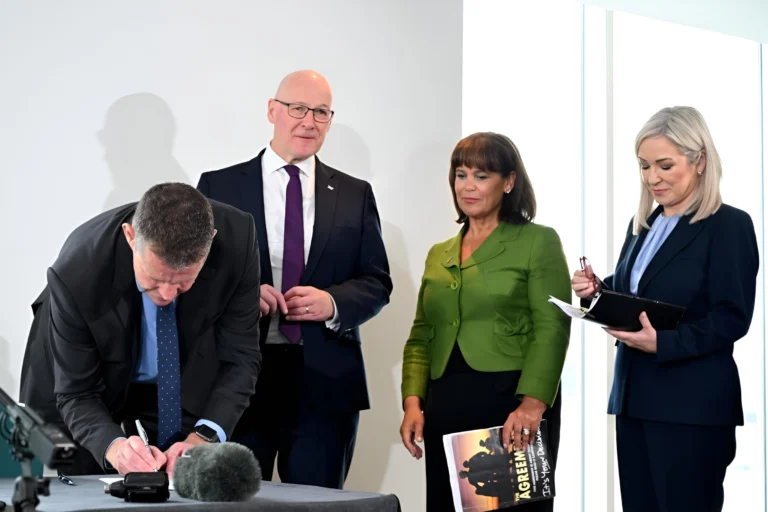
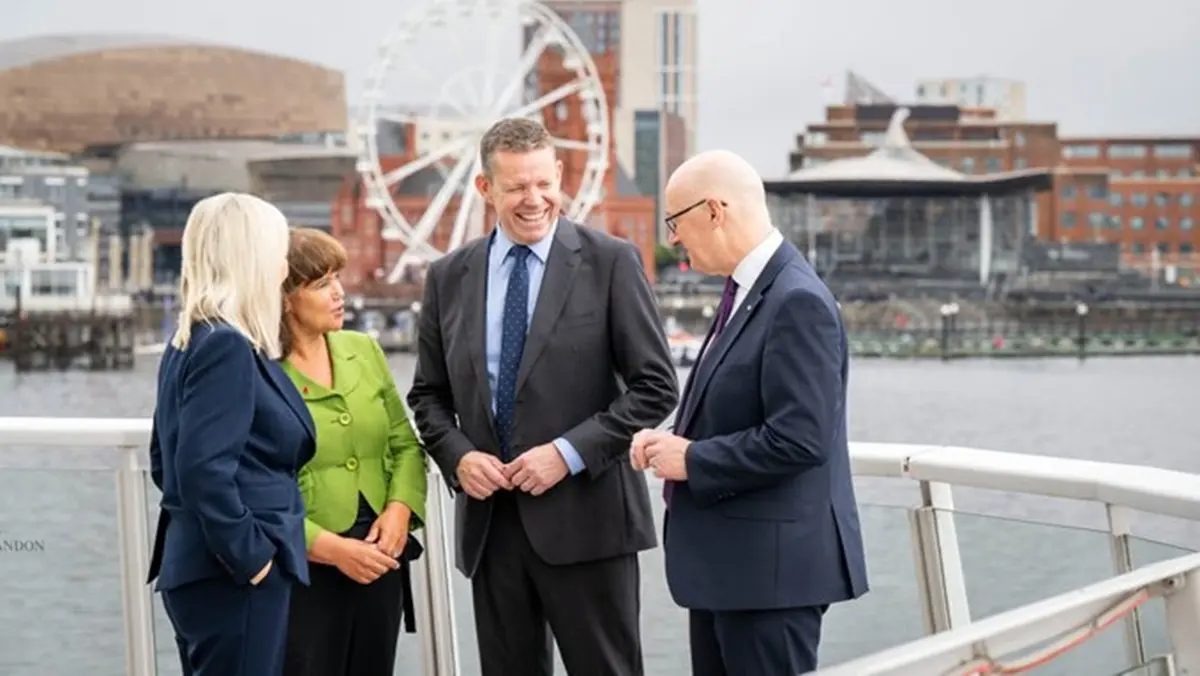
Nationalist leaders from Scotland, Wales, and Northern Ireland (including John Swinney, Mary Lou McDonald, and Michelle O’Neill) meeting in Cardiff. Photo: Jape Journal
September 18, 2026 Hour: 3:01 pm
🔗 Comparte este artículo
Decades of industrial decline and austerity fuel public distrust in central UK institutions.
The United Kingdom is often presented as a permanent, unitary nation-state comprising England, Scotland, Wales, and Northern Ireland. However, constitutional history and political economy show that it is an asymmetrical union formed through specific historical agreements.
RELATED:
Party Leaders in Scotland, Wales, Northern Ireland Call for Talks On UK Constitutional Change
On September 14, the political landscape of the United Kingdom reached a milestone when pro-independence and nationalist leaders gathered at St David’s Hotel in Cardiff, Wales.
Hosted by First Minister of Wales Rhun ap Iorwerth (Plaid Cymru party), the summit brought together First Minister of Scotland John Swinney (Scottish National Party), First Minister of Northern Ireland Michelle O’Neill (Sinn Féin Party), and Sinn Féin President Mary Lou McDonald.
Together, they signed a landmark Memorandum of Understanding, the Cardiff Agreement, demanding the right to democratic self-determination and asserting that no Westminster government has the authority to block constitutional referendums.
The central government in London retains ultimate legislative authority under the principle of parliamentary sovereignty. The Cardiff Memorandum explicitly criticized this centralized model, calling for European integration and rejecting what the leaders described as a central economic framework managed from Whitehall.
The September 2026 Cardiff pact highlights that the drive for separation has evolved from isolated regional campaigns into a coordinated, cross-border challenge to the authority of the central state.
Historical Background of Separatism
The historical roots of peripheral nationalism in the UK are closely tied to uneven economic development across the island. During the Industrial Revolution, regions such as central Scotland, South Wales, and Belfast became major centers for heavy manufacturing, coal mining, shipbuilding, and steel production.
However, during the post-World War II period, and particularly during the 1980s under Prime Minister Margaret Thatcher, the UK underwent rapid deindustrialization.
As the national economy shifted toward services and finance concentrated in London and Southeast England, the industrial regions in the peripheral nations suffered severe manufacturing job losses, structural unemployment, and reduced public investment. This economic divergence created distinct regional identities rooted in opposition to Westminster’s fiscal management.
In Scotland, opposition to Conservative economic policies during the 1980s transformed regional industrial grievances into a demand for political self-determination.
This political push led to the 1997 devolution referendum and the official opening of the Scottish Parliament in 1999. While intended to permanently secure the union by granting local autonomy, devolution established a distinct political platform in Edinburgh.
In Wales, political nationalism was historically driven by language preservation and cultural rights. Over time, Plaid Cymru and local activists expanded this focus to address economic extraction and regional underinvestment.
Proponents pointed out that while Wales was a major exporter of electricity and water to England, Welsh regions continued to report lower average household incomes and higher rates of poverty compared to the UK average.
In Northern Ireland, the background of division was defined by the legacy of the 1921 partition, civil rights struggles, and decades of conflict known as the Troubles. The 1998 Good Friday Agreement established a power-sharing executive at Stormont and recognized the legal right to a future referendum on Irish reunification, known as a border poll, if a majority of voters favor it. Over the following decades, demographics and political alignments changed significantly.
Brexit as a Catalyst
The 2016 referendum on United Kingdom membership in the European Union exposed deep political divergences among the four constituent nations.
At the national level, 51.9% of voters chose to leave the EU. However, the results were unevenly distributed across borders. Voters in England voted 53.4% to leave, and voters in Wales voted 52.5% to leave. In contrast, voters in Scotland voted 62% to remain, and voters in Northern Ireland voted 55.8% to remain.
Because the referendum was decided by a national vote recount, the England population density determined the final result. This outcome reinforced criticisms regarding a democratic deficit within the UK’s constitutional structure.
In Scotland, the Scottish National Party argued that the nation was being removed from the EU single market and customs union against the expressed political will of its electorate.
Following Brexit, the UK government passed the United Kingdom Internal Market Act 2020 to prevent regulatory divergence between nations. The act introduced principles of mutual recognition and non-discrimination across the entire UK market.
The Scottish Government and the Welsh Government formally opposed the legislation, arguing that it restricted their legal capacity to enforce distinct environmental or social standards on goods sold within their jurisdictions.
In Northern Ireland, Brexit introduced distinct constitutional and economic challenges along the border with the Republic of Ireland. To avoid a physical land border on the island of Ireland, the UK government and the EU negotiated the Northern Ireland Protocol, which was later modified by the Windsor Framework.
Under these arrangements, Northern Ireland remained aligned with key EU single market rules for goods while retaining access to the UK internal market.
This unique status established regulatory checks on certain goods moving from Great Britain into Northern Ireland. While the arrangement prevented border infrastructure on the island of Ireland, it altered regional trade patterns.
These shifting economic links accelerated debates regarding long-term constitutional integration between Northern Ireland and the Republic of Ireland.
Drivers of Separation
The primary political parties of the United Kingdom advocating independence or constitutional separation in the devolved nations operate with distinct political strategies and ideological platforms.
In Scotland, the Scottish National Party (SNP) drives the independence movement. The SNP frames its platform around civic nationalism, social democracy, and European integration. Rather than grounding its argument in ethnic identity, the party presents independence as a legal mechanism to protect public services, establish control over local energy resources, and implement progressive tax policies.
In Northern Ireland, Sinn Féin leads the movement for Irish reunification. Ideologically rooted in left-wing Irish republicanism, the party advocates for the end of British jurisdiction in Northern Ireland through the legal mechanisms of the 1998 Good Friday Agreement. Sinn Féin frames reunification as an opportunity to reorganize public administration, integrate healthcare systems across the island, and eliminate duplicate administrative costs.
Following its historic electoral performance in 2022, where it became the largest party in the Northern Ireland Assembly, Sinn Féin increased calls for the Irish Government in Dublin and the UK Government in London to begin official planning for a future border poll.
In Wales, Plaid Cymru represents the political movement for Welsh self-determination. Plaid Cymru operates as a democratic-socialist party, prioritizing green industrial transition, anti-poverty measures, and community management of local resources.
Plaid Cymru argues that Wales suffers from structural economic extraction, pointing to the export of water and green energy to English regions without proportional financial returns for local communities.
Legal Imperialism and the Labor Management Strategy
Successive UK governments in London have responded to independence movements by preserving the union’s constitutional integrity through legal mechanisms, centralized administrative controls, and fiscal management.
During the Conservative administrations following the 2016 referendum, the central government adopted a policy often described as “muscular unionism.”
Under Prime Ministers Boris Johnson, Liz Truss, and Rishi Sunak, Westminster consistently rejected requests from the Scottish Government for a Section 30 order, a legal mechanism under the Scotland Act 1998 that temporarily transfers the power to hold a constitutional referendum to the Scottish Parliament.
This legal strategy culminated in the November 2022 UK Supreme Court ruling, which confirmed that devolved parliaments cannot legally legislate for an independence referendum without central consent.
Following the general election, the Labour administration under Prime Minister Keir Starmer maintained a policy rejecting further constitutional referendums, emphasizing fiscal discipline, targeted infrastructure funding, and administrative cooperation.
However, the signing of the September 2026 Memorandum of Understanding in Cardiff directly challenged this approach. By issuing a unified demand for self-determination from the leaders of Scotland, Wales, and Northern Ireland simultaneously, the pro-independence parties neutralised London’s traditional strategy of managing each nation through separate bilateral negotiations.
The political opposition to fragmentation includes the major UK-wide political parties, the civil service, the central financial sector based in the City of London, and national defense establishments.
Viability and Scenarios of Fragmentation
The mechanics of potential UK fragmentation shifted significantly following the September 2026 Cardiff summit. In Scotland and Wales, the joint memorandum established a shared political campaign to bypass Westminster’s legal vetoes.
Rather than acting individually, the SNP and Plaid Cymru now frame self-determination as a joint constitutional right, coordinating legislative strategies and international diplomatic pressure to demand binding referendum frameworks.
In Northern Ireland, the path remains tied to the Good Friday Agreement. However, with Sinn Féin participating in the joint Cardiff pact, calls for the UK Secretary of State to set a timeline for a border poll are now integrated into a broader multi-nation push for constitutional change.
In conclusion, the potential fragmentation of the United Kingdom reflects long-term structural tensions within its constitutional model. Uneven economic development, the centralizing effects of Brexit, and differing electoral results between nations continue to place stress on the union.
The historic coordination between Edinburgh, Cardiff, and Belfast marks a transition from isolated regional movements into a unified constitutional challenge, leaving the relationship between Westminster and the devolved nations subject to permanent political renegotiation.
Sources: BBC – ITV – Channel 4 – GOV.UK – Britannica – Reuters – EFE – Democracy Now – El País – DW – The Independent – The Guardian – Anadolu Agency – Press TV – RT – Xinhua – CGTN – Hispan TV – Al Jazeera
Author: Silvana Solano
Source: teleSUR