


The CIA and the Shadow of Imperialism: Hybrid War Threats Against Venezuela
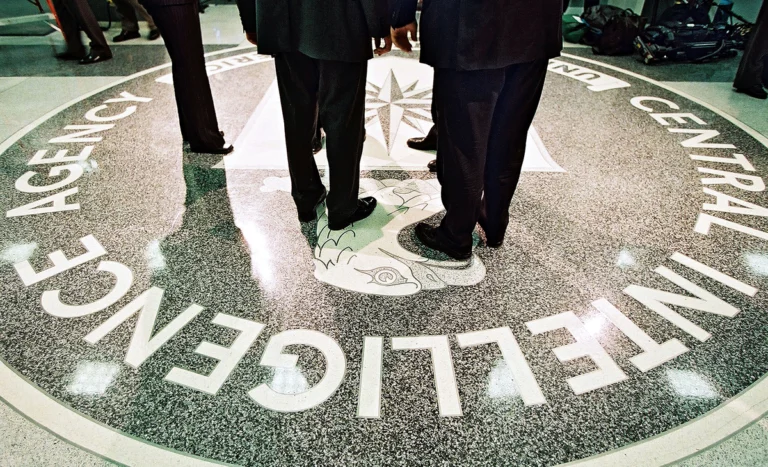
386984 06: President George W. Bush, Central Intelligence Agency Director George Tenet and others stand on the seal of the Agency March 20, 2001 at the CIA Headquarters in Langley, Virginia. Bush toured the facility and met some of the Agency”s employees. (Pool Photo by David Burnett/Newsmakers)
October 17, 2025 Hour: 1:23 pm
Latin American history is written by the popular struggles for sovereignty and independence, and also by the constant meddling of the United States.
Since the mid-twentieth century, the Central Intelligence Agency (CIA) established itself as the operational arm of American imperialism, aimed at dismantling governments that did not serve its strategic and economic interests.
What during the Cold War was justified as the “defense of the free world against communism” has now been reconfigured as the “fight against drug trafficking” or the “protection of democracy.” However, the motivations (control, resources, and hegemony) remain intact.
Every coup d’état, economic sabotage, or information war promoted by the CIA has left behind fractured democracies and dependent economies.
This trajectory of interference is expressed once again in the current aggression against Venezuela, a country that, due to its project of oil sovereignty and its geopolitical position, is once again a priority target for American power.
State Terrorism: The Model Exported by the CIA
Since its formal creation in 1947, the CIA has acted as the axis of US hemispheric control. Its “national security” policy transformed the peoples of Latin America into “internal enemies,” criminalizing any demand for social justice, agrarian reform, or economic independence. What was imposed was a doctrine of fear: stifling democracies in the name of freedom.
- Guatemala 1954: The Experiment of Terror
The 1954 coup in Guatemala was the foundational model. The CIA executed the so-called “Operation PBSUCCESS” to overthrow President Jacobo Árbenz, who had promoted an agrarian reform that affected the interests of the United Fruit Company, an American agribusiness giant.
Under the propaganda of a supposed communist threat, the US imposed a military dictatorship that began a cycle of repression, torture, and disappearances. Latin America learned that any attempt at sovereignty could be paid for in blood.
- Chile 1973: From Economic Sabotage to Military Coup
Two decades later, history repeated itself with the socialist government of Salvador Allende.
Following direct orders from Richard Nixon, the CIA drove a brutal process of economic suffocation (“make the economy scream”) that culminated in the coup d’état on September 11, 1973.
General Augusto Pinochet led a dictatorship backed by Washington; a symbol of state terrorism applied as a tool of domination and a laboratory for neoliberal policies.
- Operation Condor: Coordinated Regional Repression
In the mid-seventies, the CIA promoted the coordinated repression of the Southern Cone dictatorships (Argentina, Chile, Uruguay, Paraguay, Bolivia, and Brazil) in the so-called Operation Condor.
It was an internationalized system of intelligence, persecution, and physical elimination of dissidents.
The death flights, clandestine detention centers, and transnational espionage networks consolidated a machinery of terror that exterminated thousands of lives, all under US oversight and logistics.
With the end of the Cold War, the United States did not abandon its control agenda. It only changed its method.
CIA funding and the apparatus of interference shifted to civilian organizations like USAID, the NED, and Freedom House, tasked with funding opposition groups, media outlets, and political projects aligned with the neoliberal model. The influence became more subtle, but no less effective.
Venezuela: Continuity of Interventionism and New Hybrid Wars
The aggression against Venezuela does not emerge from a vacuum. It represents the updating of an old imperial model adapted to the 21st century.
Under the administration of Donald Trump, the policy of pressure, sanctions, and covert operations has reached unprecedented levels, combining diplomatic, financial, and military tools.
- The CIA’s Secret Authorization
A report by The New York Times revealed that the Trump administration secretly authorized the CIA to conduct covert and even lethal operations in Venezuela and the Caribbean.
These actions fall within the doctrine of “hybrid war”: a mixture of psychological strategies, economic destabilization, and media warfare aimed at creating conditions for a regime change.
John Ratcliffe, director of the CIA, stated that the agency must act “more aggressively,” opening the door to an escalation of actions that violate Venezuelan sovereignty.
- The Southern Command and the Anti-Drug Facade
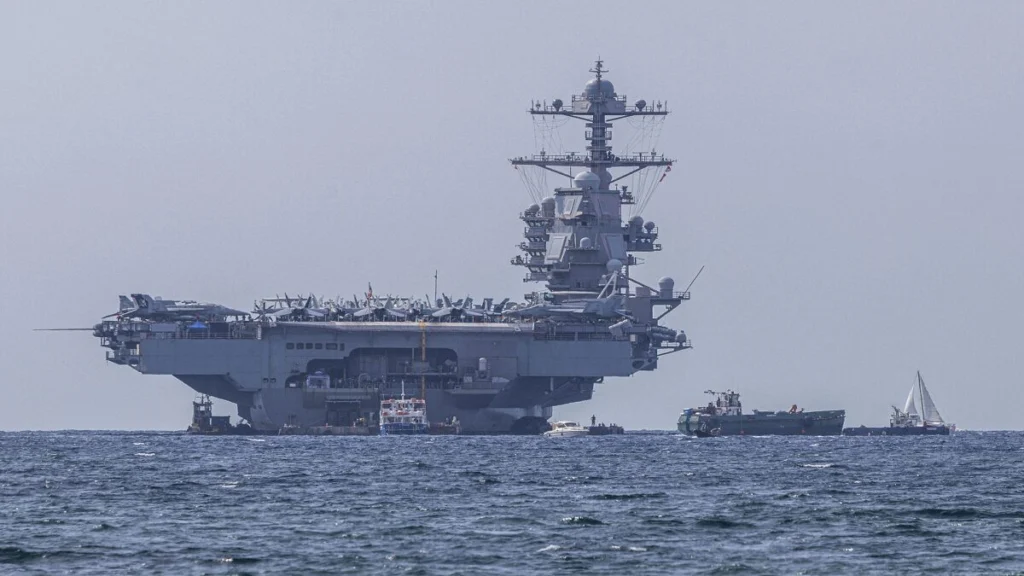
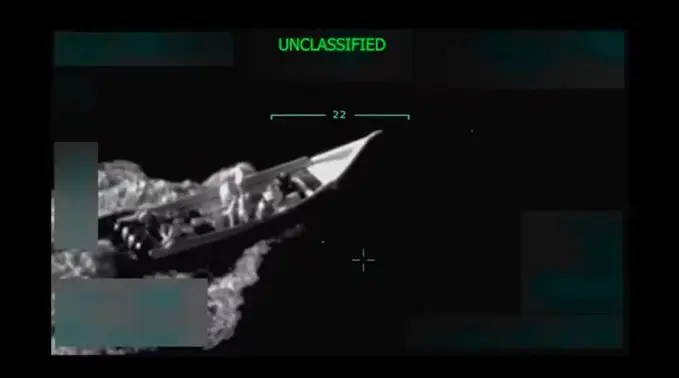
In parallel, the deployment of some 10,000 Southern Command personnel, along with destroyers and attack submarines, was presented as an “anti-drug operation” in the Caribbean.
However, its true objective is to surround and pressure Venezuela within a clear framework of military intimidation. This operational device fulfills three strategic functions:
- Psychological operations: erode collective morale and sow a feeling of siege.
- Controlled provocation: escalate tensions towards an open conflict.
- Real military prepositioning: prepare infrastructure and logistics for a potential direct intervention.
Behind Washington’s discourse on “democracy and freedom” lies a geopolitical project: to regain control over Venezuelan energy resources, dismantle the Bolivarian model of sovereignty, and reinstall governments obedient to transnational capital.
Trump and the Colonial Mindset
Testimonies collected in John Bolton’s The Room Where It Happened reveal the dangerous vision guiding Trump’s foreign policy.
According to Bolton, the president once stated that “invading Venezuela would be ‘cool'” and that the country “really belonged to the United States.”
This discourse not only embodies a colonial arrogance but also legitimizes aggression through a simplistic rhetoric of “national liberation” promoted from Washington.
- Marco Rubio and the Interventionist Agenda
Within the US Congress, Republican Senator Marco Rubio established himself as the main promoter of the offensive against Caracas.
His strategy has consisted of portraying Venezuela as a “narco-terrorist state” and a supposed threat to US national security. With this, he seeks to validate the principle of “preventive war” and justify military actions.
At the same time, Rubio has built alliances with figures from the radical Venezuelan opposition, such as María Corina Machado, projecting a narrative of a guided “democratic transition” that in reality responds to US strategic interests.
Migration and Drug Trafficking: Excuses of Power
Trump and his allies have instrumentalized the region’s humanitarian crises to reinforce their apparatus of domination.
They use migration as a political tool, criminalizing refugees and reinforcing racial and social stigmas. By linking Venezuela to supposed flows of “criminals and drug traffickers,” the Republican government constructs an internal alibi that fuels a discourse of fear and favors military spending.
It is not about protecting borders, but about consolidating a nationalist consensus that justifies imposing unacceptable conditions on Caracas.
A War for Sovereignty
The current conflict cannot be seen as a simple bilateral dispute. It is part of the long war for Latin America’s self-determination. Venezuela today represents the continuity of a history of resistance against interventionism, one previously suffered by Chile, Guatemala, or Nicaragua.
The Bolivarian nation, besieged by sanctions and threats, has raised its complaint before the United Nations Security Council, reminding that the principle of non-intervention remains a cornerstone of international law.
The CIA, under new pretexts and technologies, repeats its historical patterns: media campaigns, financial sabotage, covert operations, and cultural warfare. But the region has changed.
The peoples, social movements, and sovereign governments have learned to recognize the trap of “humanitarian aid” and the false promises of freedom manufactured in Washington.
The shadow of the CIA persists, but so does historical memory. Latin America is redrawing its horizon, aware that real independence requires not only resisting intervention but also building political, economic, and communicational alternatives to imperial power.
Author: Silvana Solano
Source: TeleSur