


The Battle of Pichincha Proved the Power of Regional Integration
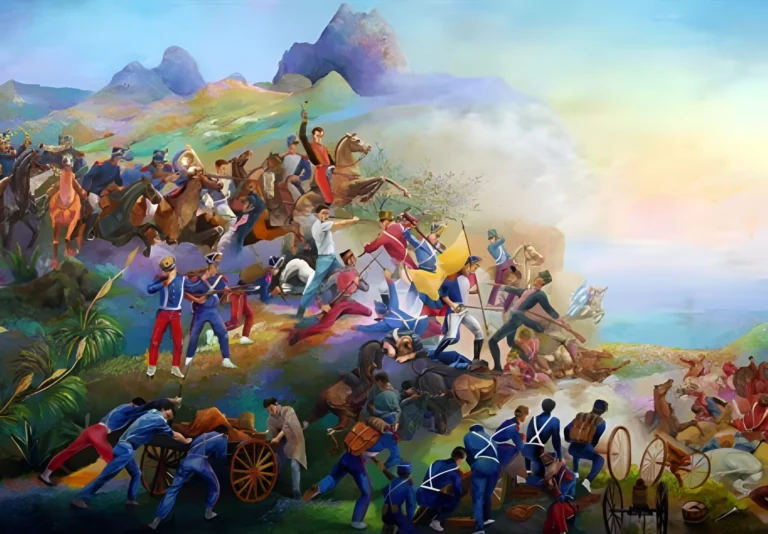
Battle of Pichincha. Mural depicting the battle. Photo: arrecaballo.es
May 25, 2026 Hour: 2:42 pm
🔗 Comparte este artículo
The collaborative victory of a multinational army served as a foundational blueprint for continental self-determination
On May 24, 1822, the slopes of the Pichincha Volcano served as the backdrop for a pivotal military confrontation that would prove to be of immense strategic importance within the broader context of South American history. The Battle of Pichincha was not merely a localized conflict over territorial boundaries.
RELATED:
203 Years of Pichincha: Sucre’s Victory, Noboa’s Challenge, and Maduro’s Anti-Imperialist Call
Instead, it marked a pivotal moment in the broader campaign to dismantle Spanish colonial rule in the Americas. This encounter, held at an elevation of more than 3,500 meters overlooking the city of Quito, united a diverse, multinational coalition of revolutionary forces determined to secure regional sovereignty.
When examined through the lens of regional integration, the events of late May 1822 demonstrate the necessity of international cooperation in overcoming imperial power. The victory achieved on the volcano had a significant impact on the geopolitical landscape of the Andes, providing a practical model for collective resistance.
By securing the strategic corridor of Quito, the battle advanced the unifying political vision of Simón Bolívar, establishing a permanent precedent for Latin American solidarity and self-determination.
The Strategic Assault on the Volcano
By early 1822, the war for independence in South America had reached a critical geopolitical deadlock. While revolutionary forces had successfully liberated the northern territories of Venezuela and New Granada, the central Andean highlands of the Real Audiencia de Quito remained a heavily fortified stronghold of the Spanish royalist army under the command of Field Marshal Melchor Aymerich.
This royalist presence functioned as a geographic wedge, threatening the stability of the newly established independent governments to the north and blocking revolutionary advancements from the south. General Antonio José de Sucre, the principal strategist appointed by Simón Bolívar, recognized that the independence of the continent would remain vulnerable as long as Quito remained under imperial control.
To break the stalemate, on May 23, Sucre led an impressive 3,000 patriot troops up the steep, icy slopes of Mount Pichincha during a rainy night. The ascent was arduous, conducted in near-total darkness along perilous paths covered in mud.
By dawn on May 24, the patriot army had reached the high slopes overlooking the city, catching the royalist garrisons completely by surprise and forcing them to engage in battle on highly irregular, fractured terrain where traditional military formations were impossible to maintain.
The fighting began mid-morning on May 24 amidst thick fog and steep ravines, testing the physical endurance of both armies due to the extreme altitude. The conflict remained in a state of equilibrium for several hours, with both sides experiencing significant losses in the challenging terrain.
The Albión Battalion, a unit comprised of British and European volunteers, arrived and secured the high ground, outflanking the Royalist lines. By the afternoon of May 25, 1822, the Spanish forces were completely routed and retreated into the walled city of Quito. This led to the formal capitulation of the Spanish Crown.
Principal Characters and Ideologues
The success of the Pichincha campaign hinged on a multifaceted leadership structure adept at overseeing intricate military operations and sensitive political alliances. At the center of this operation was General Antonio José de Sucre, whose strategic planning and diplomatic tact proved indispensable.
Sucre demonstrated particular aptitude in orchestrating a diverse, multinational coalition, adeptly reconciling the divergent agendas of local elites with the broader aspirations of the continental revolution. His leadership during the mountain ascent demonstrated a profound understanding of asymmetrical warfare, allowing him to neutralize the defensive advantages held by the Spanish royalist forces.
In addition to Sucre, seasoned field commanders such as José Mires and John MacKintosh provided vital tactical stability during the chaotic high-altitude engagement. Mires, a seasoned officer, managed the initial deployment of infantry under highly volatile conditions, while MacKintosh commanded the Albión Battalion, whose timely arrival secured the critical high ground.
The battle also produced powerful revolutionary symbols, most notably Abdón Calderón, a young lieutenant from Guayaquil who sustained multiple injuries while maintaining his position on the field. The elevation of Calderón’s sacrifice served to strengthen the collective identity and morale of the nascent republican forces.
This shift marked a permanent transition from the Spanish colonial administrative apparatus. The victory replaced a rigid imperial hierarchy with a military and political vanguard deeply committed to regional sovereignty.
The Invisible Protagonists: Indigenous Logistics and Grassroots Resistance
While conventional historical accounts emphasize the decisions of elite generals, a materialist analysis demonstrates that the victory at Pichincha was structurally dependent on the mobilization of the popular classes. The logistical foundation that sustained Sucre’s regular army was formed by indigenous communities, women, and peasant volunteers.
The patriot forces’ success in executing a high-altitude surprise maneuver over Mount Pichincha would not have been possible without widespread grassroots subversion of colonial authority. This subversion provided the intelligence, physical sustenance, and mobility required for the operation.
A key element of the campaign was the active use of local indigenous knowledge by the local population. Due to the fact that the Spanish army maintained control over the primary valley routes, Sucre relied on the use of indigenous scouts, who possessed ancestral knowledge of the Qhapaq Ñan (the historical Andean trail networks).
These guides skillfully directed thousands of troops through concealed mountain pathways in complete darkness and dense fog, effectively concealing the operation from royalist surveillance. Concurrently, local communities established a network of counter-espionage, providing Sucre with precise details regarding Spanish troop movements inside Quito while refusing to disclose patriot positions to royalist scouts.
Furthermore, the urban working classes and highland villages organized supply chains to ensure the physical survival of the army in the freezing alpine tundra, or páramo. Women known as cholas or rabonas marched alongside the battalions, carrying firewood, medical supplies, and cooking equipment to sustain the soldiers and treat altitude sickness.
Agrarian communities pooled resources to supply essential provisions like corn, potatoes, and blankets, often risking severe colonial reprisals. Additionally, irregular guerrilla units known as Montoneras, composed of peasants and Afro-descendant fighters, launched diversionary attacks that disrupted Spanish communication lines and secured the rearguard, ensuring the regular army could advance safely.
Consolidating Gran Colombia and Defending Ecuador’s Independence
The territorial liberation achieved at the Battle of Pichincha fundamentally altered the geopolitical map of South America. For the inhabitants of the Real Audiencia de Quito, the immediate consequence was the definitive collapse of Spanish administrative control in the Andean core.
The victory was secured by permanently neutralizing the royalist military apparatus in Quito. This ensured the safety of the surrounding provinces and laid the institutional foundation for what would later become the independent Republic of Ecuador.
Beyond its local impact, Pichincha resolved a critical structural vulnerability within the broader Gran Colombia project. Before May 1822, the Spanish presence in Quito functioned as a strategic military wedge, dividing the liberated northern territories of Venezuela and New Granada from the independent port city of Guayaquil. This victory led to the unification of these fragmented regions, resulting in the formation of a contiguous territorial bloc under Republican governance.
This strategic shift effectively integrated Guayaquil into the Gran Colombia federation, countering local secessionist movements and safeguarding the strategic port from external regional influences.
Furthermore, the integration of the Ecuadorian highlands provided the revolutionary movement with a vital material base. The region’s agricultural valleys and textile workshops supplied food, horses, and uniforms directly to the republican forces, reducing their dependence on costly imports.
With its northern borders secure and its economy reinforced, Gran Colombia successfully transformed the newly liberated territory into a strategic launching pad for the final southern campaigns, ultimately enabling the total liberation of Peru at the battles of Junín and Ayacucho in 1824.
The Living Legacy of Pichincha and Regional Sovereignty
The Battle of Pichincha stands as a foundational milestone in the history of Latin American emancipation, illustrating that military success is inseparable from popular participation and cross-border cooperation.
The events of May 24 and 25, 1822, demonstrated that isolated revolutionary movements were unable to withstand the systemic power of a global empire. By pooling continental resources and integrating the popular classes into a unified strategy, the patriot forces effectively demonstrated the practical necessity of regional unity.
In the contemporary context, the historical lessons of Pichincha continue to offer relevant insights for Latin American integration and self-determination. The collaboration of multinational armies, the indispensable support of indigenous communities, and the shared political vision of Gran Colombia emphasize that true sovereignty is a collective endeavor.
Sources: Archives of the Liberator’s Secretariat – teleSUR – Britannica – Center for Historical Studies of the Ecuadorian Army – Encyclopedia – Ecuador.com
Author: Silvana Solano
Source: teleSUR