







The 1983 U.S. Intervention in Grenada Confirmed the Imperialist Will to Power
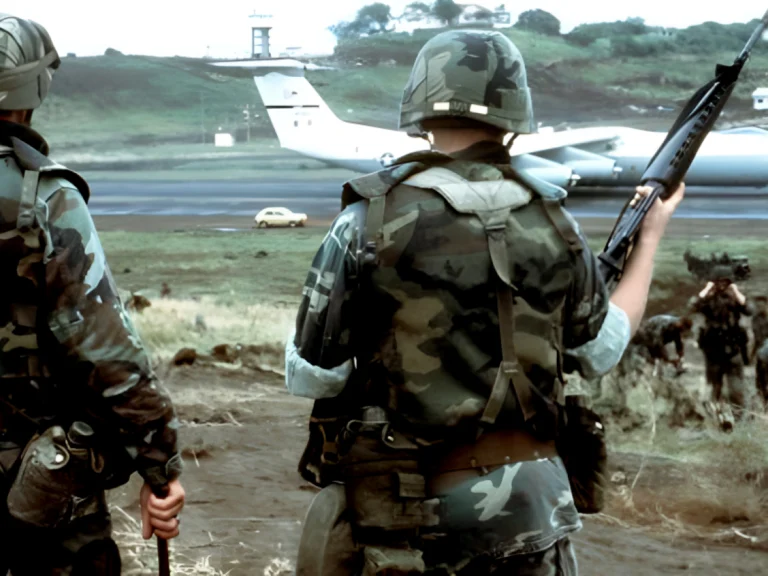
US Military. Photo: CiberCuba
January 7, 2026 Hour: 1:48 pm
🔗 Comparte este artículo
The ghosts of the Cold War have returned to the Caribbean. On January 3, 2026, under the name “Operation Absolute Resolve,” U.S. forces bombed Venezuela, an action Caracas denounces as a crime against sovereignty.
RELATED:
Monroe Doctrine: Two Centuries of Implacable Imperialism
For anyone in Latin America, the script feels painfully familiar: an old imperial playbook dressed up in the language of “law enforcement” and “democracy.”
To understand why the U.S. military now claims the right to “arrest” the leadership of a sovereign state, it is necessary to look back 42 years to a small Caribbean Island: Grenada.
The 1983 invasion was not a minor Cold War episode. It was a blueprint for today’s open violation of Latin American and Caribbean sovereignty, from Point Salines to Caracas.
From Grenada to Caracas
The attack on Venezuela and the capture of President Maduro and First Lady Flores are being sold to the U.S. public as a “surgical strike” against “narco‑terrorism” and a wanted “fugitive president.”
Seen from the South, however, it looks like the Monroe Doctrine reborn: Washington once again assumes it can decide who governs in the Americas and under what terms.
In 1983, Ronald Reagan launched “Operation Urgent Fury” in Grenada to “restore order” and allegedly protect U.S. medical students.
In 2026, Donald Trump presents “Operation Absolute Resolve” as a law‑enforcement action with military support, a Trump‑era corollary to the same doctrine, where the U.S. executive unilaterally declares which governments are “legal” and which leaders can be seized.
The continuity is striking. The invasion of Grenada was condemned at the United Nations as a “flagrant violation of international law,” with 108 states in the General Assembly voting to deplore the armed intervention and demand respect for the island’s sovereignty.
Today, the strike on Venezuela, carried out without Security Council authorization, again runs against the UN Charter’s basic principle of non-intervention and has already triggered a wave of criticism.
Then, the pretext was stopping the “spread of communism” and supposedly neutralizing a Soviet‑Cuban outpost. Now, the pretext is a rotating vocabulary of “narco‑terrorism,” “failed state,” and “energy security,” all pointing toward the same material objective: control of Venezuela’s vast oil reserves and strategic position in the Caribbean basin. Washington’s Big Stick policy never disappeared; it simply waited for a new excuse.
How the Empire Builds a Pretext
Empires rarely invade without a story to tell. In 1983, the U.S. State Department and the White House built a narrative to manufacture consent for military action and present aggression as rescue.
In the early 1980s, the Grenadian revolutionary government began constructing an international airport at Point Salines, with Cuban cooperation and external financing.
Grenada’s leaders insisted the new runway was essential for tourism and commercial flights, since the existing airport could not handle larger jets.
Washington, however, insisted it was a Soviet‑Cuban military base in disguise, despite the lack of hard evidence of deployed offensive weapons on the island.
Internal crises then became the accelerant. After a split inside the New Jewel Movement, the arrest of Maurice Bishop, and his subsequent execution in October 1983, the U.S. government framed its invasion as a mission to “protect” American medical students and restore order.
Behind this humanitarian language was a clear objective: remove a socialist experiment in the Caribbean, neutralize Cuban influence, and reassert U.S. dominance over the region’s political direction.
In that case, the U.S. waited for a moment of internal vulnerability and political crisis, violent conflict in Grenada, to move in under the banner of “protection,” “democracy,” or “law enforcement.” The chaos that Washington claimed to be fixing served as the gateway for a new cycle of geopolitical control.
Asymmetric Warfare and the Inverted Narrative
On the ground, the 1983 invasion of Grenada was a demonstration of overwhelming force against a small island with limited defensive capacity.
Yet the dominant narrative in U.S. media portrayed the operation as a near-heroic struggle in which elite troops faced unexpectedly “tough” resistance.
The reality was an asymmetrical confrontation. The United States deployed thousands of troops, aircraft carriers, helicopter gunships, and special forces against Grenadian units and Cuban construction workers who were never equipped to confront a global superpower.
Despite this imbalance, accounts of the “Siege of Government House” framed episodes such as a handful of Navy SEALs coming under fire as proof of a dangerous enemy and justification for calling in devastating AC‑130 gunship support.
The operation was also riddled with technical and intelligence failures, which reveal how improvisational the “precision” war really was. U.S. planners relied on tourist maps to navigate Grenada because detailed military charts were not available, a fact that speaks volumes about how little Washington actually knew about the country it was invading.
Several soldiers from the 19th PSYOP Company drowned during a night parachute jump after a sudden storm, an avoidable tragedy linked to poor weather forecasting and planning, not enemy fire.
Perhaps the most telling detail is communications. In one widely cited incident, U.S. special forces found that their sophisticated radios had been damaged or were unusable.
To reach the Pentagon, they ended up making an international phone call from the residence of Grenada’s Governor‑General, using civilian infrastructure that the invasion itself had placed at risk.
This contradiction, destroying civilian systems and then depending on them in moments of crisis, echoes in the modern language of “surgical strikes,” where the supposed distinction between military and civilian targets often disappears in practice.
Occupation, “Liberation,” and the Cost to Sovereignty
Once the shooting stopped in Grenada, the real aims of the intervention became visible in the political and economic measures imposed on the island.
The U.S. did not simply leave after the last shot; it shaped a new order designed to erase the gains of the revolutionary process.
Washington pushed for the rapid expulsion of Cuban, Soviet, and other socialist‑aligned personnel, effectively dismantling the internationalist support networks that had helped build Grenada’s social programs and infrastructure.
The same airport that had been presented as a looming Soviet military platform was completed and put into service, but now under a government aligned with U.S. interests, turning a supposed security “threat” into a convenient commercial and strategic asset.
Politically, the U.S. worked with local elites and regional allies to install a “provisional” administration that would be acceptable to the State Department and committed to reversing the previous government’s orientation. In the rhetoric of the time, this meant purging “communist agents” and rebuilding Grenada as a safe space for Western investment and Caribbean security.
In both Grenada and Venezuela, the demand is the same: renounce your sovereign right to choose your allies, your development model, and the use of your own resources, or face the consequences of U.S. military power.
The language may shift, from communism to narco‑terrorism, from Soviet influence to Iranian or Russian presence, but the underlying project of control remains.
Grenada’s Wounds
For the people of Grenada, “Operation Urgent Fury” did not feel like a clean, bloodless rescue mission. It brought death, fear, and a forced redirection of the country’s destiny. Official U.S. accounts record dozens of American casualties and acknowledge Grenadian and Cuban deaths, while local testimonies describe the trauma of bombardment and occupation on a small island where everyone knows one another.
The invasion’s legality was rejected by much of the international community. Within days, dozens of governments expressed disapproval, and the UN Security Council debated a resolution calling the intervention a violation of international law, which Washington vetoed.
Soon after, the General Assembly passed a resolution by 108 votes condemning the invasion as a “flagrant violation” of Grenada’s independence, sovereignty, and territorial integrity.
Yet inside Grenada, October 25 is now marked as “Liberation Day,” a holiday that many progressive voices consider a form of imposed memory that celebrates the narrative of rescue while silencing the story of foreign occupation and lost sovereignty.
Post-invasion claims by U.S. intelligence that they had “found” documents proving Soviet and North Korean military plans on the island functioned as retroactive justification, evidence discovered after the fact to validate decisions already taken.
Breaking the New Monroe Doctrine
The parallels between 1983 and 2026 are too precise to dismiss as a coincidence. From the “airport threat” in Grenada to the “narco‑state” label in Venezuela, Washington continues to rotate pretexts to justify interventions in Latin America and the Caribbean, while insisting that its actions defend democracy, human rights, or international security.
The abduction of Venezuela’s leadership is the 21st-century evolution of gunboat diplomacy. It confirms that the Monroe Doctrine is not a relic filed away in history books, but a living policy framework that still informs how U.S. elites see the region: as a sphere where sovereignty is conditional and can be revoked by the White House in the name of “order” or “law.”
Grenada offers a warning and a lesson. When the “Big Stick” falls on one small island or one besieged country, it sends a message to all others: your independence is negotiable if it clashes with U.S. strategic interests.
For that reason, building regional solidarity is not a rhetorical gesture but a survival strategy. Governments, social movements, and media in Latin America carry the responsibility of dismantling humanitarian and law-and-order narratives that disguise aggression as rescue.
The road to real liberation in Latin America and the Caribbean will not be built from a 2,700-meter runway designed for foreign approval, nor from the deck of a U.S. aircraft carrier anchored off our coasts.
It will be built on the insistence that our nations must be governed by our own people, for our own interests, with the freedom to choose our alliances and our economic paths without the threat of bombs or kidnappings.
Sources: teleSUR – EcuRed – Rumbo Alterno – Cuba Debate – Zenda – Al Jazeera – CiberCuba
Author: Silvana Solano
Source: teleSUR