







Spain Launches Audiovisual Map of Franco-Era Exhumations
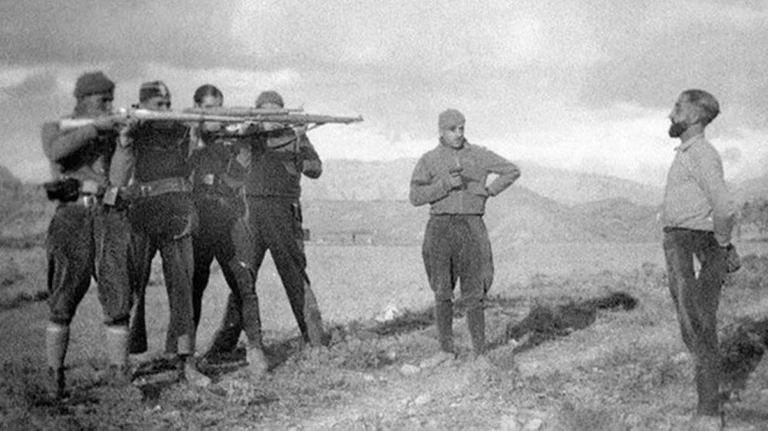
Execution of a civilian during the Spanish Civil War. X/ @NavarraxESP
October 20, 2025 Hour: 2:28 pm
🔗 Comparte este artículo
The project seeks to keep alive the memory of thousands of Spaniards murdered by the dictatorship during the Civil War.
On Monday, Spain’s Democratic Memory Secretariat and public broadcaster RTVE signed an agreement to create the first audiovisual map of exhumations of people who disappeared under the dictatorship of Gen. Francisco Franco (1939–1975).
RELATED:
Spanish Congress Urges Government to Honor Last Living Anti-Franco Guerrillas
Titled “The Country of 6,000 Graves,” the project aims to recover memory of the crimes committed by the far-right regime during the Spanish Civil War (1936–1939).
Francoist repression killed at least 140,000 Republican fighters, according to the Platform for Victims of Forced Disappearances. Many of the victims of the dictatorship remain buried in mass graves that have yet to be located or exhumed.
“It’s very important to give names back to those who once lost them — to those who others tried to erase. We want to help restore the stories of those killed during the Civil War,” said RTVE News Director Jon Ariztimuño.
Democratic Memory Secretary Fernando Martinez emphasized that the two institutions have joined forces “in favor of truth.” The project has three components: the audiovisual map itself, a documentary that portrays “pain, but also courage and dignity at a time when no one spoke about historical memory,” and a podcast.
“Barely Beneath the Surface” (A Flor de Tierra), a documentary produced by RTVE News team, is set in 1978, three years after Franco’s death. It tells the story of families of missing Republicans from Navarre’s Ribera region who came together to recover their loved ones — executed by Francoist forces and buried in mass graves 40 years earlier.
The Horrors of Francoism
The Spanish Civil War erupted after years of deep political, social, and ideological polarization between supporters of the democratic Second Republic and conservative, monarchist, and fascist forces led by Gen. Francisco Franco.
The military coup that began in July 1936 divided Spain into two warring zones: the Republican side, backed by the Soviet Union and international volunteers, and the Nationalist side, supported by Nazi Germany and Fascist Italy.
The conflict became a brutal proxy war between fascism and socialism, resulting in massive destruction and the deaths of hundreds of thousands of people, including civilians targeted in widespread political violence.
Franco’s far-right forces emerged victorious in 1939, establishing a totalitarian dictatorship that lasted until his death in 1975. The regime immediately launched a campaign of systematic repression against anyone associated with the defeated Republic.
Tens of thousands were executed in extrajudicial killings, while many others were imprisoned or forced into labor camps under inhumane conditions. Political tribunals condemned alleged “rebels” without due process, and surveillance, torture, and fear became tools of state control.
Beyond physical violence, the Franco regime imposed deep cultural and social repression designed to erase dissenting identities and values. Censorship restricted freedom of expression, and regional languages such as Catalan and Basque were banned from public life.
Women lost many of the rights they had gained under the Republic, as the state promoted a patriarchal and Catholic model of society.
Thousands of children were abducted from Republican or “morally unfit” families and placed in religious or pro-Franco households, often under false identities — a practice that continued for decades after the war.
teleSUR/ JF
Sources: EFE – teleSUR