







Spain and Morocco Reinforce Cooperation as Migrant Crossings Surge at Ceuta Border
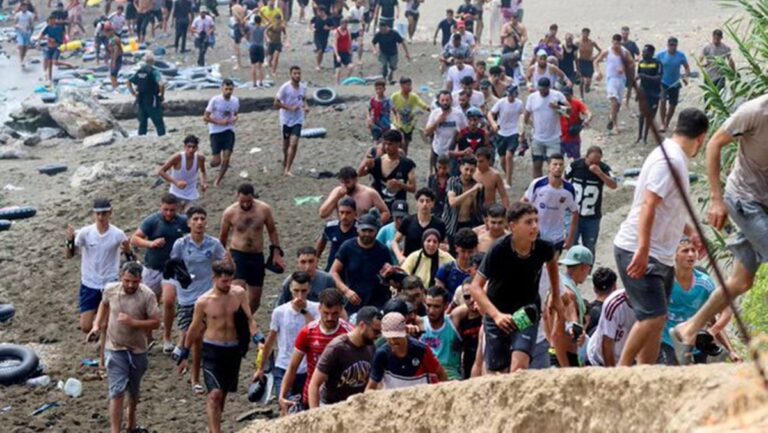
African migrants cross from Morocco into the Spanish city of Ceuta, July 30, 2026. X/ @herqles_es
July 30, 2026 Hour: 2:23 pm
🔗 Comparte este artículo
Thousands Attempt to Reach Spanish Enclave in North Africa as Human Rights Groups Criticize Government Response.
During the last week of July, the border between Spain and Morocco has experienced mounting tensions as thousands of migrants have attempted to cross from Castillejos and other Moroccan border areas into Ceuta, one of Spain’s two cities in Africa.
RELATED:
U.S. Ends Temporary Protection for Over 300,000 Haitian Migrants
On Thursday, thousands of young Moroccans headed to the border between Castillejos and Ceuta in an attempt to cross the fence separating the two cities. In previous days, hundreds tried to reach the city by swimming, and dozens died in the attempt.
The Ceuta government estimates that up to 2,000 people have entered the city over the past 10 days. “That figure is equivalent to 2% of the city’s entire population,” explained Juan Vivas, president of the Spanish autonomous city.
On Wednesday, Spain’s Maritime Rescue Service rescued more than 300 migrants, ages 18 to 30, from the sea, and authorities estimated that 800 Moroccans and Algerians attempted to swim into Ceuta, most of them intercepted by Moroccan patrol boats. In addition, the Civil Guard recovered the bodies of two migrants who died while trying to cross by swimming.
So far this year, 29 migrants have died along Ceuta’s coastline, six of them since the current migration flow began on July 25. Vivas, however, maintains that 60 bodies have been recovered over the past month. The situation has not yet reached the scale of the 2021 crisis, when 10,000 people entered Ceuta amid a diplomatic dispute between Rabat and Madrid.
What Triggered the Situation?
In early July, Spain’s Supreme Court confirmed that the country’s immigration law does not allow the practice of border pushbacks, also known as “hot returns,” for migrants intercepted at sea. This may have encouraged those waiting in Morocco to enter Europe and created a “pull factor.”
According to Mohamed Benaissa, president of the Northern Observatory for Human Rights, social media posts by young people who have migrated to Spain have helped persuade others to make the journey. He attributed the current migration wave to the summer season and the recent ruling by Spain’s Supreme Court.
The Humanitarian Emergency
Ceuta, a city covering 18.5 square kilometers and home to about 83,000 residents, is facing “an absolute humanitarian and social emergency,” Vivas said.
The Temporary Stay Center for Immigrants (CETI), where irregular migrants are transferred upon arriving in Spain, is overwhelmed.
The facility can accommodate only 512 people, and more migrants are outside the center than inside it. The section for minors is operating at 2,400% over capacity.
Vivas requested financial support from the Spanish government on Thursday morning, and the North African city has called for the border to be closed as a matter of “urgency and without delay.”
The text reads, “Thousands of migrants crossed the border between Morocco and the Spanish enclave of Ceuta without being checked. Faced with the massive influx, law enforcement opened the border crossings to prevent overcrowding. Local authorities are requesting that Madrid declare a state of emergency in anticipation of a migration crisis similar to that of 2021.”
What Have Spain and Morocco Agreed?
To address the emergency, Spain and Morocco agreed to strengthen coordination and joint efforts to deal with the migration crisis. Both countries also committed to reviewing and implementing measures for the transfer of all people who entered the city in recent days.
“We are mobilizing all the necessary resources, working with the Moroccan and international authorities, and preparing the measures needed to restore normality as soon as possible,” Spanish Prime Minister Pedro Sanchez said.
On Thursday, Morocco broke its official silence on the migration crisis to confirm the agreement. “Both countries agreed to strengthen coordination and efforts to address these flows and committed to reviewing and implementing measures for the repatriation, as soon as possible, of all those who entered Ceuta illegally,” Moroccan official sources told EFE.
Human Rights Defenders Criticize Public Policies
“Cooperation cannot result in handing people over without considering each person’s individual circumstances,” said Mauricio Valiente, director of the Spanish Commission for Refugee Aid (CEAR), who believes the agreement is “a bad solution” because “Morocco is not a safe country.”
The Moroccan Democratic Human Rights Body expressed its “deep concern” over the situation facing young people in the country and described the collective attempt to reach Ceuta by swimming as a “political failure.”
“What is happening is not an isolated incident or a temporary crisis, but the direct result of a structural political failure and the accumulation of unjust public policies that have deepened social inequalities,” it said.
teleSUR/ JF
Source: EFE