







Sovereignty First: Venezuela Warns Against Foreign Interference
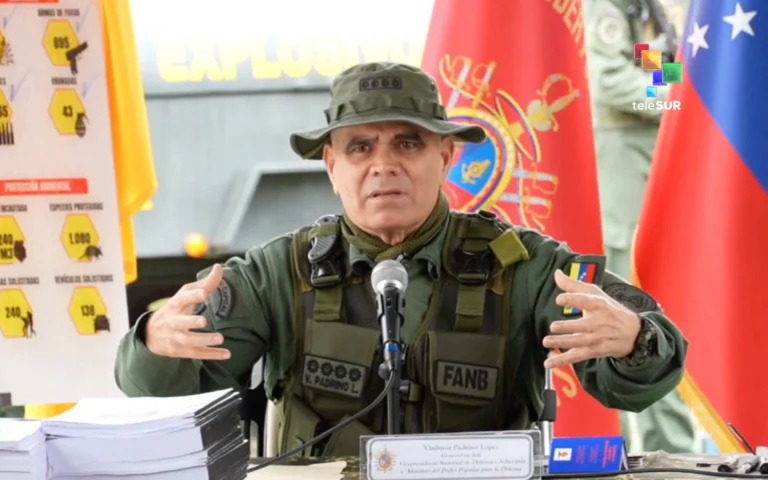
Venezuelan Defense Minister, General Vladimir Padrino Lopez (Photo: teleSUR).
September 8, 2025 Hour: 7:36 pm
🔗 Comparte este artículo
In a world where national security and sovereignty are increasingly challenged, Venezuela’s Defense Minister, General Vladimir Padrino Lopez, recently provided a robust update on the Bolivarian National Armed Forces (FANB) activities aimed at safeguarding the nation.
Amid escalating tensions, particularly related to alleged U.S. military maneuvers in the Caribbean region, Padrino emphasized the army’s commitment to protecting Venezuelans from both internal and external threats.
Security Operations Along the Colombian Border
The Venezuelan government has ramped up its security initiatives, particularly through “Operation Iron Hand,” targeting drug trafficking and smuggling along the Colombian border.
The operation deployed tactical units across four key binational bridges and established multiple citizen service posts.
The FANB has reported substantial successes in this initiative, resulting in the seizure of over 1,746 kilograms of drugs, including cocaine, marijuana, and synthetic drugs like Tusi, marking one of the largest busts in the country’s history.
The operation also led to the arrest of 984 individuals and the confiscation of nearly 980 tons of contraband goods, emphasizing a proactive approach to border security.
The dismantling of 116 organized crime groups further illustrates the commitment of Venezuela’s armed forces to combat drug-related violence and smuggling activities that have plagued the region for years.
What to Watch Next
- Verification of seizures and arrests as cases move through courts and regional anti-drug databases.
- Details and independent assessments of “Operation Sierra” and any UN follow-up regarding illicit crops.
- Responses from the United States and neighboring countries to Venezuela’s claims about military deployments and cross-border armed groups.
- Sustained FANB presence at key crossing points in Tachira state and potential spillover effects on trade and mobility.
As Padrino Lopez casts the FANB as “busy protecting the people” and defending sovereignty, the coming weeks will test whether the operational tempo translates into durable security gains—and how the broader geopolitical standoff shapes events on Venezuela’s borders and in the Caribbean.
A Focus on Human Rights and Constitutional Respect
General Padrino Lopez asserted that all military actions were conducted with respect for human rights and compliance with Venezuela’s Constitution.
This statement highlights the military’s dual role of enforcing law and order while respecting civil liberties—a balancing act that is critical in maintaining public trust during such operations.
The absence of reported combat casualties among FANB personnel is also a positive indicator of the operation’s management and strategic execution.
Framing the Narrative Against Foreign Interference
While discussing the domestic security measures, Padrino Lopez did not shy away from addressing external pressures, particularly from the United States.
Venezuelan officials have frequently criticized what they perceive as an aggressive display of U.S. military force in the Caribbean, which they argue poses a direct threat to the country’s sovereignty.

Calling upon historical rhetoric from the late Hugo Chavez, Padrino Lopez reinforced the notion that Venezuelans must remain vigilant against foreign interventions that seek to undermine their national integrity.
This geopolitical backdrop adds layers of complexity to Venezuela’s security narrative.
As the country continues its counternarcotics efforts, the implications of U.S. military presence in the region could complicate bilateral relations and joint security initiatives that are essential for addressing cross-border crime.
The Future of Venezuela’s Security Landscape
Looking ahead, the Venezuelan military strategy appears set on continuing its aggressive stance against drug trafficking and organized crime through operations like “Iron Hand” and the newly introduced “Operation Sierra.”
The initiative seeks to eliminate illicit crops along the border, portraying Venezuela as a victim of transnational criminal organizations rather than a major drug producer or consumer like North American or European countries.
The results generated by these operations will be crucial indicators of their long-term effectiveness.
Key metrics to observe will include the sustainability of arrests and seizures, as well as any potential humanitarian consequences in border communities.
Additionally, monitoring diplomatic engagements will be vital to gauge whether tension alleviates as Caracas seeks to navigate its complex geopolitical landscape.
Significant Steps in Bolstering Sovereignty
General Vladimir Padrino Lopez’s announcements underscore the ongoing challenges and commitments within Venezuela regarding national defense and sovereignty.
By relentlessly pursuing operations to safeguard its borders and disrupt criminal networks, the FANB is taking significant steps in bolstering national security.
Despite external pressures, particularly from the United States, Venezuela’s claims of sovereignty and security remain fragile.
The country’s national destiny hinges on the resilience of its military forces as they protect the people amidst internal and external challenges.
Author: Manuel F. Diaz
Source: teleSUR