







Duma Elections Consolidate Russian Power Amidst Western Sanctions
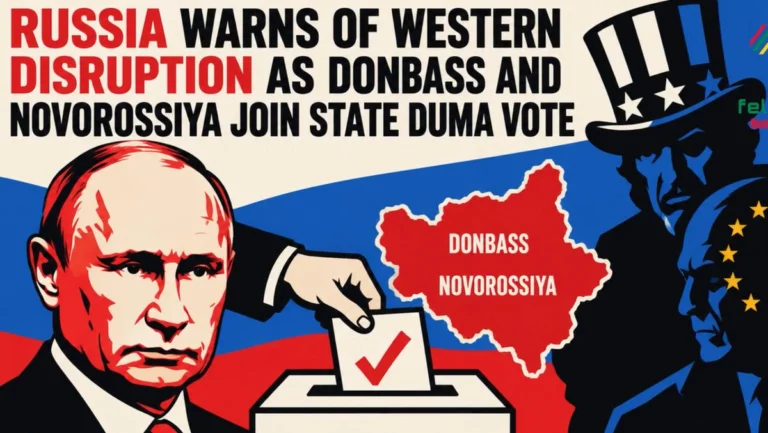
Poster regarding the 2026 Duma elections. X/ @FelastoryMedia
September 17, 2026 Hour: 2:36 pm
🔗 Comparte este artículo
The legislative branch balances military spending, state enterprise support, and targeted social subsidies.
On Sept, 20, elections for the State Duma, the lower house of the Russian Federal Assembly, serve as a focal point for analyzing this country’s political economy.
RELATED:
Peskov Calls New U.S. Sanctions Against Russia an ‘Unfriendly Step’
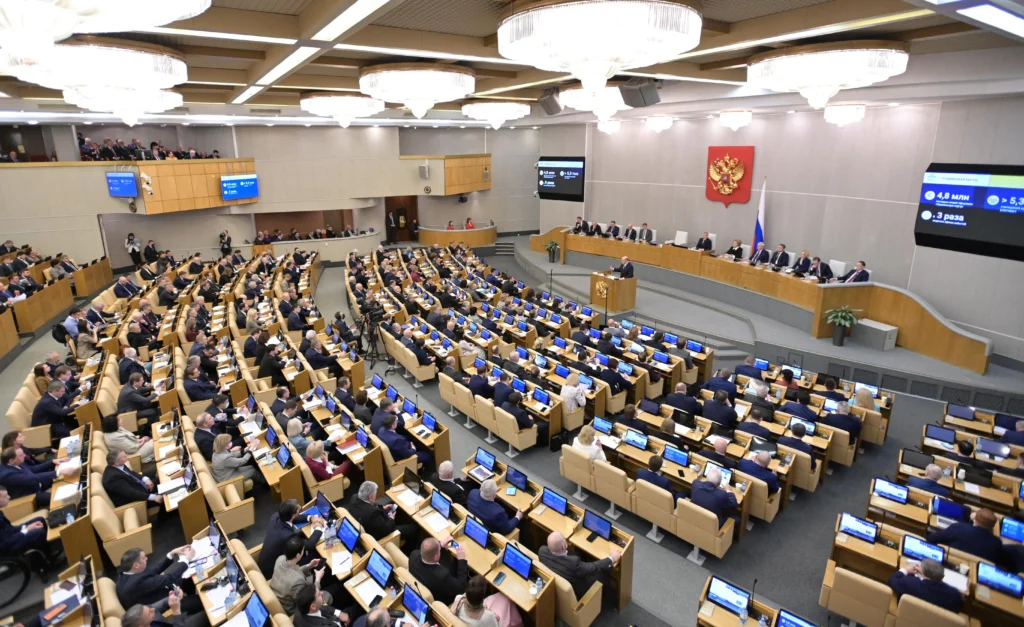
Composed by 450 deputies, the Duma is elected to five-year terms using a parallel mixed-member system. Voters fill 225 seats through nationwide party-list proportional representation with a 5 percent threshold, while the remaining 225 seats are decided in single-mandate constituencies using a first-past-the-post majority system.
The State Duma acts as the primary arena where Russian interest groups negotiate policy, manage social tensions, and balance federal priorities.
Amidst Western sanctions and state-driven industrial reorganization, these elections serve to maintain consensus, control strategic state assets, and align national economic policy against external financial pressure.
Candidate Landscape and Systemic Opposition
The competitive structure of Russian State Duma elections reveals the distinct roles of political parties in representing different class interests and factional networks within the state-capitalist framework.
– United Russia
United Russia holds a constitutional supermajority in the State Duma, retaining over 300 of the 450 seats. Led by figures such as former President Dmitry Medvedev, the party serves as an electoral mechanism for the state apparatus, top industrial managers, regional governors, and security elites.
United Russia provides the legislative framework necessary to execute executive decrees, secure national defense budgets, and pass key economic legislation.
United Russia’s platform emphasizes state-controlled industrial sovereignty, targeted social welfare, and increased military expenditure, thereby protecting key state-owned enterprises in energy, metallurgy, and defense from internal oligarchic divisions and foreign acquisition.
– Communist Party of the Russian Federation (CPRF)
The Communist Party of the Russian Federation (CPRF), headed by Gennady Zyuganov, remains the primary organized left-wing party in the legislature. The party occupies a complex position within the Russian political landscape.
The CPRF’s platform focuses on explicit anti-capitalist demands, calling for the full renationalization of strategic natural resources, public utilities, and primary industries.
CPRF advocates for progressive taxation targeting high-income earners and private corporate profits, the repeal of the 2018 pension age increase, and stronger statutory protections for labor unions.
Smaller systemic left formations, such as A Just Russia – For Truth, offer a center-left platform combining social-welfare expansion with strong state nationalism.
– Right-Wing and Liberal Formations
The right-wing nationalist presence is led by the Liberal Democratic Party of Russia (LDPR), currently headed by Leonid Slutsky. The LDPR captures populist and anti-establishment sentiment among provincial working-class voters by emphasizing state sovereignty and national security.
Pro-market liberal parties, such as New People, represent urban middle-class voters and small business owners. They advocate for reduced state regulation and tax incentives for private enterprise, while maintaining compliance with state geopolitical policies.
Older pro-Western liberal parties, such as Yabloko, have seen their vote share decline and have faced structural disqualifications. Yabloko, headed by Nikolai Rybakov, was excluded from the federal party-list ballot in August 2026 by the Russian Supreme Court.
Yabloko’s exclusion follows a petition filed with the Russian Supreme Court by Rodina (Motherland), a Russian nationalist party, arguing that Yabloko violated campaign finance and intellectual property laws in its campaign materials. The grounds also include violations of campaign finance regulations, as well as accusations of extremism and an anti-war stance.
Election Monitoring, Structural Barriers, and Institutional Power
Under Central Election Commission Chair Ella Pamfilova, Russia’s electoral system has been reformed to streamline voting and increase state oversight of vote counting.
A major institutional shift is the widespread adoption of multi-day voting, which extends polling across a three-day window. Russian authorities present multi-day voting as a practical measure to boost voter turnout and provide operational flexibility.
However, independent labor unions such as the Independent Confederation of Labor of Russia (KTR) and opposition groups like Yabloko argue that preserving ballot integrity overnight across thousands of Precinct Election Commissions creates significant logistical monitoring hurdles.
The introduction of Remote Electronic Voting (REV) represents another significant technological change. Deployed across dozens of key regions, the REV network enables registered citizens to cast ballots digitally through centralized government portals.
REV supporters tout their digital platform as a modernizing force, improving access for mobile and urban demographics. Critics, however, argue that this digital processing centralizes data encryption and vote decryption keys on federal servers, effectively preventing real-time, independent precinct-level audits.
Structural barriers to ballot access are enforced through strict candidate registration laws. Independent candidates and non-systemic political organizations must navigate rigorous signature-gathering requirements, where minor technical flaws often result in disqualification.
Domestic Russian election monitoring is primarily organized through official bodies, such as the Civic Chamber of the Russian Federation, which deploys tens of thousands of trained observers to polling stations nationwide.
State Capitalism, Social Spending, and Elite Consolidation
The legislative outcome of the State Duma elections directly shapes Russia’s internal political economy, guiding state budget allocations, taxation policies, and economic planning.
The State Duma acts as the primary institutional venue where the central government balances the needs of industrial development with social expenditures required to maintain public support.
A key priority for any incoming Duma convocation is managing national fiscal policy amid external economic pressure and Western sanctions. The legislative branch controls the state budget, determining the balance between defense spending, industrial subsidies, and social safety nets.
Under United Russia’s legislative leadership, state budgets prioritize strategic industrial import-substitution programs, military-industrial production, and targeted social welfare transfers designed to cushion lower-income households against inflation.
The composition of the Duma also influences national labor legislation, tax structures, and public services. Pressure from systemic left parties like the CPRF keeps issues like progressive taxation, utility cost controls, and pension indexation active in parliamentary debates.
The Duma serves as a controlled platform where regional governors, directors of state-owned energy and manufacturing enterprises, and federal bureaucrats negotiate resource allocation. This integration of regional representatives into federal legislative processes enables the central authority to preempt the formation of regional oligarchies, thereby maintaining state stability.
International Significance and Conflict of Imperial Interests
In an increasingly polarized multipolar world order, the political alignment and stability of Russia’s State Duma impact global trade networks, alternative financial infrastructures, and geopolitical balances across the Global South.
The Russian State Duma plays a key constitutional role in ratifying international trade treaties, approving defense cooperation frameworks, and supporting alternative payment mechanisms that bypass the Western-dominated SWIFT banking system.
The incoming Duma convocation remains central to expanding Russia’s integration with multipolar blocs such as BRICS+ and the Shanghai Cooperation Organization (SCO). By authorizing state-backed investments in Eurasian transport corridors, energy partnerships with China and India, and industrial joint ventures across Africa and the Middle East, the Russian legislature acts as an institutional counterweight to Western economic dominance.
Hegemony, Resistance, and the Future of the Russian Working Class
The Russian parliamentary elections for the State Duma offer a comprehensive look at the contradictions shaping contemporary Russia.
Moving beyond liberal narratives that reduce the russian system to a purely authoritarian exercise, a materialist analysis shows how these elections manage domestic class relations, secure elite consensus, and maintain state control over strategic sectors of the national economy.
The Russian State Duma remains an arena of domestic class friction. The presence of systemic left forces, led by the Communist Party of the Russian Federation, reflects persistent working-class demands for progressive taxation, stronger labor rights, public-sector investment, and the protection of social welfare.
As the incoming Duma navigates ongoing global geopolitical pressures, high inflation, and industrial restructuring, balancing the resource demands of the state with the material needs of working-class citizens will remain a central internal challenge.
Ultimately, the State Duma elections demonstrate that Russia’s domestic politics cannot be separated from its global position.
While the state apparatus successfully maintains institutional stability and advances a multipolar foreign policy, genuine democratic and economic development depends on the degree to which the working class can organize within this framework to advance its material interests against both domestic oligarchic power and foreign imperialist pressure.
Sources: Russian Today – Sputnik – TASS – Ria Novosti – VGTRK- Anadolu Agency – Xinhua – CGTN – BBC – TRT World – HispanTV – Press TV – Al Jazeera – Al Mayadeen – teleSUR
Author: Silvana Solano
Source: teleSUR