


Petro’s Constitutional Reform Proposal Struggles to Gain Traction
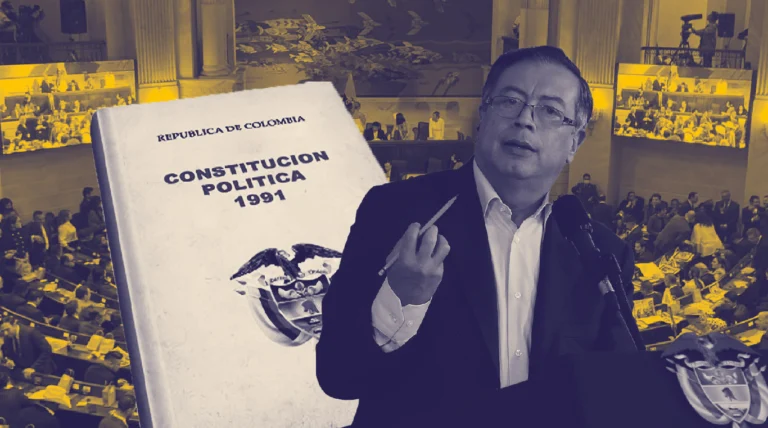
Pictured: Petro and the 1991 Constitution of Colombia. Photo: Dejusticia
May 5, 2026 Hour: 3:01 pm
🔗 Comparte este artículo
Congressional opposition, legal barriers, and shifting alliances undermine his push for the Constituent Assembly.
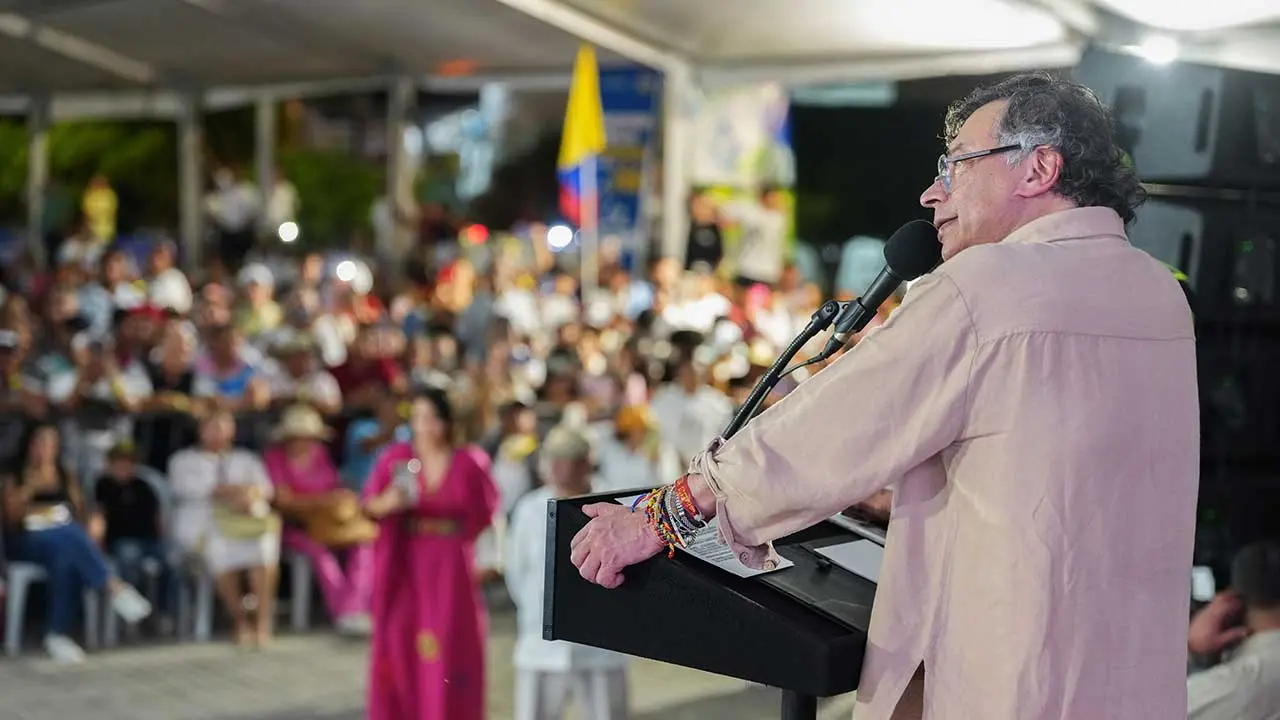
In May 2026, the President of Colombia, Gustavo Petro, announced a proposal to convene a National Constituent Assembly. This announcement followed the blocking of several of his social reforms, including changes to the health and pension systems, by Congress.
RELATED:
Colombian President Petro Urges Signature Collection to Convene Constituent Assembly
Petro argues that the legislative branch has become an obstacle to fulfilling the promises of the 1991 Constitution, particularly those related to social justice, peace implementation, and the fight against corruption.
The proposal does not seek to replace the 1991 Constitution entirely. Instead, Petro has stated that he wants to add new chapters and reform specific parts of the document. The formal proposal is to be presented to Congress by 20 July 2026.
Some parties consider this to be a perilous plan that has the potential to compromise the stability of democratic institutions. This article provides a comprehensive overview of the proposal’s contents, the operational framework of a constituent assembly within the context of Colombian legislation, and the positions adopted by various political actors.
The Eight Main Areas of Reform
According to the information released by the government and reported by media outlets President Petro’s constituent assembly proposal is organized around eight main points. The purpose of this document is not to replace the 1991 Constitution, but add or modify specific chapters as necessary.
The focus is on making fundamental rights effective, changing how the political system operates, and addressing long-standing commitments such as the 2016 Peace Agreement.
The first area is the guarantee of rights. The proposal aims to enhance the implementation of the 2016 Peace Agreement, with a focus on agrarian reform and addressing the drug problem. It also aims to ensure basic conditions, such as access to healthcare, pensions and drinking water, are recognised as enforceable rights.
The second area is judicial reform. The government is proposing the creation of a justice system that is closer to citizens, with a restorative approach and guarantees of non-repetition.
The third area is the political system. The proposal includes measures to eradicate corruption and separate politics from private financing. Specifically, it seeks to prohibit the use of private capital in electoral campaigns, which the government argues is a main driver of systemic corruption.
The fourth area is the environment. The proposal would elevate the fight against climate change and the decarbonization of the economy to constitutional status. The fifth area is territorial autonomy. The proposal aims to strengthen local power and reorganize territory around water resources.
The sixth, seventh, and eighth areas include complementary provisions related to social justice, transparency, and the effective enforcement of rights that have been blocked by congressional inaction.
President Petro has communicated on multiple occasions that he will not be seeking re-election as President or an extension to his current term. In his own words, he stated the following: “We are not seeking to amend the 1991 Constitution; our objective is to ensure its enforcement.” He also made the following statement: “The National Constituent Assembly is the people’s instrument for determining the reforms that the Congress party is reluctant to pursue.”
The Legal Process to Convene a Constituent Assembly in Colombia
According to the Colombian legal system, the President is not permitted to call a National Constituent Assembly by presidential decree. The procedure is clearly established in Article 376 of the 1991 Constitution.
The first stage is congressional approval. The government is required to submit a bill to Congress that defines the agenda, the term of the assembly, and how its members will be composed.
For this bill to be approved, it must be endorsed by an absolute majority of both chambers: the Senate and the House of Representatives. This represents a substantial challenge for President Petro, as his coalition currently lacks the requisite majorities in Congress.
The second stage is judicial control. Following the approval of the convening law by Congress, the Constitutional Court will undertake a review. It is the court’s duty to ensure that the law does not infringe upon the fundamental principles of Colombian democracy. This includes ensuring that the assembly does not seek to eliminate fundamental rights or replace democratic principles.
The third stage is a popular vote. Following the passing of the law, the Colombian people will have the opportunity to decide in a direct vote whether they want a constituent assembly. This is the most demanding requirement. For the measure to be adopted, at least one third of the electoral roll, approximately 13 million citizens, must vote in favour. If this threshold is not met, the assembly cannot be convened.
The fourth stage is the election of constituent assembly members. If the popular vote is successful, a separate electoral act will be held to elect the members who will draft the specific changes. Only upon completion of this process can the assembly commence its work.
In view of the difficulty of obtaining congressional approval, the Petro administration has adopted an alternative strategy. The government has initiated a signature collection process.
Rejection and Opposition Arguments
The proposal for a constituent assembly has encountered significant opposition in the Colombian Senate. According to some reports, a significant proportion of the opposition and some independent blocs have publicly rejected the initiative. The rejection is based on several key arguments.
The first argument is that the constituent assembly poses a threat to institutional stability. Members of the senate and former presidents have expressed concerns that the proposal seeks to alter the established democratic principles and dismantle the current constitutional framework. They argue that Colombia already has a functioning constitution and that the proper mechanism for reform is through ordinary laws and congressional debate.
Secondly, the proposal is considered unnecessary and populist. Critics believe that constitutional reform is not necessary to implement social changes. The proposal has been described as a media spectacle and an attempt to deflect attention from the government’s legislative shortcomings. Some opposition leaders have argued that the government should focus on building consensus within Congress instead of trying to bypass it.
Former President Álvaro Uribe and other leaders have rejected any substantial modification of the current charter. They argue that the 1991 Constitution was the result of a great national agreement and should be respected and implemented, not replaced or supplemented through a constituent process.
Humberto de la Calle, a former peace negotiator and senator, has expressed concerns over the safety of the proposed route and has called upon the government to prioritize the achievement of consensus within Congress. The President of the Senate, Iván Name, called upon Petro to show respect for the institutions and to refrain from undermining democracy.
Despite the rejection, the government continues to insist on the constituent assembly. Petro argues that the forces within Congress that favour maintaining the status quo have blocked changes, and that the people must therefore intervene in order to exercise their constituent power.
The Evolution of Iván Cepeda’s Position
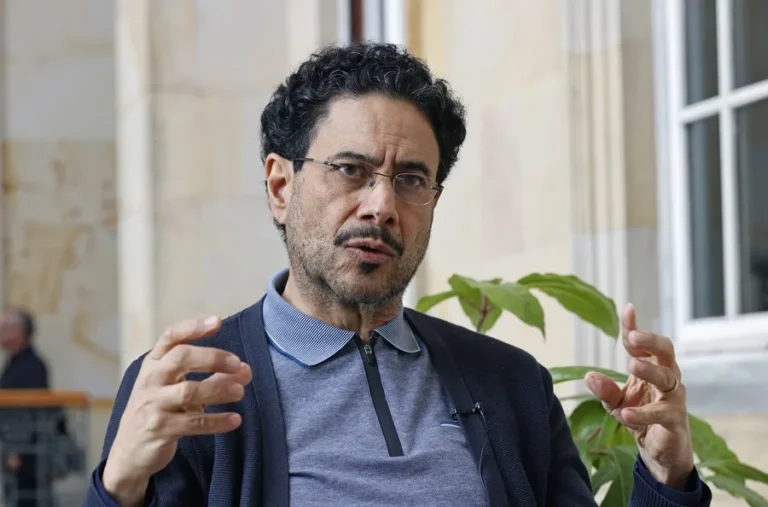
Iván Cepeda is a senator and a current presidential hopeful for the 2026 elections. He is a member of the Historical Pact, the same coalition that supports President Petro. However, according to outlet reports, his position on the National Constituent Assembly has undergone a clear evolution over time.
Cepeda expressed skepticism at the outset. He stated that the 1991 Constitution still has unexplored potential and that the focus should be on its full implementation rather than on reforming it.
He also highlighted that convening a constituent assembly in a highly polarized environment could be counterproductive for the government’s social reforms. At this stage, he evidently disengaged from the assembly mechanism.
During the transition phase, Cepeda adopted a softer tone in his discourse, while also shifting the focus of the debate. He began to argue that a National Constituent Assembly would only be valid and viable if it arose as a result of a Great National Pact that included all political sectors.
He emphasized that any path must strictly adhere to the legal procedures outlined in Article 376, avoiding any institutional leaps into the void. This condition transformed the assembly from a government tool into a consensus-based process.
Cepeda has stated that the constituent assembly should not be the sole focus of the Historical Pact campaign. He asserts that the country requires immediate solutions that cannot wait for a long and complex constitutional process. Rather than focusing on the assembly, his current discourse centres on a national political agreement to guarantee the stability of the reforms already achieved.
As the 2026 presidential elections approach, Cepeda appears to be seeking a more conciliatory profile to attract moderate sectors, even if that means distancing himself from his own coalition’s leader. It is not yet clear whether this represents a genuine policy difference or a campaign strategy. The conclusion of this article will synthesise the main findings and offer a final overview of the debate.
A Deep Division with No Immediate Resolution
President Gustavo Petro’s proposal for a National Constituent Assembly has sparked a significant political debate in Colombia in 2026. The initiative seeks to add chapters to the 1991 Constitution on health, pensions, judicial reform, political financing, the environment, and the 2016 Peace Agreement. Petro argues that Congress has blocked his social reforms, and that the people should have the final say through a direct vote.
The legal process under Article 376 requires congressional approval, judicial review by the Constitutional Court, a popular vote with at least one third of the electoral roll in favour, and the election of assembly members.
As the government does not hold a majority in Congress, it has decided to collect 2.5 million signatures to pressure the legislative branch. This strategy is yet to result in formal approval.
Within the government coalition, presidential candidate Iván Cepeda has evolved from scepticism to a more distant stance, preferring a national agreement over a divisive assembly.
As of May 2026, no convening law has been approved, and the signature collection is ongoing. The pivotal date of 20 July 2026 will determine whether the debate progresses or halts, leaving unresolved the question of whether Congress or the people hold ultimate power to reform the state.}
Sources: teleSUR – El País – Pulzo – RCTVC – DW – Presidencia Colombia
Author: Silvana Solano
Source: teleSUR