Peru Extends State of Emergency for 60 Days in Vraem and Tumbes Border
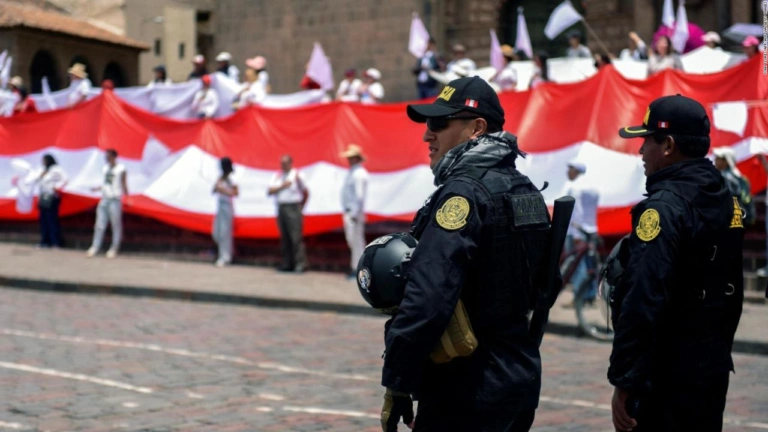
According to a decree surveillance at unauthorized border crossings and strategic infrastructure will be reinforced, as well as combating the illegal use of telecommunications associated with extortion and squatting. Photo: CNN.
November 20, 2026 Hour: 7:45 pm
🔗 Comparte este artículo
Peru’s government extended the state of emergency for 60 days in the Vraem valley and the border provinces of Tumbes and Zarumilla to combat terrorism, drug trafficking, criminality and violence.
Peru’s government formalized a new extension of the state of emergency for 60 days this Friday across several regions of the country. The measure covers the Vraem, a remote valley spanning four departments, and the northern border provinces of Tumbes and Zarumilla, which sit across from Ecuador.
The decision aims to sustain security operations against criminality and other acts of violence in both jurisdictions along the border with Ecuador. The measure came through Supreme Decree No. 153-2026, published this Friday in the official gazette. Its approval answered a request from the National Police, which sought to continue operations against crimes such as extortion, aggravated robbery, homicide and assault.
RELATED: Peru to Build Two Mega-Prisons Prisons With U.S. Support
In the Vraem, short for the Apurímac, Ene and Mantaro river valleys, the emergency takes effect on November 22. It applies to 12 districts and eight population centers in Ayacucho, Huancavelica, Junín and Cusco. The Camisea gas energy corridor and the Ene river corridor also fall under the measure.
The new decree introduces a change: an unified police-military command against organized crime now operates under police leadership. This body will coordinate joint actions, share intelligence and logistics capabilities, and carry out operations against criminal organizations. When the extension concludes, that command must report its results to the Interior Ministry within five business days.
Text reads: “Supreme Decree extending the state of emergency in some districts and populated centers of provinces belonging to the departments of Ayacucho, Huancavelica, Junín and Cusco.”
Military Takes Control
During this period, the Peruvian Armed Forces will assume control of internal order with support from the National Police. The expenses will be covered by the institutional budgets of the ministries involved.
The Vraem region has long been a stronghold of drug trafficking and the remnants of armed insurgency. Coca cultivation and cocaine production concentrate there, and the state’s presence remains uneven across a vast, rugged terrain where rivers and gorges make access difficult.
In Tumbes and Zarumilla, the emergency begins on November 24, also for 60 calendar days. The National Police keeps control of internal order in those provinces, with the military acting in support.
That border axis with Ecuador is marked by smuggling, drug and arms trafficking, human trafficking and contract killings tied to transnational organized crime. Authorities will target extortion, aggravated robbery, homicide and assault.
Border Security Bolstered
Police operations will concentrate on critical points identified through intelligence, statistics and crime maps. Permanent patrols, identity checks, a crackdown on illegal firearms and oversight of illicit activities are all part of the plan.
The decree also calls for reinforced surveillance at unauthorized border crossings and strategic infrastructure. It seeks to disrupt the illegal use of telecommunications linked to extortion and hitmen.
For Tumbes and Zarumilla, the measure specifically directs security forces to fight crimes such as extortion, aggravated robbery, homicide and assault along an axis where contraband and criminal networks move people, weapons and drugs across the frontier.
The inclusion of the Camisea gas corridor underscores the strategic stakes. That infrastructure supplies natural gas to a large share of the country, and the government has long sought to shield it from attacks by armed groups operating in the surrounding valleys.
The document carries the signatures of Luis Galarreta, first Vice-president in charge of the presidency, and Rafael Belaunde Llosa, the Defense Minister who is Acting Head of the Cabinet. Interior Minister César Augusto Astudillo, Economy Minister Elmer Cuba and Justice Minister Ernesto Álvarez also signed.
The decree orders that the measures be financed from existing ministry budgets, a detail that signals no additional emergency funds were allocated for the operation.
Constitutional Rights Restricted
For the next two months, the exceptional regime under Article 137 of the Constitution remains in force. That framework allows authorities to restrict or suspend the exercise of certain rights, including the inviolability of the home, freedom of movement, freedom of assembly and personal liberty and security.
The National Police keeps command of internal order while the Armed Forces continue in a support role. All interventions must comply with the rules governing the use of force and the protocols that apply, including those designed for women and people in vulnerable situations.
On the ground, the extension preserves the operational measures already in place. Police will keep up foot and motorized patrols in critical zones, identity checks in public spaces, vehicles and properties, and surveillance of unauthorized border crossings.
The prison in Tumbes also remains under restrictions. Inmates in the ordinary closed regime may receive one visit per week, while those in the special closed regime are allowed one every two weeks. Authorities will continue raids to seize cellphones and other prohibited objects, alongside actions against illicit telecommunications.
Peru has applied this exceptional framework across several regions in recent years. In the northern border, the measure responds to a particular geography, where unauthorized crossings and porous routes complicate enforcement. The 60-day window gives security forces expanded powers to detain suspects and restrict movement in the covered areas. It also shifts operational control in the Vraem to the military, a step reserved for zones where civilian institutions cannot guarantee order.
For residents of Tumbes and Zarumilla, the extension means another 60 days under a regime that restricts daily movement and gatherings while expanding police authority. The government presents the measure as a necessary shield, meanwhile its critics have long warned about the repeated use of emergency powers and the burden they place on ordinary people.
Author: Laura V. Mor
Source: Agencies