







Nobel Prize in Medicine Honors Three Optogenetics Researchers
X/ @AsiaOne_News
October 5, 2026 Hour: 10:23 am
🔗 Comparte este artículo
They developed a method that shows how nerve cells control memories, feelings and behavior in the brain.
On Monday, the Nobel Prize in Medicine honored three researchers for ushering in a new era in neuroscience through the development of optogenetics, a method that shows how nerve cells form memories, feelings and behaviors in the brain.
RELATED:
Science Communication Festival Brings Together Six Nobel Laureates
The method and their discoveries involving light-activated ion channels earned the prize for American Karl Deisseroth and Germans Peter Hegemann and Georg Nagel, according to the Nobel Assembly of the Karolinska Institute in Stockholm.
The use of optogenetics has revealed how neural circuits control everything from specific memories to the sensation of pain, social behaviors, thirst, food consumption and attention, as well as how they are responsible for functions as diverse as controlling circadian rhythms or causing fever when the immune system has been activated.
Progress has also been made in using optogenetics for medical treatments aimed at restoring sight in people with visual impairment, and the method has provided greater understanding of neurological and psychiatric disorders such as depression, anxiety, schizophrenia, Parkinson’s disease and Alzheimer’s disease.
“Optogenetics provides opportunities to map the brain in a way that we could previously only dream of,” said Per Svenningsson, chairman of the Nobel Committee for Medicine.
At the news conference announcing the prize, Anna Wedell, a professor of genetic medicine, spoke of the “tremendous step forward” represented by optogenetics.
“Before, we had anatomical maps of the brain. Now we can generate functional maps and we can also understand how different cells communicate in the brain. It is a completely new dimension,” she said.
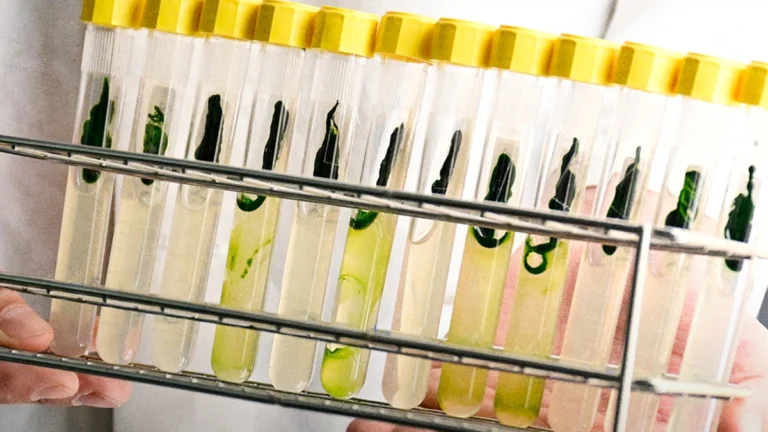
Hegemann and Nagel discovered a remarkable protein, channelrhodopsin, in a single-celled alga, chlamydomonas; Deisseroth transformed that protein into “a light-controlled switch” for nerve cells, the committee said.
A Swimming Alga That Senses Light and Frog Oocytes
The Nobel Committee highlighted the longstanding interest in understanding the brain’s “biological mystery” and how, in the 20th century, researchers identified the regions that controlled different physiological functions, although the lack of appropriate methods prevented a clearer picture.
In the early 1990s, at the Max Planck Institute of Biochemistry, Hegemann became interested in chlamydomonas, a single-celled alga that reacted to light 20 times faster than the human eye.
Hegemann thought that the difference could only be explained by a single protein complex that captured light and also acted as an ion channel, and he found two genes very similar to others known to encode light-capturing proteins.
He then turned to his colleague Georg Nagel, of the Max Planck Institute of Biophysics, who, using frog oocytes, discovered that Hegemann’s hypothesis was correct: The newly discovered proteins, channelrhodopsin 1 and 2, were ion channels that opened when exposed to light.
In 2003, the two published the results of their experiment and proposed that channelrhodopsin 2 be used as a tool to generate electrical impulses in cells using light.
The Birth of Optogenetics
Deisseroth, a graduate student at Stanford University in the U.S. who was interested in proteins that could trigger electrical impulses in nerve cells, learned of the discovery of channelrhodopsin 2 and wrote to Nagel to request access to the DNA that encoded it.
He subsequently introduced that DNA into rat nerve cells grown in Petri dishes, and they began producing channelrhodopsin 2 without problems: When exposed to blue light, the cells reacted immediately.
Deisseroth then began numerous collaborations, including with Hegemann and Nagel, to find new proteins that could activate nerve cells using a method that was named optogenetics and that allowed him a year later to activate nerve cells in the brains of living mice.
Hegemann, born in Münster in 1954, is currently a senior professor of neuroscience at Humboldt University of Berlin; Nagel, born in Weingarten in 1953, is at the Department of Molecular Plant Physiology and Biophysics at the University of Würzburg in Germany; and Deisseroth, born in Boston in 1971, is a psychiatrist at Stanford University.
The three succeed Americans Mary E. Brunkow and Fred Ramsdell and Japanese Shimon Sakaguchi in the Nobel Prize’s roll of honorees. They were recognized in 2025 for revealing how the immune system regulates itself. The laureates will split equally US$1.2 million awarded with this year’s Nobel Prizes.
The round of Nobel winners will continue Tuesday with the Physics Prize and, in subsequent days, with the prizes for Chemistry, Literature, Peace and Economics.
teleSUR/ JF
Source: EFE