


Milei Frames Argentine Sea as ‘Global Common Good’ in U.S. Agreement
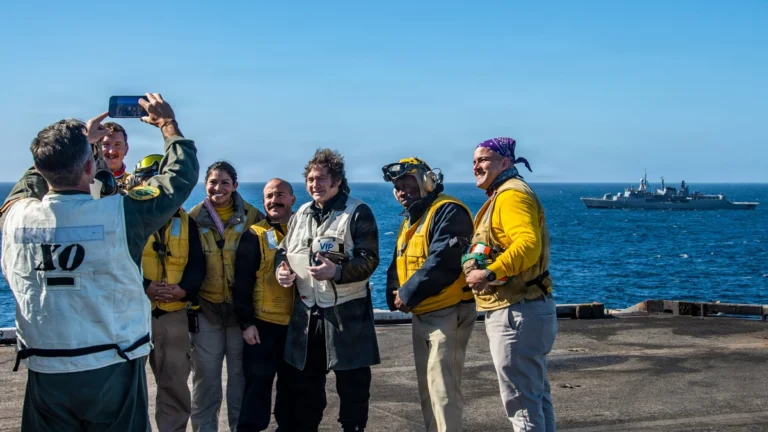
avier Milei (C) visiting the USS Nimitz, 2026. X/ @FAArgentinas
May 21, 2026 Hour: 2:09 pm
🔗 Comparte este artículo
Washington found a new way to seize strategic resources in the South Atlantic.
On Thursday, the Argentine newspaper Pagina 12 published information according to which far-right President Javier Milei carried out a cession of sovereignty over Argentine waters, using as a pretext the designation of maritime territories as a “Global Common Good.”
RELATED:
Argentine State Workers Launch Strike Against Milei
This concept appears specifically in a letter of intent between the Argentine Navy and the U.S. Southern Command’s Fourth Fleet. Among other provisions, the document would enable the possibility that U.S. Marines could provide support to neutralize maritime threats in the region.
“The agreement, on which the government provided no official details, was announced by the U.S. Embassy and constitutes a new chapter in Javier Milei’s automatic alignment with Donald Trump’s agenda, which months earlier had already led him to join the military coalition ‘Shield for the Americas,’” Pagina 12 commented.
On May 18, the U.S. Embassy in Argentina had announced the launch of a five-year program for the protection of “Global Commons” and the strengthening of maritime security in the South Atlantic.
“The letter of intent was signed directly by Navy Chief Juan Carlos Romay and Fourth Fleet Commander Carlos Sardiello. Weeks earlier… Sardiello declared that the time had come to ‘work with international partners and industry leaders to secure the Western Hemisphere’,” Pagina 12 recalled.
“The main interest of the United States is to keep China away from the region, particularly from the South Atlantic. The justification for cooperation is the activity of Chinese vessels at the edge of the 200-mile limit that defines Argentina’s exclusive economic zone,” it added.
Pagina 12 also mentioned that the U.S. Navy chief had made statements warning about the presence in the South Atlantic of “powers with divergent interests,” which made “presence, surveillance and rapid response capability” necessary.
Although the Milei administration has refused to explain the commitments reached with Washington, criticism of the letter of intent is beginning to highlight its potential implications for Argentina.
“This agreement is yet another example of the automatic and subordinate foreign policy alignment with the United States promoted by Milei,” former Defense Minister Jorge Taiana said.
“Understanding the defense of the South Atlantic through the logic of ‘global common goods’ implies extending that concept not only over maritime spaces, but also over Argentina’s continental shelf and exclusive economic zone, thereby relativizing the sovereign dimension of an area that is fundamental for the country because of the wealth of its renewable and nonrenewable resources.”
“The defense of sovereignty cannot be conditioned by agreements that, under the discourse of cooperation, security or environmental protection, ultimately enable greater levels of foreign interference over areas that are key to the country’s development and future,” he added.
Former Security Minister Sabina Frederic also pointed out that the exclusive economic zone within the Argentine Sea is not a global good: “it is Argentine sovereign territory. Therefore, the United States has no reason to interfere in monitoring that space. This is not merely technical cooperation.”
“Responsibility for monitoring the exclusive economic zone and its boundaries currently belongs to the Argentine Naval Prefecture, which has limited equipment, but equipment nonetheless. There are not only Chinese vessels there; there are also Spanish and Portuguese vessels. Beyond the sovereignty dispute, this will also create conflict between the Naval Prefecture and the Navy,” she warned, according to Pagina 12.
teleSUR/ JF
Source: Pagina 12