







Milei Faces Fierce Resistance Over Foreign Land Ownership Law

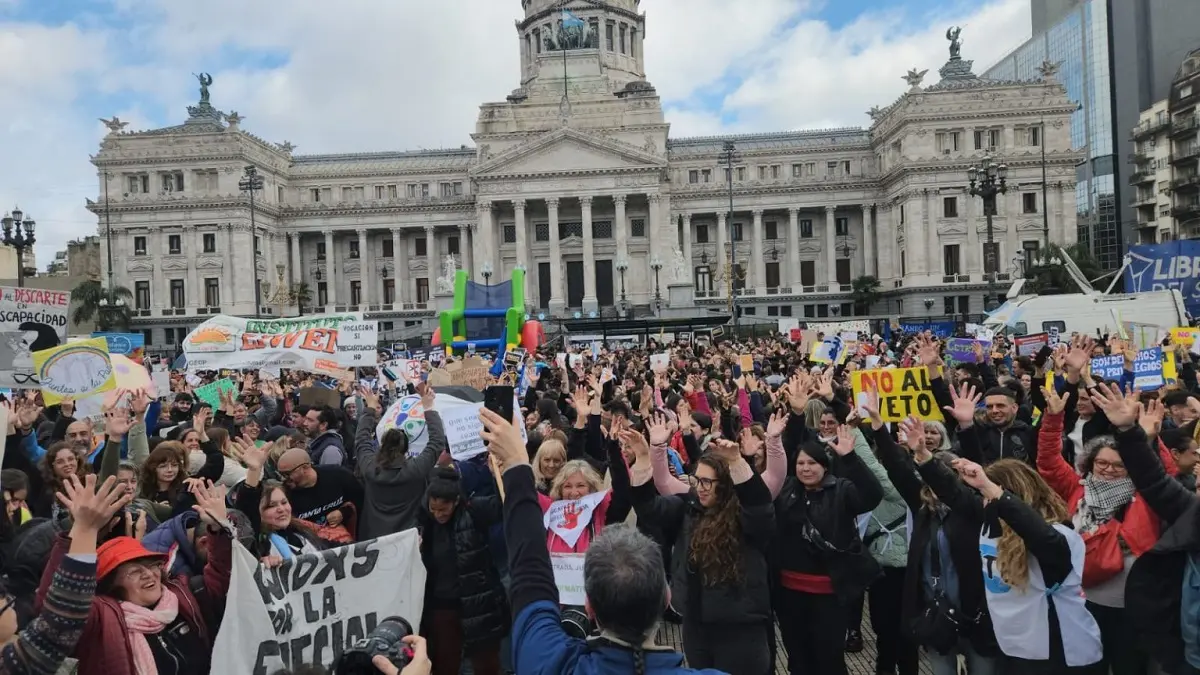
The sign reads,”The land is not for sale. It is not to be burned. People are not to be evicted. No to the Law of Inviolability of Private Property.” Photo: LT9
August 6, 2026 Hour: 2:45 pm
🔗 Comparte este artículo
Legislative hurdles and public outcry force the government to pivot away from immediate total repeal toward partial policy concessions.
Far-right President Javier Milei has promoted a bill to eliminate legal restrictions that prevent foreign investors and companies from acquiring land in Argentina.
RELATED:
Argentinean Senate Postpones Inviolability of Private Property Bill Amid Rejection
By attempting to modify long-standing land policies through executive measures and legislative initiatives, the executive branch seeks to enable unrestricted real estate transactions in rural, agricultural, and resource-rich areas.
Under this neoliberal model, natural ecosystems, agricultural zones, freshwater basins, and mineral deposits are primarily treated as financial assets for markets. Milei’s administration argues that removing regulatory barriers will attract critical foreign direct investment and integrate Argentina into international commerce.
The attempt to dismantle restrictions on rural property ownership in Argentina raises significant questions regarding national sovereignty, resource stewardship, and regional development. Examining these legal shifts reveals a deep conflict between market-driven deregulation and the protection of strategic national territory.
The Framework of Law 26.737: Protecting the National Domain
Argentina’s current regulatory regime governing real estate ownership was established on December 22, 2011, through Law 26,737, formally titled the Regime for the Protection of National Sovereignty over the Ownership, Possession or Tenure of Rural Lands.
Enacted during the presidency of Cristina Fernández de Kirchner, the law was designed to address concerns about growing land concentration and the unregulated acquisition of strategic rural zones by foreign entities.
Under Law 26.737, foreign individuals and legal entities are barred from holding more than 15 percent of total rural land across the entire national territory, as well as within any individual province or municipal administrative division.
To avoid concentrated ownership by specific national groups, the law mandates that citizens or corporations from a single foreign country cannot hold more than 30 percent of that overall 15 percent allowance, effectively capping ownership by any single foreign nationality at 4.5 percent of the total rural land in a given jurisdiction.
Furthermore, individual foreign holdings are restricted to a maximum of 1,000 hectares in the highly fertile zona core or an equivalent area elsewhere in the country as defined by local provincial authorities.
The statutory framework imposes strict prohibitions on foreign purchases of land that contains or directly borders significant, permanent bodies of water, including lakes, rivers, and critical groundwater sources such as aquifers. It also maintains restrictions in designated border security zones to safeguard national territorial integrity.
According to official data from the National Rural Land Registry (RNTR) and investigative tracking by the Land Observatory, foreign entities hold approximately 13.3 million hectares of rural land in Argentina.
While this amounts to under 5 percent of the total national land area on paper, data show that foreign ownership is heavily concentrated in strategic hotspots, including border regions, major river basins, and areas rich in lithium and freshwater, where individual departments frequently exceed the 15 percent legal cap.
Executive Deregulation, Legislative Retreats, and Judicial Setbacks
President Javier Milei initiated his attempt to dismantle Law 26.737 shortly after taking office through Emergency Decree (DNU) 70/2023, issued on December 20, 2023. Article 154 of the decree called for the complete repeal of the land protection framework.
By utilizing an executive emergency decree, the Milei administration bypassed parliamentary debate, immediately eliminating foreign ownership caps, minimum residency requirements, and strict bans on selling land surrounding vital water reserves.
In January 2024, Federal Judge Ernesto Kreplak of La Plata issued a preliminary injunction suspending Article 154 following a constitutional lawsuit filed by the Malvinas War Veterans Center (CECIM). The court ruled that the administration failed to demonstrate the urgency or economic necessity required to override legislative authority on matters involving national territory and sovereign resources.
Faced with ongoing judicial injunctions and a lack of a working majority in Congress, the administration modified its tactical approach. The Milei government introduced deregulation measures through legislative channels, integrating them into broader statutory proposals such as the Inviolability of Private Property Law.
When complete repeal proved politically unviable due to sustained opposition in the Senate, the executive branch offered compromises, such as raising the national foreign ownership ceiling from 15 percent to 25 percent. Amid opposition from provincial leaders, social coalitions, and opposition legislators, the administration faced pressure to alter its land reform provisions to pass broader financial deregulation packages.
Free Market, Capital Inflow, and Deregulation
The Milei administration frames the repeal or easing of the Land Law as essential to unlock foreign direct investment (FDI), eliminate bureaucratic barriers, and restore absolute private property rights.
Officials argue that the 2011 restrictions act as an arbitrary barrier that discourages international agricultural and industrial conglomerates from placing capital in Argentina’s economy.
Federico Sturzenegger, Minister of Deregulation and Transformation of the State, publicly articulated this position during presentations to agricultural export producers. Sturzenegger argued that Law 26.737 acts as a direct prohibition on productive international investment across forestry, port infrastructure, and primary agriculture.
Government estimates presented by Sturzenegger suggest that completely deregulating rural real estate markets could attract roughly $15 billion in foreign capital inflows.
The executive branch asserts that financial capital operates globally and that assigning legal restrictions based on investor nationality violates constitutional guarantees of equal treatment for foreign individuals and foreign-owned enterprises.
Under this framework, the administration positions land deregulation alongside broader structural incentives, such as the Incentive Scheme for Large Investments (RIGI), as part of a strategy to integrate Argentina into global supply chains for food, energy, and raw materials.
Sovereignty, Extractivism, and Resource Grab
Environmental legal centers and social movements counter the Milei administration’s narrative, asserting that removing land acquisition boundaries triggers speculative real estate dynamics rather than productive capital expansion.
Academic studies on rural property regimes in Latin America indicate that institutional investors and sovereign wealth funds frequently purchase land as a speculative asset hedging against global inflation, rather than deploying operational capital for agricultural production.
Opponents emphasize that unrestricted land sales undermine national resource sovereignty, particularly in environmentally sensitive zones. The Argentine territory contains extensive reserves of fresh water, notably the Guaraní Aquifer in the northeast and major glacial reserves along the Andean mountain range.
Under Law 26.737, foreign ownership of properties containing or bordering major water bodies is strictly prohibited. Research from environmental organizations shows that eliminating these legal barriers opens critical freshwater sources to private control, limiting public access and heightening the risk of environmental degradation from large-scale extractive ventures.
The critique highlights the social consequences for family farming and rural populations. Unchecked land accumulation by transnational agribusiness drives up land values, making small-scale farming financially unviable and displacing local agrarian producers.
Opponents note that shifting land use toward large-scale export monocultures, such as soy, corn, and industrial forestry, weakens domestic food security, drives food price inflation, and accelerates deforestation across ecologically fragile regions like the Gran Chaco.
Civil Society Resistance: “Argentina is Not for Sale”
Mobilization against the deregulation of rural property in Argentina has brought together a broad coalition of civil society actors arguing for the protection of national territory as a continuation of territorial defense and sovereign integrity.
Agrarian unions, such as the Union of Land Workers (UTT) and the Argentine Agrarian Federation, joined with indigenous rights organizations, including Mapuche and Qom communities, to coordinate nationwide demonstrations, public forums, and marches under the banner “Argentina no se vende”.
These coordinated social and political mobilizations directly impacted the legislative process. Widespread public rejection and pressure from provincial governors forced executive negotiators to pull controversial land reform provisions from congressional bills to avoid legislative defeats.
Parliamentary tallies and political media tracking showed sustained opposition across multiple party blocs, highlighting significant public resistance to changing the 2011 land framework.
The debate surrounding Argentina’s Ley de Tierras illustrates a conflict between opposing development trajectories in Latin America. The Milei executive branch presents land deregulation as a necessary step to attract international investment, integrate into global markets, and guarantee economic freedom.
The judicial rulings, legislative halts, and sustained public demonstrations show that the management and ownership of national territory is in the central and contentious political debate in modern Argentina.
Sources: teleSUR – Brasil de Fato – Página 12 – Resumen Latinoamericano – El País – La Nación – La Prensa Digital – Barricada TV – ARG Medios
Author: Silvana Solano
Source: teleSUR