ICJ Rules Myanmar Committed Genocide Against Rohingya in Rakhine
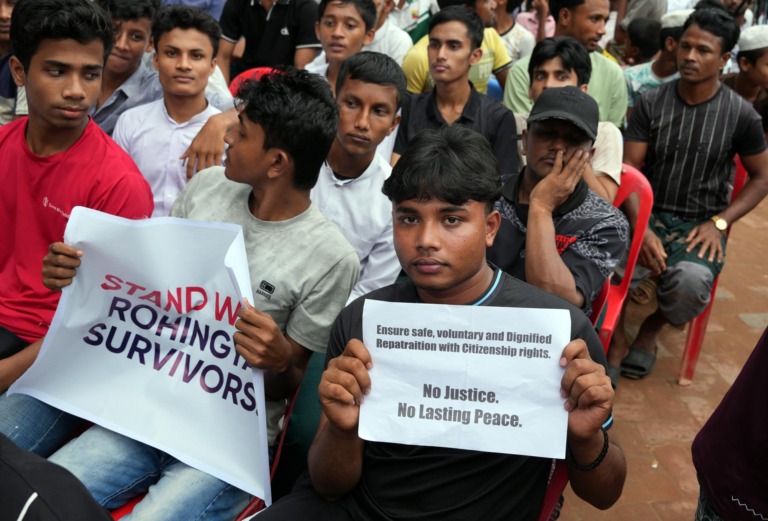
This is the first time that the International Court of Justice has found a state responsible for genocide. They ordered Myanmar to indemnify the Rohingya group and its members for damages. Photo: EFE.
November 19, 2026 Hour: 6:43 pm
🔗 Comparte este artículo
The International Court of Justice (ICJ), the UN principal judicial body, ruled on Thursday that Myanmar committed genocide against the Rohingya people and failed in its duty to prevent and punish the crime, in a landmark judgment that marks the first time the court has held a state responsible for genocide.
The decision in the case The Gambia v. Myanmar, which concerns the application of the Genocide Convention, was delivered on November 19, at the court’s seat in The Hague after a three-hour hearing.
Court President Yuji Iwasawa, a Japanese judge, detailed episodes of extreme violence carried out by the Myanmar military against Rohingya communities, who are mostly Muslim, in Rakhine State.
RELATED: Myanmar: Attacks in Rakhine Prevent the Return of the Rohingya
According to the ruling, security forces and other state organs intentionally carried out conduct prohibited under Article II of the Convention. The court found that members of the group were killed and subjected to serious physical or mental harm, and that measures intended to prevent births within the group were imposed. It linked the latter to the killing of babies during the military operations of 2017.
Evidence of Atrocities
The case stems from proceedings initiated by The Gambia in November 2019. The court relied on testimony from survivors of the villages of Min Gyi, Chut Pyin and Maung Nu, as well as graphic evidence and reports from international investigators on the so-called clearance campaigns in northern Rakhine.
The records documented executions of men and boys and rapes of women and girls. They also documented an estimated 10,000 people killed and the total or partial destruction of about 400 villages, roughly 40 percent of the nearly 1,000 in three townships. The destruction was followed by land clearing with bulldozers and new construction. About 700,000 Rohingya fled the country after the 2017 operations.
The court also heard a witness presented by Myanmar, who described an attack by insurgents of the Arakan Rohingya Salvation Army (ARSA) that reportedly killed about 100 civilians.
Reparations and Precedent
The tribunal ordered Myanmar to end any ongoing violations through legislation that fully implements the Convention. It also ordered the country to investigate, prosecute and punish those responsible and to provide guarantees of non-repetition.
In addition, Myanmar must facilitate restitution, including the safe, voluntary and dignified return and the family reunification of internally and externally displaced people, and compensate the affected group for the harm caused. The court gave Myanmar two years to submit a report on restitution measures and on the forms and amounts of reparation.
U.N. Secretary-General António Guterres welcomed the ruling on social media as a significant acknowledgment for Rohingya victims. “It is binding, final and not subject to appeal,” he stressed. He added that the judgment reaffirms that impunity for such atrocities cannot prevail, and that Myanmar “must act in accordance with its obligation to comply with the decision of the Court.”
“Breaking the cycle of impunity in Myanmar and ensuring accountability are essential for national reconciliation and lasting peace,” Guterres said.
The judgment departs from earlier ICJ precedents. In Bosnia and Herzegovina v. Serbia and Montenegro (filed in 1993, decided in 2007), the court did not attribute the commission of genocide to Serbia, but found that it failed to prevent and punish the 1995 Srebrenica genocide. In Croatia v. Serbia (filed in 1999, decided in 2015), both the claim and the counterclaim were rejected for lack of proof of specific genocidal intent during Croatia’s war of independence.
Author: Laura V. Mor
Source: Agencies