







Ecuador’s President Noboa Rejects Dialogue With Indigenous Organisations
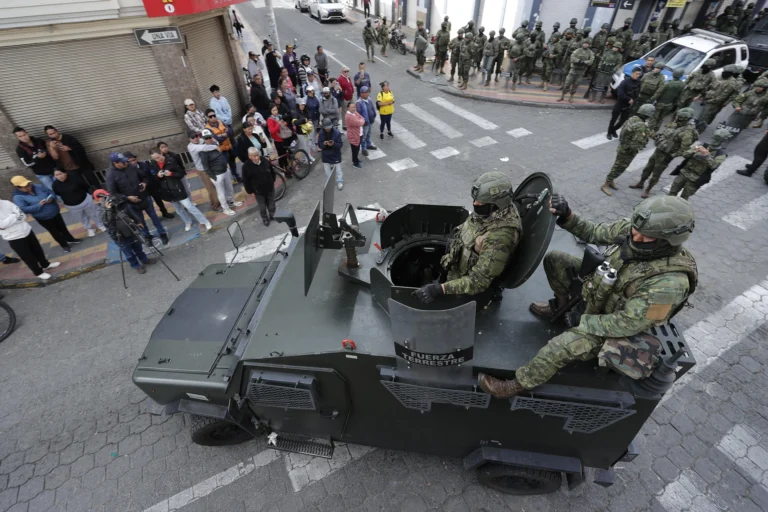
Members of the Armed Forces guard the city this Wednesday, in Otavalo, Ecuador. Photo: EFE/ Jose Jacome
September 27, 2025 Hour: 10:13 pm
🔗 Comparte este artículo
Ecuadorian President Daniel Noboa has dismissed any possibility of dialogue or negotiation with the Confederation of Indigenous Nationalities of Ecuador (CONAIE), the main indigenous organization spearheading the ongoing protests.
RELATED:
7 Critical Updates on the Ecuador National Strike: Noboa Rejects Talks Amid Crisis
The strike marks its fifth day amidst widespread discontent with the government’s recent decision to eliminate the diesel subsidy, a move that has sparked sharp backlash from transport sectors and indigenous communities across the country.
Noboa issued a stern warning on Friday, emphasizing that yielding to the protestors’ demands would be an attack on democracy. He contended that only a small fraction of the population supports the strike, while the majority of Ecuadorians—he estimates around 98%—reject the stoppage and wish to continue their daily work.
“The state will resist the paralysis, and the Public Force will do its job to restore order and clear the blocked roads,” Noboa stated. He assured the public that the police and armed forces would continue their operations “within the law,” citing as an example the actions taken in the province of Imbabura, a protest hotspot.
In addition to rejecting dialogue, Noboa sought to delegitimize the protests by alleging links between some demonstrators and organized crime. He specifically accused participants in Imbabura of connections to illegal mining activities and to the so-called transnational criminal group “Tren de Aragua,” a serious claim criticized by human rights organizations for criminalizing social protest.
The government’s hard line comes as Ecuador faces a volatile political landscape, further intensified by the ongoing strike, which has led to road blockades, shortages, and disruptions in various regions. While the indigenous movement remains steadfast, the authorities are preparing a security crackdown to regain control.
Meanwhile, the National Electoral Council (CNE) approved the opening of an electoral period for a popular consultation proposed by Noboa, coinciding with the protest. This referendum, set for November 16, 2025, includes a question on whether to convene a Constituent Assembly to rewrite the country’s constitution—a controversial move that could reshape Ecuador’s political system.
The CNE president Diana Atamaint clarified that the popular consultation only seeks to ask citizens if they want constitutional change, but the timing of the referendum amid the ongoing strike adds to the already high political volatility. The indigenous mobilization remains a critical challenge to Noboa’s government, clearly signaling that social unrest and political tensions are the most urgent issues facing the country.
This latest crisis highlights deep-seated grievances in Ecuador, a country grappling with social inequality, economic reforms, and political polarization. Noboa, who took office in late 2023, has pursued austerity measures and structural reforms aimed at stabilization and modernization but has faced fierce opposition from indigenous groups and workers.
Historically, indigenous movements in Ecuador have played a key role in shaping national politics. The current conflict underscores the urgent need for dialogue and solutions that address the socio-economic realities fueling the protests.
Observers warn that while Noboa’s government pushes forward its agenda with firmness, the absence of meaningful dialogue risks prolonging unrest and deepening divisions. The government’s accusations against protestors and the threat of force signal a precarious path ahead, with the potential for escalated confrontations in the days to come.