







Ecuador State Femicide Registries Undercount Killings of Women
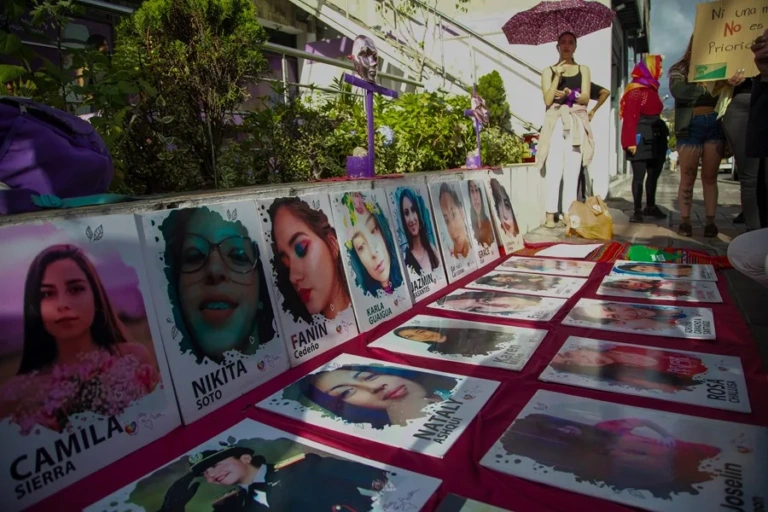
File photo of posters bearing images of women during a protest outside what was then the Ministry of Women in Quito, Ecuador. Photo: EFE.
November 26, 2026 Hour: 4:37 am
🔗 Comparte este artículo
A study by Flacso’s Observatory on Gender- and Sexuality-Based Violence and the Feminist Alliance for Mapping Femi(ni)cides has found that state registries are failing to reflect the scale of femicide, with organizations documenting 1,721 victims between 2020 and 2025 against 485 recognized by the State.
In 2025, the year with the highest number of killings of women in the period analyzed, the Prosecutor’s Office counted 62 femicides while the alliance identified 434.
Ailynn Torres, coordinator of the observatory and one of the study’s authors, told media that the state registry has lost the capacity to reflect the magnitude of the problem. “Between 2020 and 2025 we see a collapse of the state femicide registry system that is essential to discuss and correct, because without a registry there are no reparation or prevention policies,” she said.
RELATED: Noboa Extends Ecuador’s State of Emergency by 30 Days
The investigation attributes part of the statistical gap to institutions mainly recognizing cases occurring in partner or family contexts, leaving other expressions of sexist violence outside that classification. The distance between the two registries widened from 2021, when feminist entities began including killings linked to criminal structures; the report says such groups may use women’s bodies as war booty and links some crimes to disputes, reprisals, trafficking and territorial control.
The report also records a shift in the weapons used: 75% of killings in 2025 were carried out with firearms, compared with 9% in 2020, when bladed weapons predominated at 38% and attacks with hands at 25%. It says many crimes occurred in public spaces, challenging the idea that feminicides occur mainly inside homes, and warns of a rapid increase in homicides of adolescents aged 12 to 17 amid greater recruitment of minors by criminal groups.
The report calls for reforming or more broadly interpreting the crime of femicide to respond to new forms of violence.
Author: vmmh