







Powerful Signs the Dongfeng-17 missile Is Advancing China’s Strike Power
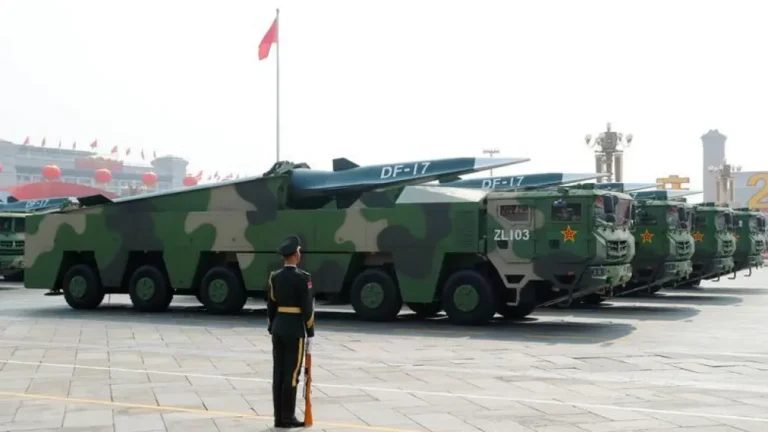
China showcased Dongfeng-17 missile mobility, precision, and coordination during a Rocket Force exercise in northwest China.
June 20, 2026 Hour: 10:23 am
🔗 Comparte este artículo
Dongfeng-17 missile drills show China’s growing mobility, precision, and electronic warfare resilience in a new military exercise in the northwest.
Related: China-Myanmar Corridor: Strategic Benefits Unveiled in State Visit Agreements
Dongfeng-17 missile capabilities were highlighted in a new military exercise by China’s People’s Liberation Army Rocket Force, which showcased mobility, precision, and adaptability in complex combat scenarios. Official accounts said the drill was designed to test coordinated strikes, electronic interference resistance, and faster command links under difficult conditions.
Dongfeng-17 missile and the new military drill
The exercise featured several missile units carrying out coordinated maneuvers in an open-air training area, with the ability to conduct multi-stage attacks and respond to possible electromagnetic interference or precision strikes. According to official reports, the new equipment reflects higher levels of intelligence, mobility, and accuracy.
The training also emphasized operations under varied conditions with less dependence on fixed installations. That shift is important because it allows missile forces to disperse, move quickly, and reduce vulnerability to surveillance or attack. Officials said the new technologies have simplified command links and reduced the time needed to organize fire missions.
The drill took place in a desert zone in northwest China, where ground forces, aviation units, and Rocket Force elements trained together to improve coordination across branches of the military. The joint nature of the exercise suggests a broader effort to make missile operations faster and more integrated.
Military commentator Du Wenlong said the Dongfeng-17 display showed a high level of readiness. He highlighted the launch vehicles’ ability to move across difficult terrain and operate in non-predetermined conditions, which is critical in modern warfare where fixed positions are easier to target. He added that the exercise also simulated multiple layers of interference.
That kind of scenario matters because it tests whether missile crews can still complete launch and strike missions under pressure. Du said simultaneous launches from multiple vehicles are technically important because they can improve the protection of launch positions and increase operational effectiveness.
Dongfeng-17 missile and China’s evolving force structure
Du also noted that small wings installed on some missiles, including the Dongfeng-17 and members of the Dongfeng-26 family, change aerodynamic characteristics and improve maneuverability in the final phase of flight. That allows the missile to adapt to complex targets and makes interception more difficult.
The People’s Liberation Army Rocket Force, created six decades ago, has developed a missile structure that includes nuclear and conventional capabilities, multiple ranges, and systems designed for different operational needs. That mix gives China a more flexible strike doctrine and expands the role of the Rocket Force in national defense planning.
The exercise fits into China’s ongoing modernization drive, in which mobility, survivability, and precision are increasingly prioritized over static missile deployments. By training in desert terrain and under electronic interference, the force is preparing for battle conditions in which communications may be disrupted and launch sites may need to change quickly.
It also reflects a broader doctrinal trend toward multi-domain coordination. Ground forces, aircraft, and missile units working together suggest the PLA is building a system in which different branches can support one another more closely. That kind of integration is central to modern military planning, especially in high-intensity scenarios.
The emphasis on the Dongfeng-17 is not accidental. The missile has become a symbol of China’s ability to field advanced strike systems that combine speed, maneuverability, and resilience. In practical terms, that makes it more than a single platform; it is part of a larger message about the country’s defense modernization.
Geopolitical context
Dongfeng-17 missile drills have implications beyond China’s borders. They signal to regional and global audiences that Beijing continues to invest in rapid-response strike systems capable of surviving electronic warfare and reaching complex targets. That has direct relevance for military planners in East Asia, the Pacific, and beyond.
The exercise also feeds into wider strategic competition among major powers. As the United States and its allies expand missile defense, surveillance, and long-range strike capabilities, China is answering with systems designed to move faster, react sooner, and complicate interception. This dynamic increases the pressure of an already tense security environment.
At the same time, the drill reinforces the centrality of the Rocket Force in China’s defense posture. If future exercises continue to showcase mobility, precision, and joint operations, the Dongfeng-17 will remain a key marker of how Beijing intends to deter adversaries and project military credibility. That makes the missile not just a weapons platform, but a strategic signal.
Author: JMVR
Source: PL