Cuba’s President Díaz-Canel Urges U.S. Dialogue Without Pressure or Conditions
Cuban President Miguel Díaz-Canel has called for renewed dialogue with Washington, insisting that negotiations must respect the island’s sovereignty and political system. His remarks come amid heightened tensions and Trump’s comments about possible military intervention.
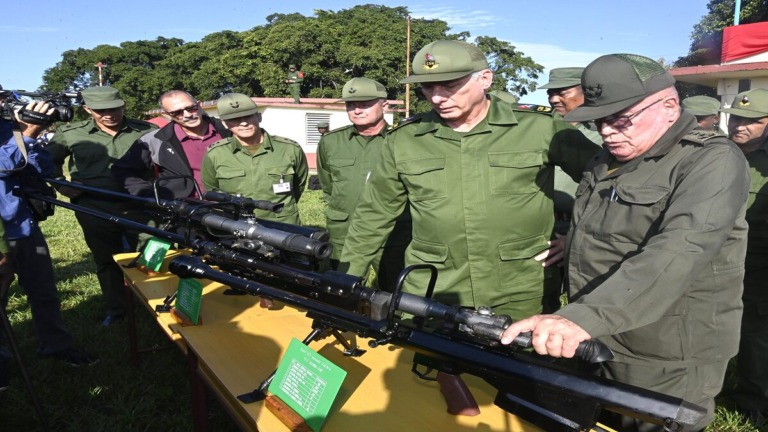
Cuban President Miguel Díaz-Canel speaks with university students during a Defense Day military exercise in Havana. Photo: @PresidenciaCuba
November 21, 2026 Hour: 7:10 am
🔗 Comparte este artículo
Cuba’s president calls for cooperation with Washington while rejecting any negotiations that challenge the island’s sovereignty or political system.
Cuban President Miguel Díaz-Canel has called for dialogue and cooperation with the United States amid renewed bilateral tensions, saying any negotiations must respect Cuba’s sovereignty and take place without pressure or conditions.
RELATED: Cuba Denounces U.S.-Funded Poll on Support for Invasion as Fraud
Speaking on Friday during Cuba’s weekly Defense Day activities, Díaz-Canel said confrontation served neither country’s people and urged both governments to pursue closer ties.
“The Cuban and American peoples do not deserve confrontation. They deserve rapprochement and opportunities for cooperation between our two peoples,” he told more than 100 students from the Technological University of Havana (CUJAE) and the University of Informatics Sciences (UCI).
The remarks came during a shooting exercise at the Gloria Combativa Rescate de Sanguily Tank Unit, according to the Cuban Presidency.
Text Reads: When the Homeland is in danger, it is up to all of us to defend it The President of the National Defense Council, @DiazCanelB, joined students from @CujaeRedSocial and @universidad_uci in the University Student Bastion.
Díaz-Canel reaffirmed Havana’s willingness to engage in talks but ruled out negotiations involving pressure on Cuba’s political system or challenges to its sovereignty and right to self-determination.
“We have always sought dialogue, but it must be respectful, without pressure, conditions or questioning of our political system, sovereignty or right to self-determination,” he said.
The president, who also heads Cuba’s National Defense Council, said the country would maintain intensive military preparedness, with the aim of deterring any potential adversary and preventing confrontation.
His remarks followed statements he made the previous week accusing U.S. politicians and spokespersons of repeatedly encouraging and reinforcing the prospect of military action against Cuba. He warned that the island would reject any attempt at foreign military aggression.
U.S. President Donald Trump has himself raised the possibility of military intervention. In a recent telephone interview with Salem News Channel, he said he would “consider” such an option when asked about the prospect of intervening in Cuba.
Trump also said he wanted to resolve the Cuba issue before leaving office in 2029, naming U.S. Secretary of State Marco Rubio as the person he considered well suited to handle it. Referring to Rubio’s Cuban parents, Trump added that the secretary of state “would love to do it.”
Washington has intensified pressure on Havana since January, imposing additional sanctions and a petroleum blockade while demanding political and economic reforms. These measures have further aggravated Cuba’s economic and energy crisis.
Despite the escalating rhetoric and military tensions, Díaz-Canel reiterated that Havana remained open to rapprochement and cooperation, provided any dialogue respected Cuba’s sovereignty and political system.