


New Court Ruling Declares Unconstitutional Key Article of Milei’s Labor Reform
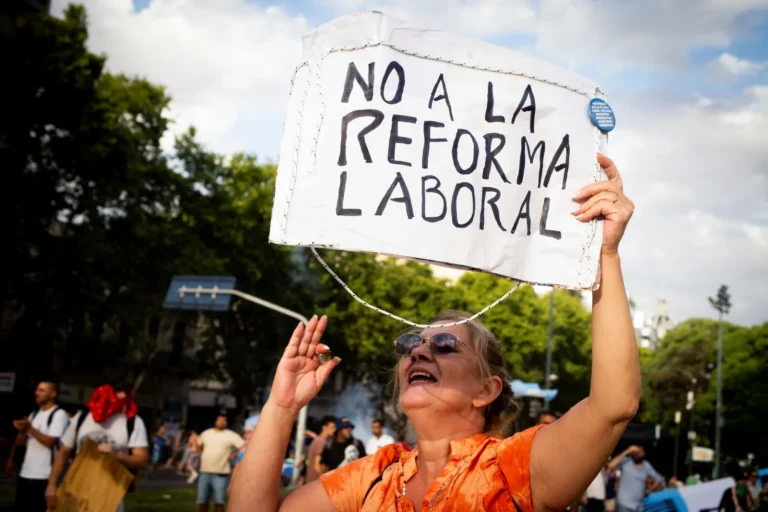
(FILE) The Judiciary Power declares unconstitutional the calculation of compensation established in the new law. Photo: Getty Images.
March 16, 2026 Hour: 7:56 pm
🔗 Comparte este artículo
The Argentinean Judiciary Power is again suspending full implementation of Milei’s labor reform, alleging that an article contrary to the rights of article 14 bis of the Constitution.
An Argentina’s Labor Court in La Plata, on March 16, declared Article 55 of President Javier Milei’s Labor Reform unconstitutional, halting a key provision that threatened workers’ rights and indemnity calculations. This judicial action marks another significant challenge to the Government’s economic policies.
RELATED: Argentina’s Public Universities on Strike, Teachers Demand Fair Salaries
The Labor Court No. 3 of La Plata rendered Article 55 of Law 27.802, known as Labor Modernization Law, unconstitutional. The Court determined that its application directly infringes upon the constitutional rights of workers, which are unequivocally guaranteed by Article 14 bis of the nation’s Constitution.
This ruling constitutes another substantial judicial setback for a pivotal article within the neoliberal Labor Reform spearheaded by the Javier Milei Government, demonstrating persistent legal opposition to its implementation.
The judicial decision specifically stipulates that the revised calculation method for indemnities should not be applied under criteria that disregard the depreciation of salary value due to inflation, nor should it employ parameters that are disadvantageous to the worker. This landmark resolution was issued barely ten days following the law’s entry into force, intensifying the legal scrutiny surrounding the legislative package promoted by the ruling party and its parliamentary allies.
This is not an isolated incident; the Labor Reform previously encountered an adverse ruling in the province of Cordoba, also declared the same article unconstitutional, which violates the constitutional guarantee of equality before the law by attempting to apply an unfavorable indemnity calculation to labor lawsuits initiated years prior to the reform.
In both instances, the judiciary concluded that Article 55 introduces retroactive effects by seeking to modify Article 276 of the Labor Contract Law. This alteration directly impacts ongoing legal processes and encroaches upon the acquired rights of workers, a cornerstone of Argentinean labor legislation.
Text reads: “Yesterday in this Senate we approved the Mercosur – European Union agreement, which explicitly establishes the commitment to guarantee levels of labor protection. Today we are dealing with a labor reform that weakens them. We were in a hurry to be the first country to ratify the agreement, but it seems that we will be the first to break it.”
The Labor law, officially enacted on March 6, controversially mandated that the new indemnity criteria be applied to “pending trials and those still awaiting a definitive sentence”, a provision now robustly challenged and deemed unconstitutional by the courts.
The controversial new calculation mechanism dictates that indemnities are to be updated using a passive rate established by the Central Bank, which cannot be less than 67% of the Consumer Price Index, plus an additional 3% annually.
However, the magistrates firmly contended that this formula inevitably leads to a significant loss in the real value of compensation, effectively ignoring the devastating impact of inflation on salaries. In their pronouncement, the courts emphatically stressed that “inflation is a risk that must be borne by the employer” and that “updating mechanisms cannot be insufficient or detrimental to the worker.” This underscores a fundamental principle of labor law in Argentina, prioritizing worker protection.
The continued judicial scrutiny of Milei’s Labor Reform signifies an ongoing struggle to defend fundamental labor rights against policies perceived as regressive and detrimental to the working class, echoing commitment to social justice and the protection of vulnerable populations.
Author: Laura V. Mor
Source: Pagina 12