







CONAIE Warns of Risks in Noboa’s Mining and Energy Project in Ecuador
“Ecuador’s historical experience demonstrates that this path has deepened inequality, criminalized territorial defense, and exacerbated social and environmental impacts,” Conaie stated.
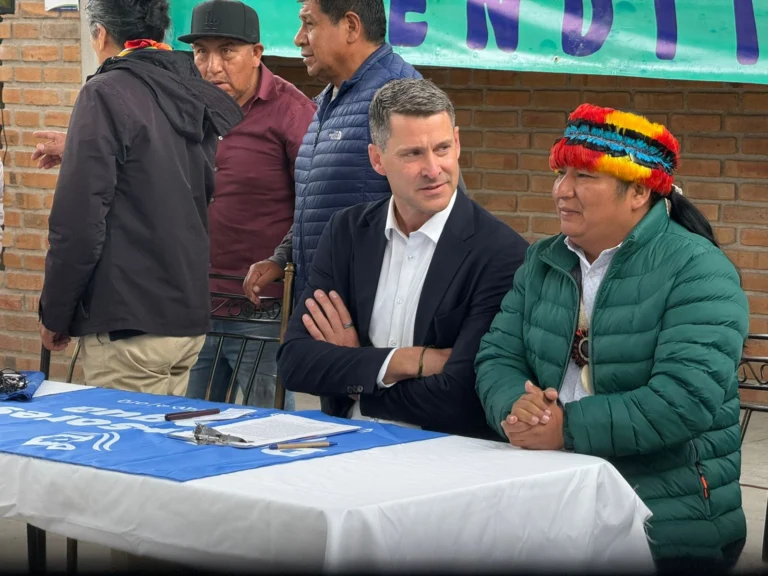
From Azuay, Marlon Vargas, president of CONAIE and representatives from the Kimsakocha communities, met with the Canadian ambassador to denounce abuses by Dundee Precious Metals, the criminalization of water defenders, and to reject a mining free trade agreement. Photo: @CONAIE_Ecuador
February 3, 2026 Hour: 10:25 pm
🔗 Comparte este artículo
The Confederation of Indigenous Nationalities of Ecuador (CONAIE) issued a statement warning of the social and environmental risks of the Organic Law Project for the Strengthening of the Strategic Mining and Energy Sectors, promoted by the government of President Daniel Noboa and processed as an urgent economic initiative in the National Assembly.
“This project is generating alarm among Indigenous peoples, nationalities, and peasant communities, as it puts at risk collective rights, ancestral territories, and essential water sources,” CONAIE stated.
RELATED:
Ecuador–Colombia Trade Dispute Escalates With New Tariffs
The Indigenous organization questions the proposal’s prioritization of expediting extractive investments without guaranteeing prior, free, and informed consultation, a right enshrined in the Ecuadorian Constitution and international human rights treaties. Furthermore, it indicates that replacing environmental licenses with simplified authorizations and accelerating administrative procedures would reduce consultation to a mere formality, without ensuring genuine processes of collective decision-making or the consent of the affected communities.
The statement highlights the relaxation of environmental controls and water use regulations, which would weaken the state’s capacity to prevent irreversible damage to strategic ecosystems such as páramos (high-altitude Andean ecosystems), forests, and rivers. In the context of the climate crisis, CONAIE maintains that water must be protected as an essential common good for life and peasant agriculture, not subordinated to a market-driven, extractive logic.
The organization criticizes the project for reinforcing a model of extractive dependency, concentrating strategic decisions and expanding private participation through long-term concessions, without effective mechanisms for social control, transparency, or accountability.
“Ecuador’s historical experience demonstrates that this path has deepened inequality, criminalized territorial defense, and exacerbated social and environmental impacts,” stated CONAIE, warning that extractive expansion will not resolve the violence or disorder in these territories.
Last week, the Legal Secretary of the Presidency, Enrique Herrería, presented two urgent economic bills to the legislature. Because of their urgency, the Assembly has 30 days to process the initiatives, which require at least 77 votes in two debates each for approval.
Author: HGV
Source: Prensa Latina