Colombia Drone Attack: 4 Soldiers Dead, 44 Wounded in Bolívar
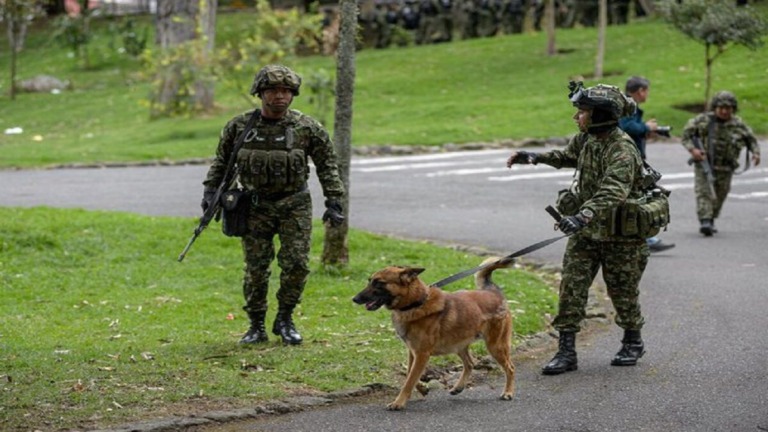
A Colombia drone attack on a military canton in Santa Rosa, Bolívar, killed four soldiers and wounded 44 others, prompting an immediate security response.
November 8, 2026 Hour: 9:38 am
🔗 Comparte este artículo
A Colombia drone attack on a military base in Santa Rosa, Bolívar, killed four soldiers and wounded 44, prompting a security response.
Related: Illegal Armed Groups Recruit a Child Every 22 Hours in Colombia, Unicef Warns
Colombia Drone Attack: 4 Soldiers Dead, 44 Wounded in Bolívar
A Colombia drone attack on a military installation in Santa Rosa, in the southern part of Bolívar department, killed four soldiers and wounded 44 others on Saturday. The attack targeted the military canton with explosive-laden drones while troops were gathered for lunch.[telesurtv]
The First Division of the Colombian Army said it immediately activated security protocols and technical verification procedures to determine the extent of the damage. It described the attack as a flagrant and serious violation of international humanitarian law and human rights.[telesurtv]
The incident marks a serious escalation in the use of armed drones against Colombian military facilities. It also raises questions about the security of military bases in areas where armed groups retain operational capacity.[telesurtv]
What Happened in Santa Rosa
According to sources cited by local media, the drones launched explosive devices while soldiers were gathered for lunch at the military canton in Santa Rosa. The attack caused four deaths and left 44 people wounded.[telesurtv]
The First Division of the Colombian Army confirmed the attack in an official statement. It said security protocols were activated immediately and that technical teams were assessing the damage.[telesurtv]
The military described the incident as an act of terrorism. It said the use of drones against a military installation represents a new and dangerous form of asymmetric warfare.[telesurtv]
External link: International Committee of the Red Cross
Early Investigation Points to Retaliation
Initial hypotheses suggest the attack may have been a retaliation by armed groups following the recent capture of an alleged commander of the National Liberation Army (ELN) in the area. Authorities have not formally confirmed that link.[telesurtv]
The ELN is one of Colombia’s most active armed groups and operates across several border and rural regions. Its presence in Bolívar has been associated with drug trafficking, illegal mining, extortion, and territorial control.[telesurtv]
The use of drones suggests that armed groups are adapting their tactics. Rather than relying solely on ambushes or roadside explosives, they may now be using commercially available or modified unmanned aircraft to strike military installations from a distance.[telesurtv]
United Nations Office on Drugs and Crime
Government Response: No Retreat
President Abelardo de la Espriella expressed solidarity with the families of the victims and warned that the security forces will not retreat in the face of criminal organizations.[telesurtv]
“We will not be intimidated,” the president said. He confirmed that he has instructed the Armed Forces to intensify offensive operations against armed structures in the region.[telesurtv]
The government’s response is likely to include increased patrols, aerial surveillance, intelligence operations, and coordinated action between the Army, Navy, Aerospace Force, and National Police.[telesurtv][telesurtv]
The attack comes days after the government demanded the immediate release of Second Lieutenant María Camila Pantoja, who was kidnapped by members of the ELN’s Eastern War Front in Arauca.[telesurtv]
A Pattern of Escalating Violence
The Colombia drone attack is part of a broader pattern of violence affecting military personnel and civilian communities. In Arauca, the ELN kidnapped Lieutenant Pantoja while she was carrying out urban registration and control duties.[telesurtv]
The government has mobilized the Army, Navy, Aerospace Force, and National Police to locate the officer and secure her release. The ELN said it would guarantee her physical integrity and rights “according to the realities of war” in the region.[telesurtv]
President de la Espriella warned the ELN that it had “chosen the wrong government” and said Colombia would not allow kidnapping to be used to intimidate the security forces or challenge state authority.[telesurtv]
Drone Warfare Reaches Colombia
The use of explosive drones marks a significant shift in Colombia’s armed conflict. Until now, drones have mainly been used for surveillance, reconnaissance, and targeted operations. Their use as weapons against a military base suggests a new level of technical adaptation by armed groups.
The attack also raises concerns about the protection of military installations. Bases, checkpoints, and troop concentrations may need new counter-drone systems, reinforced perimeters, and stricter protocols for gatherings in open areas.[telesurtv]
The Colombian military will likely need to invest in electronic warfare, radar detection, jamming equipment, and rapid-response teams. The threat is not limited to Bolívar; armed groups operating near borders and in rural areas could replicate the tactic elsewhere.[telesurtv]
Geopolitical Context
The Colombia drone attack reflects a broader regional trend in which non-state armed groups are adopting technologies once associated with conventional militaries. Drones are relatively inexpensive, difficult to detect, and can be used to strike targets without putting operators directly at risk.
For Colombia, the incident tests the government’s ability to respond to a conflict that has evolved beyond traditional guerrilla warfare. Armed groups are increasingly using technology, criminal economies, and territorial control to challenge state authority.[telesurtv][telesurtv]
The attack also comes amid political tension over the presence of U.S. military forces in Colombia. Human rights organizations have questioned joint exercises and accused President de la Espriella of signing cooperation agreements without congressional authorization.[telesurtv]
The broader implication is that Colombia’s security crisis is becoming more technologically complex. A response based only on military operations may not be enough if armed groups continue to adapt their tactics and exploit weak state presence in rural and border areas.[telesurtv][telesurtv]
What Comes Next
The immediate priority is to treat the wounded, secure the base, and determine how the drones were able to reach the installation. Investigators will also seek to identify the group responsible and establish whether the attack was directly linked to the recent capture of an ELN commander.[telesurtv]
The government’s decision to intensify offensive operations could lead to further confrontations in Bolívar and other affected regions. That raises the risk of retaliation against military personnel, civilians, and local communities.[telesurtv]
For now, the Colombia drone attack stands as a warning that the country’s armed conflict is entering a new phase. The use of drones against military targets suggests that armed groups are not only surviving but adapting to modern warfare.[telesurtv]
Author: JMVR
Source: Agencias