Colombia’s Congress Approves 2027 Budget Over Opposition Objections
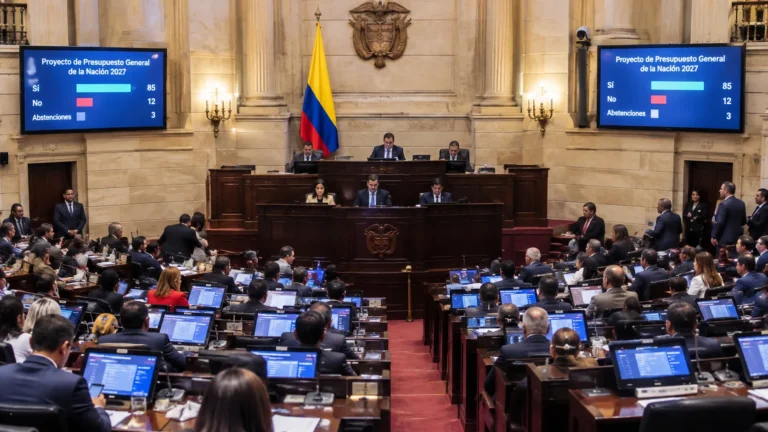
The Historic Pact questioned the law’s direction by pointing out that the government preferred to protect financial institutions, oligopolies and the most favored ones rather than devote more resources to key sectors such as education. Photo: El Pais.
October 20, 2026 Hour: 4:08 pm
🔗 Comparte este artículo
Colombia’s Congress approved the 2027 national budget of 200 billion dollars on October 20, igniting a backlash from opposition lawmakers who say the plan favors debt payments and financial interests over education, peace and regional development.
The approval of the General Budget of Colombia for 2027capped a tense legislative session. President Abelardo de la Espriella’s government secured passage of the law, over the objections of the opposition, which was led mainly by the Historic Pact party.
The approval of the General Budget of Colombia for 2027 capped a tense legislative session. President Abelardo de la Espriella’s government secured passage of the law, worth 634.9 trillion Colombian pesos (about $200 billion), roughly 200 billion dollars at the current exchange rate, over the objections of the opposition, which was led mainly by the Historic Pact party.
RELATED: Colombia’s First National Strike Against De la Espriella Met With Police Crackdown
Representative María Fernanda Carrascal described the debate as a “disaster” and faulted the national government for refusing to accept any of the 700 proposals submitted by her party. The initiatives sought to channel more resources into public education, support for victims of violence and the regions, she said. Faced with the lack of agreement, the opposition walked out of the debate, stating it would not back a measure it considers harmful to the country.
The Historic Pact also questioned the law’s orientation. Its members argued that the government chose to protect financial entities, oligopolies and the most favored sectors. They further denounced that the project promotes over-indebtedness, which they say will end up shifting heavier tax burdens onto Colombian citizens.
Text reads: “Colombia has budget for 2027! The Congress of the Republic approved the Truth Budget for $634.9 trillion, the first step to reorient the country’s economy toward growth, fiscal responsibility, and meeting the country’s needs.”
Debt Over Peace
Other voices in the legislature added their objections. Senator Jennifer Pedraza of the Dignity and Commitment party (Dignidad y Compromiso, in Spanish) criticized the absence of a fixed allocation to address the consequences of the earthquake that struck on August 10. She questioned the fact that assistance to hard-hit departments such as Risaralda, Chocó and Valle del Cauca depends solely on leftover budget balances.
Senator Ariel Ávila, in turn, lamented the underfunding of resources earmarked for electric infrastructure and energization in non-interconnected zones such as Vichada, Guainía, Arauca, Putumayo and Vaupés. He also pointed to a lack of concern for victims of the armed conflict and what he called a budgetary strangling of the Special Jurisdiction for Peace (JEP).
After the law’s validation, Congress gave the Executive 90 days to draft a fiscal adjustment plan, which the national administration has called the Rescue Law. The Ministry of Finance and the cabinet are already holding talks with the International Monetary Fund, a signal that new credit instruments and the conditions attached to them may be on the negotiating table.
Mobilization Set for November
The Historic Pact called on citizens to join a national mobilization on November 24 to reject the budget. The party maintains that the project raises debt service by 46% while cutting investment in the Special Jurisdiction for Peace by 82% and stripping 500 billion Colombian pesos (about $157 million) from the National Learning Service (SENA).
Lawmakers also warned that 14 departments will see their real investment shrink. They denounced that the norm prioritizes debt repayment over the financing of peace, education and regional development. “The complaint is clear: more resources for debt and less for peace, education and the regions,” the party stated on social media.
Text reads: “November 24: National Mobilization! The Historic Pact bench calls for mobilization against the 2027 budget of the government of Abelardo de la Espriella, for $634.9 billion. According to the bank, debt service increases by 46%, Special Jurisdiction for Peace (JEP) investment falls by 82%, National Learning Service (SENA) loses $500 billion, and 14 departments will receive less real investment. The denunciation is clear: more resources for debt and less for peace, education, and regions.”
The mobilization announced for late November now stands as the opposition’s next test of strength. In the meantime, the government’s 90-day clock to deliver its fiscal adjustment plan is running, and the talks with the International Monetary Fund could define the conditions under which Colombia finances its 2027 spending. The opposition has vowed to keep the pressure on, both in the streets and in the legislature.
Author: Laura V. Mor
Source: Agencies