







7 Shocking Facts: Cadenazo por Cuba Exposes U.S. Blockade Against Island
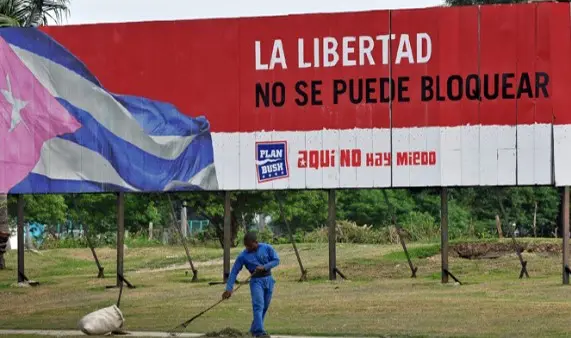
Over 50 media outlets from more than 10 countries joined the Cadenazo por Cuba to highlight the island’s resistance against the U.S. energy blockade.
June 13, 2026 Hour: 1:01 pm
🔗 Comparte este artículo
Cadenazo por Cuba connects over 50 media outlets from a dozen countries to highlight Cuba’s resistance against the U.S. energy blockade and rebuild internationalist solidarity.
Related: Cuba Says the US Has No Real Interest in the 100 Million Humanitarian Aid
Cadenazo por Cuba united more than 50 media outlets from over a dozen countries in a massive collaborative broadcast to support Cuba’s sovereignty and show solidarity with the island amid a renewed U.S. energy blockade. The simultaneous transmission, launched at 8:00 PM Cuba time, replicated content across digital platforms and social networks to highlight the population’s resistance.
Cadenazo por Cuba and the global media response
The initiative coordinated the efforts of over 50 media outlets from more than 10 countries in the region, creating a unified communicational front in defense of Cuba’s right to self-determination. Activists insisted that this deployment represents an urgent duty to return internationalist solidarity to the island at a moment when U.S. pressure is intensifying.
In Cuba, the coverage was followed through platforms of the Cuban News Agency, Resumen Latinoamericano, and the Cuban chapter of the Network of Intellectuals, Artists, and Social Movements in Defense of Humanity. The radio and digital space featured interviews conducted in Havana with Gabriel Vera Lopes, Brazil’s correspondent for Fato, who captured the voices of representatives from various organizations.
These dialogues offered a radiographic view of Cuba’s current reality and warned about the danger posed by a “decaying North American imperialism” that, through a reactivation of the Monroe Doctrine, seeks to reestablish control over the region while disregarding the independence of its peoples. The message framed the blockade not as a security measure, but as a political strategy aimed at weakening the revolution.
Activists emphasized that the U.S. government has recently intensified the energy blockade, cutting access to fuel and deepening the crisis on the island. They said this saña (savagery) to block fuel access raises an ethical and moral debate at the multilateral level about impunity and the permissiveness with which North American imperialism acts.
Six decades of asymmetric hostility and social wear
Ariel Dacal Díaz, a popular educator from the Martin Luther King Memorial Center, said during his intervention that Cuba is entering a stage of intensified historical resistance, rooted in more than six decades of consistent hostility from Washington. He denounced that the impacts suffered by the population, aggravated by recent executive orders and sanctions, carry the accumulated weight of asymmetric and unilateral aggression.
Dacal Díaz stressed: “This adds to the erosion from so much time of resistance and is degrading the quality of life of the population, which suffers unimaginable costs.” He also debunked the claim that the island represents a threat to the U.S. and recalled that revolutionary diplomacy promotes the peaceful resolution of conflicts. The activist argued that Cuba’s resilience is not due to threat, but to the principle of sovereignty.
Fernando Luis Rojas, a member of the Cuban chapter of the Network of Intellectuals, echoed concern about the wear and tear in strategic sectors, especially the energy sector, whose deterioration directly impacts all scenarios of daily life. He said the energy crisis is not just a technical problem, but a political weapon designed to generate social discontent.
Rojas assessed that Washington’s behavior reactivates the postulates of the historic Mallory Memorandum (1960), which openly called for precarizing people’s living conditions to generate social discontent and channel anger toward the revolutionary power. The memorandum, drafted by U.S. official Lester Mallory, remains a reference point for understanding the logic of the blockade.
He also criticized the narrative that tries to normalize Cuba’s dependence on oil imports as a negative factor, arguing that this normalizes the “prepotent exercise of a single State” above international law and free trade rules. The activist said this framing hides the political intent behind the blockade and turns a sovereign right into a moral accusation against Cuba.
The saña to cut fuel access establishes, according to forum participants, an ethical and moral debate at the multilateral level about impunity and hegemonic relations. In the days before the event, communicators and activists insisted that this deployment represents an urgent duty to return internationalist solidarity to Cuba at a moment when the U.S. offensive is most fierce.[lanacion.com]
Geopolitical context
Cadenazo por Cuba carries broader regional implications beyond the media broadcast itself. The initiative revives a tradition of Latin American and global solidarity that has historically supported Cuba against external pressure. In a region where right-wing governments and U.S. influence have regained ground, the Cadenazo signals resistance to renewed attempts to isolate the island.
The debate over the energy blockade also touches on multilateral norms about free trade, sovereignty, and the right to development. If a single state can cut fuel access to another without international consequence, it undermines the principles of international law and opens the door to similar actions against other countries. That is why activists frame the issue as an ethical and moral question, not just a technical one.
The episode also highlights how media solidarity can become a tool of political defense. By connecting over 50 outlets across the region, the Cadenazo creates a counter-narrative to the dominant U.S. media framing of Cuba as a threat. This type of collaborative journalism is increasingly important in moments of crisis, when information access is restricted and narratives are weaponized.
Author: JMVR
Source: Agencia Cubana de Noticias