







800 Migrants Walk to Mexico City Seeking Jobs and Regularization
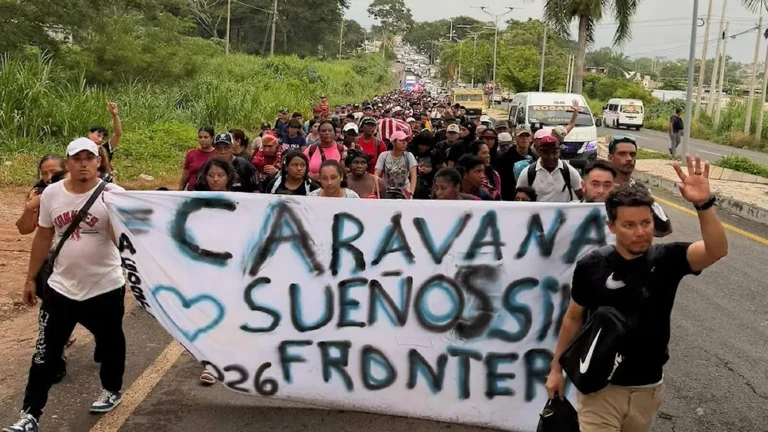
People in the context of mobility decided to leave this city of the state of Chiapas due to difficulties to continue to the United States, lack of employment and limitations to survive while waiting for an answer to their immigration procedures. Photo: X/@diariosur_oem.
August 21, 2026 Hour: 7:53 pm
🔗 Comparte este artículo
Around 800 migrants departed Tapachula, southern Mexico, marching this Friday toward Mexico City to demand employment and faster migrant regularization amid heavy institutional delays.
This mobilization consists of roughly 800 migrants who represent approximately ten different nationalities -the majority of these travelers originate from Cuba, Haiti, Honduras, Guatemala, El Salvador, Colombia, and Venezuela. This mobilization includes families with children, adolescents, adults, elderly citizens, and pregnant women carrying backpacks and water, all sharing the expectation of accessing labor opportunities and legalizing their situation in other Mexican states.
Their immediate objective is to reach Mexico City to obtain official identification papers and then move toward northern Mexican states in search of stable jobs.
RELATED: Trump Shares Article Criticizing Mexico, Sheinbaum Responds
The migrant group decided to leave the southern border state of Chiapas because they face massive obstacles to continue toward the United States, a severe lack of employment, and limited resources to survive while waiting for answers from Mexican authorities. Many of the participants have spent months waiting for administrative resolutions from the Mexican Commission for Refugee Assistance (Comar, in Spanish). The severe delays in processing refugee and humanitarian status have left thousands of families stranded without access to basic services or formal incomes.
The economic stagnation in the southern region of the country worsens their vulnerability, making long stays in border towns unsustainable for families without stable incomes.
Local officials from Tapachula supported the logistics of the departure to ensure safety. The State Preventive Road Guard, under the Secretariat of People’s Security, led the convoy. The caravan also received assistance from an ambulance, Human Rights personnel, the National Guard, and the Beta Group of the National Migration Institute (INM), while a helicopter monitored the movement from above to prevent accidents on the highway.
Denouncing Institutional Delays
Migrants expressed gratitude to Mexico and local residents but emphasized that they had to leave Tapachula due to the lack of response from the INM and the Mexican Commission for Refugee Assistance (Comar, in Spanish). Many participants stated they attempted to follow legal channels but encountered bureaucratic delays, irregularities, and alleged corruption within the migration system, which left them in legal limbo.
This mobilization illustrates a profound shift in regional migration dynamics. Mexico is no longer just a transit country for individuals aiming to reach North America. Instead, it has become a forced destination due to the strict border closures implemented by Donald Trump since his return to the White House. Due to the tightening of United States immigration policies, Mexico has transformed from a transit country into a permanent destination.
Non-governmental organizations estimate that approximately 65,000 migrants remain stranded in Mexico’s southern border awaiting administrative resolutions.
Consequently, caravans have changed their political purpose. Previously used as a strategy to reach the U.S. border, these marches are now a mechanism to demand documentation from Mexican authorities. This shift highlights a deeper structural issue: the restrictive policies of the global North do not stop migration flows. Instead, they export the humanitarian and administrative costs of migration directly to the countries of the global South, which must manage the crisis with limited resources.
Author: Laura V. Mor
Source: Agencies