




What does the declaration of “state of foreign commotion” imply in Venezuela?
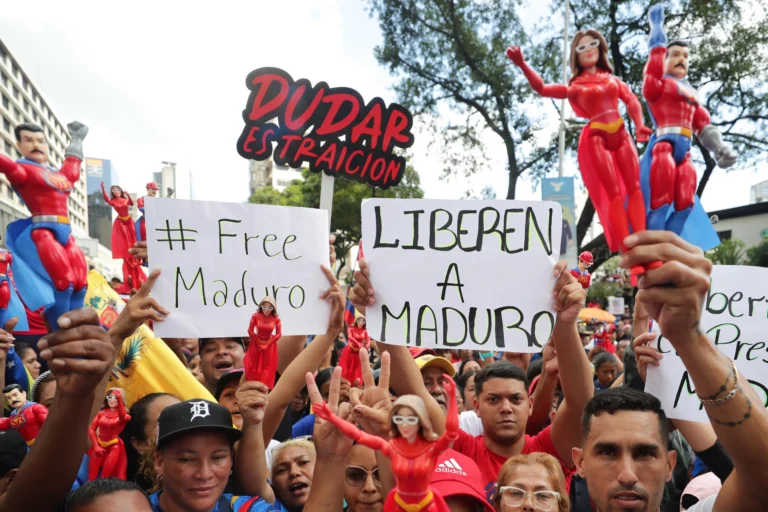
People hold signs and figures of Venezuelan President Nicolás Maduro and his wife, Cilia Flores, during a march this Sunday in Caracas, Venezuela. Photo: EFE/ Ronald Peña R
January 4, 2026 Hour: 4:47 pm
Venezuela is preparing a decree of foreign shock in the wake of the kidnapping by the United States of the constitutional president of Venezuela, Nicolas Maduro, and his wife, Cilia Flores.
RELATED:
This legal figure, contemplated in the Venezuelan Constitution and developed in the Organic Law on States of Exception, seeks to activate the entire nation and its institutions to respond to attacks against the country.
This measure seeks to provide the Venezuelan State with legal tools to defend its sovereignty against imperial threats and another possible military actions by Washington.
The Venezuelan framework —established in the Organic Law on States of Exception of 2001— requires approval from the National Assembly within eight days, constitutional control by the Constitutional Chamber of the Supreme Tribunal of Justice (TSJ) within ten days, and expressly prohibits the suspension of 14 fundamental rights, in line with the American Convention and the International Covenant on Civil and Political Rights.
According to Article 14 of the Organic Law on States of Exception, a state of external commotion may be decreed “in the event of an external conflict that seriously endangers the security of the Nation, its citizens, or its institutions.”
This measure is activated when there is a threat to territorial integrity, national sovereignty, or institutional stability originating from abroad.
The decree, which must be issued by the President in the Council of Ministers, has an initial duration of up to 90 days, extendable for another 90 days, provided it has the approval of the National Assembly.
During this period, the Executive may adopt extraordinary measures in the social, economic, political, or ecological spheres, even if these imply the temporary limitation of certain constitutional guarantees—although never of fundamental rights such as life, personal freedom, physical integrity, or due process, expressly protected by Article 7 of the law and by international human rights treaties.
Venezuela’s state of external upheaval has equivalents in multiple democratic systems in the region. The state of siege is an exceptional measure regulated in several countries, including Argentina, Mexico, Bolivia, Chile and Spain, which allows the government to temporarily restrict certain rights and freedoms in situations of serious crisis or threat, such as internal commotion, external attack, invasion or disturbance of the constitutional order.
While procedures and requirements vary from country to country, approval by the Congress or Legislative Assembly is generally required, and the principles of proportionality, necessity, temporality and institutional control must be respected, in accordance with international law.
Source: teleSURtv.net
