




Venezuela Boosts Energy Sector with Repsol, Eni Strategic Agreements
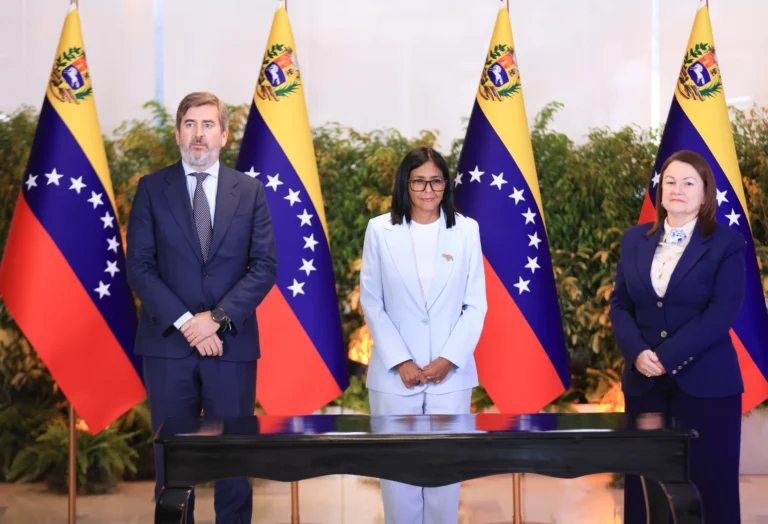
From the headquarters in Caracas of the Venezuelan state oil company, Delcy Rodriguez, accompanied by the new minister of hydrocarbons, Paula Henao, and the president of PDVSA, Héctor Obregon, welcomed the Director General of Exploration and Production and member of the Executive Committee of Repsol, Francisco Gea Pascual de Riquelme. Photo: Venezuelan Presidential Press.
March 12, 2026 Hour: 6:25 pm
Acting President Delcy Rodriguez emphasized that the Cardon IV Project is not only a key piece for domestic industrial development, but also a pillar for Venezuela’s insertion in the global hydrocarbon market.
The Venezuelan Government formalized on March12 the signing of a new strategic energy agreement with the Spanish Repsol Company and the Italian Eni Company for the development of the called Cardon IV Project, one of the most important gas projects in the Latin American region.
RELATED: Venezuela Rallies in Defense of National Sovereignty and Peace
Acting President Delcy Rodriguez spearheaded the signing ceremony, emphasizing the profound importance of this alliance for Venezuela’s energy sovereignty and the stability of the international market, with recently consolidated key alliances with other industry giants such as the multinational Shell in the context of the Reform of the Hydrocarbons Law approved on January 29 that boosts the legal security of the country.
In this sense, Rodriguez underscored that the Cardon IV Project is not merely a key component for internal industrial development but also a cornerstone for Venezuela’s integration into the global hydrocarbon market.
During the event, Rodriguez extended gratitude to Repsol and Eni Companies for their unwavering commitment, acknowledging that they “have stood with the Venezuelan people in the hardest times.”
She highlighted that the agreement is “the product of that joint work”. “It is not only guarantees the supply of gas to our country for national development and domestic consumption but also permits expansion for exportation, setting Venezuela on the path to become a gas-exporting nation”, she detailed during the ceremony.
In a gesture of diplomatic appreciation, Rodriguez thanked the representatives of the European multinationals for maintaining their operations on Venezuelan soil, despite the considerable external pressures experienced in recent years.
“On behalf of the Venezuelan people, I give thanks and tell you: there is a working team here”, she conveyed.
Rodriguez also commended the boards of directors of Petroleos de Venezuela (PDVSA, in Spanish) and PDVSA Gas, signaling a broader commitment to strengthen joint ventures and mixed companies within the oil sector.
Venezuela’s Global Energy Role
The agreements will ensure the continued provision of gas to the Venezuelan people, and also will facilitate that the Bolivarian country can evolve into a major gas exporter, diversifying its economic landscape and enhancing its role in the global energy sector.
As Rodriguez explain, The objective is to increment production, translating into tangible benefits for the Venezuelan people, as well as for the peoples of Spain, Italy, and other nations requiring energy resources, consolidating Venezuela as a reliable and secure energy provider on the international stage.
“Venezuela’s compass, as a proud member of OPEC and OPEC+, points firmly north towards guaranteeing a reliable supply of energy”, stated Rodriguez, underscoring the nation’s long-standing dedication to global energy security.
In this sense, the Venezuelan Acting President reaffirmed Venezuela’s fundamental role within OPEC and OPEC+ and she asserted that the guiding principle of Venezuelan oil policy is to ensure a reliable energy supply, to contribute to the balance of the international economy, and to foster multipolar cooperation within the energy sector.
The re-engagement with European firms like Repsol and Eni demonstrates a clear strategy to attract foreign investment, modernize infrastructure and restore production levels and marks a significant encounter for all interested nations, signifying a crucial inflection point in Venezuela’s energy and diplomatic policy. After years of U.S. unilateral coercive measures that severely impacted its oil production and international partnerships, Venezuela is actively repositioning itself on the global energy stage.
Author: Laura V. Mor
Source: Venezuelan Presidential Press

