


US Military Interventions: Imperialism Sacrifices Dominican Sovereignty, 1965
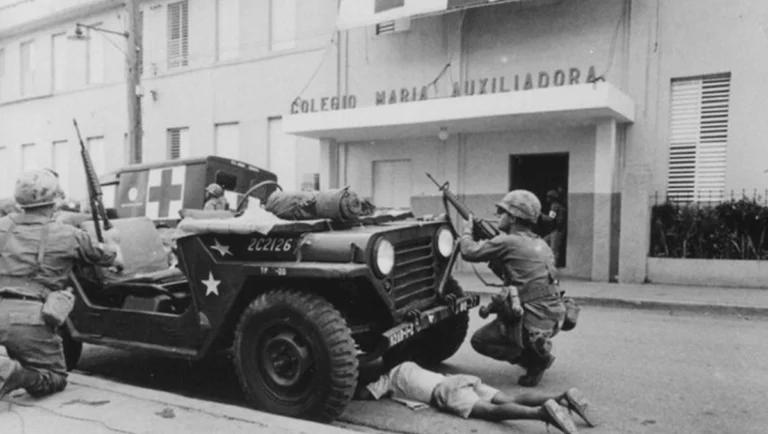
Santo Domingo, Dominican Republic, 1965. X/ @USArmyCMH
January 6, 2026 Hour: 12:25 pm
How 42,000 Soldiers Erased the 1963 Constitution and Installed a Subservient Regime
History in Latin America rarely moves in straight lines. It turns in cycles of emancipation and repression, of peoples rising and empires retaliating.
RELATED:
The U.S. and Its History of Invading LATAM Countries
To understand the shockwave that shook Caracas on January 3, 2026, one must look back sixty years to the streets of Santo Domingo.
“Operation Southern Spear,” the U.S. military assault that dismantled Venezuelan air defenses and captured President Nicolás Maduro, was no anomaly. It was the 21st-century echo of an old imperial tune: the Monroe Doctrine reborn under a new name.
In 1965, the pretext was stopping “another Cuba.” In 2026, it’s fighting “narco-terrorism” and “safeguarding democracy.” The song changes, but the rhythm remains the same.
For Washington, such incursions are “humanitarian missions” or “peacekeeping operations.” In reality, they sacrifice sovereignty at the altar of U.S. control.
Just as the Organization of American States (OAS) legitimized the invasion of the Dominican Republic six decades ago, today we see a fractured continent facing the same imperial arrogance.
This article revisits the 1965 U.S. occupation of the Dominican Republic, to understand what has and has not changed in Latin America’s long struggle for independence.
A Broken Democratic Spring: The 1963 Coup
The U.S. invasion of 1965 did not emerge from nowhere. It was the violent backlash against a brief democratic awakening.
After the 1961 assassination of dictator Rafael Trujillo, the Dominican Republic tried to shake off three decades of tyranny.
Hope arrived in 1962 when Juan Bosch, a writer and social reformer, won the first free elections in 30 years. His victory marked a new beginning for farmers, workers, and intellectuals who had long been silenced by fear.
Bosch’s 1963 Constitution became the symbol of a new era. It guaranteed civil rights, curbed military privilege, and promised land reform. However, for the oligarchy, comprising landowners, generals, and clergy, this democratic challenge to their dominance was intolerable.
With Washington’s approval, they overthrew Bosch just seven months after his inauguration. A military junta known as the “Triumvirate” took power, enriching itself while dismantling the country’s fragile institutions.
Between 1963 and 1965, more than 300 protests erupted across the nation. The popular discontent simmered until it erupted into what became known as the April Revolution.
The April Revolution: A People’s War for Dignity
On April 24, 1965, the Dominican people rose. Soldiers, students, and workers united around a simple demand: restore the 1963 Constitution and bring back Juan Bosch.
Colonel Francisco Alberto Caamaño Deñó emerged as the leader of the Constitutionalist forces, a rare alliance between progressive soldiers and the popular classes. Throughout Santo Domingo, ordinary citizens manned barricades, organized militias, and resisted against overwhelming odds.
In neighborhoods like Ciudad Nueva and San Carlos, women like Hilda Gautreaux and Yolanda Guzmán played central roles, carrying weapons, nursing the wounded, and defending the revolution’s ideals. For a brief moment, the divisions between class and uniform dissolved in pursuit of national dignity.
It was, as Caamaño declared, “a fight not just for one man or one government, but for the soul of the Republic.”
Operation Power Pack: When Empire Unmasked Itself
When the loyalist generals failed to defeat the uprising, Washington abandoned the pretense. President Lyndon B. Johnson ordered 42,000 U.S. Marines to occupy the island of 8 million, a staggering show of force under the banner of “preventing another Cuba.”
The invasion divided Santo Domingo in two. U.S. troops established a “security corridor” cutting off the resistance in Ciudad Nueva from the rest of the country. General Bruce Palmer Jr. commanded the operation, which Washington described as a “peacekeeping” mission.
To camouflage the invasion’s unilateral nature, the U.S. used the OAS to create the “Inter-American Peace Force” (IAPF), recruiting soldiers from Latin American dictatorships like Brazil, Paraguay, and Honduras. This diplomatic theater offered legitimacy while keeping all decisions firmly under U.S. control.
Behind this façade of order, atrocities unfolded. “Operation Clean-Up” aimed to crush dissent through sheer terror. Civilians were massacred in working-class neighborhoods, and resistance fighters were executed without trial. Thousands died, proof that “peacekeeping” was a euphemism for occupation.
How Washington Redefined Democracy
By September 1965, the April Revolution lay smothered, not defeated. Washington did not just restore “stability”; it redesigned Dominican democracy in its image.
The U.S. presented four “non-negotiable” conditions for withdrawal:
- Eradicate leftist influence. Any official branded “communist” was banned from politics, effectively excluding reformists and grassroots leaders.
- Disarm the people. The “National Reconciliation Act” enforced total civilian disarmament, neutralizing the popular movement while leaving the old military apparatus intact.
- Install a safe transition government. Diplomat Héctor García Godoy became the provisional president, tasked with defusing revolutionary energies and preparing U.S.-supervised elections.
- Protect foreign investment. “Stability” meant preserving the island as a supplier of raw materials and a reliable ally in Washington’s Cold War front yard.
Through these mechanisms, the 1965 occupation replaced democratic self-determination with a managed democracy, a model later exported across the hemisphere.
Aftermath: The Seeds of 2026
When the last U.S. troops left the Dominican Republic on September 21, 1966, they left behind a “tutelary democracy”: formally independent, structurally dependent.
Joaquín Balaguer, Trujillo’s old ally, won the U.S.-approved elections, ushering in twelve years of repression, censorship, and state terror.
The dreams of 1963, the promise of agrarian reform, civil rights, and justice, were buried under new chains of economic dependency. Yet the spirit of the April Revolution endured, inspiring generations who refused to accept Washington’s tutelage as destiny.
In this sense, 1965 was not a closed chapter; it was a prototype. Each new “doctrine” from Washington, whether anti-communist, anti-terrorist, or anti-narcotic, has served as rebranding for the same imperial prerogative: the right to intervene.
The 2026 strike in Venezuela follows the same logic. Replace Caamaño’s “constitutionalists” with Bolivarian troops, and Johnson’s “peacekeeping” with Trump’s “Southern Spear.”
Our America Resists
Two images, separated by sixty years, now mirror each other: U.S. Marines raising their flag in Santo Domingo, and drones flying over Caracas skies. Both moments reveal the persistence of the Monroe Doctrine, the belief that the Western Hemisphere belongs to Washington.
Yet the response today is different. From Mexico City to Brasília and Bogotá, leaders like Gustavo Petro and Lula da Silva denounce the intervention in Venezuela as an assault not just on one nation, but on Latin America’s dignity.
The region may still be fractured, but it is no longer silent. The spirit of Caamaño’s resistance lives on, in the collective refusal of Nuestra América to remain anyone’s “backyard.”
Sources: teleSUR – Al Jazeera – NYT – El Socialista Centroamericano – Agencia Hondureña de Noticias – Resumen Latinoamericano
Author: Silvana Solano
Source: TeleSUR