




Alarming Signs of U.S. Electromagnetic Interference in the Caribbean
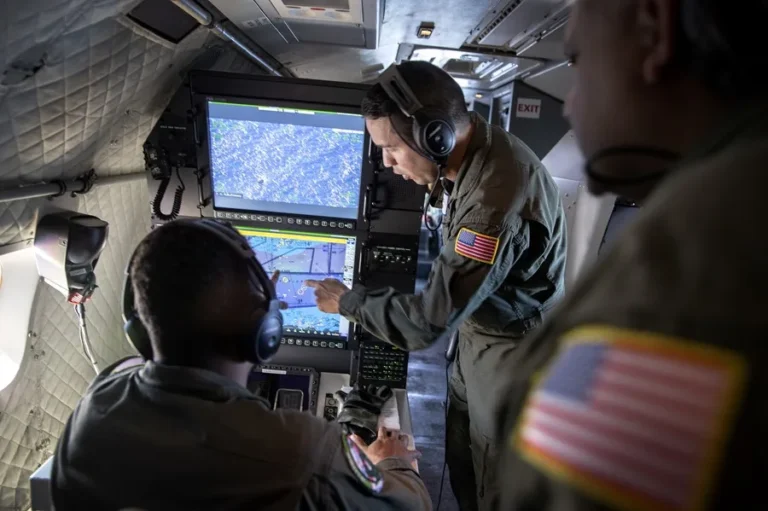
Technical data reveals a “wall of electromagnetic noise” over the Caribbean, coinciding with heightened U.S. military activity and Trump’s airspace closure over Venezuela.
November 29, 2025 Hour: 1:01 pm
Cuba denounces U.S. electromagnetic interference and Trump’s airspace closure over Venezuela as acts of hybrid warfare in the Caribbean.
Related: Cuba Express Gratitude to Venezuela for Support After Hurricane Melissa
U.S. Electromagnetic Interference Caribbean Sparks Regional Alarm
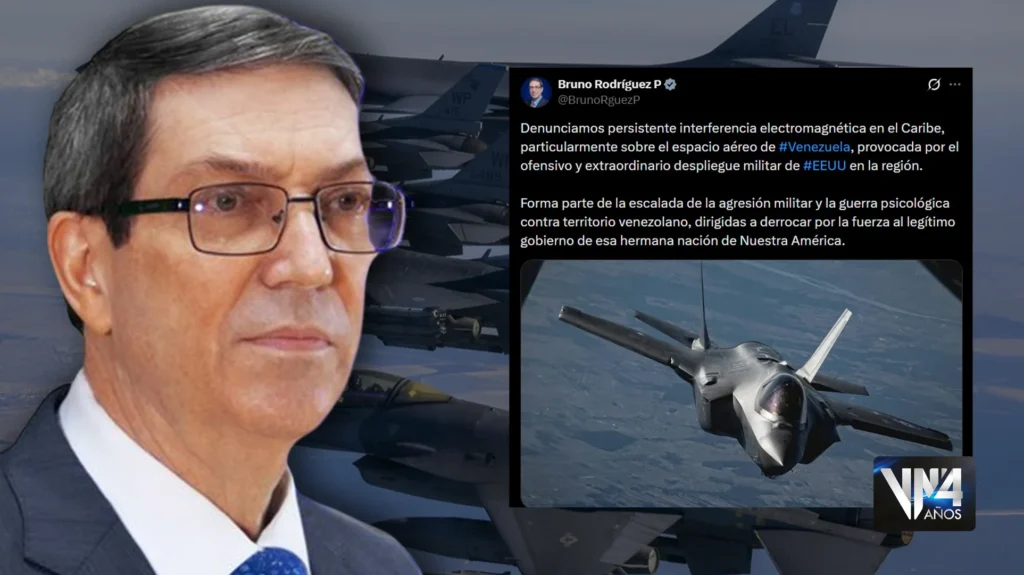
HAVANA — Cuban Foreign Minister Bruno Rodríguez Parrilla issued a stark warning on Saturday, denouncing what he described as persistent U.S. electromagnetic interference across the Caribbean and over Venezuelan territory. The accusation comes amid escalating tensions, as former U.S. President Donald Trump declared Venezuela’s airspace “completely closed”—a move Havana and Caracas label as unilateral, illegal, and part of a broader campaign of psychological and hybrid warfare.
Rodríguez attributed the disruptions to what he called the “offensive and extraordinary U.S. military deployment” in the region. “This electromagnetic interference is not accidental—it is intentional, coordinated, and designed to destabilize,” he stated, adding that such actions form part of a “military escalation and psychological war aimed at forcibly overthrowing Venezuela’s legitimate government.”
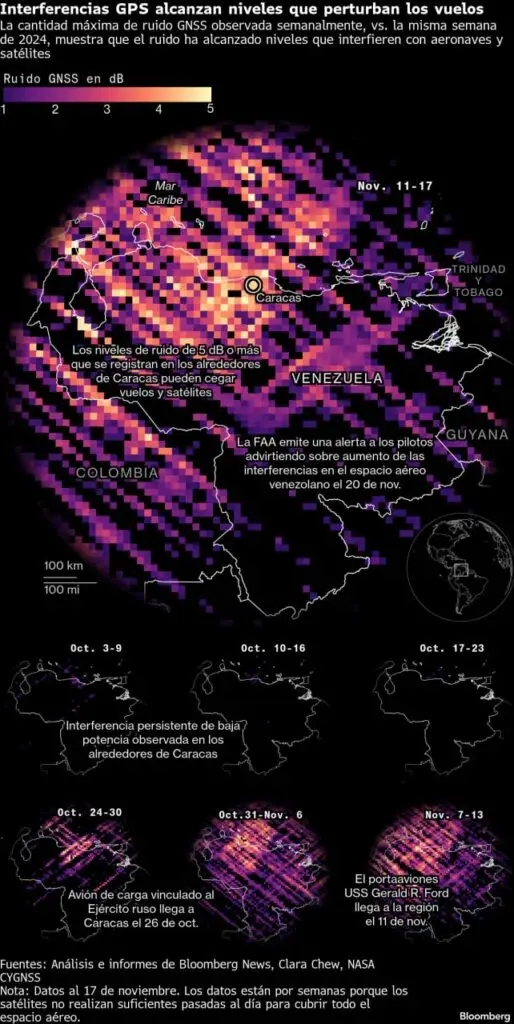
The Cuban government’s warning coincides with reports from Bloomberg and independent monitoring agencies that a “wall of invisible electromagnetic noise” has blanketed the Caribbean in recent weeks. This interference has severely degraded the reliability of Global Navigation Satellite Systems (GNSS)—including the U.S.-run GPS, Europe’s Galileo, and Russia’s GLONASS—rendering standard satellite navigation practically unusable for commercial and civilian aircraft in parts of the region.
U.S. Electromagnetic Interference Caribbean: A New Form of Hybrid Warfare?
According to data analyzed by technical observers, the electromagnetic disturbances began intensifying weeks before Trump’s airspace announcement, aligning with a surge in U.S. naval activity near Venezuela and the eastern Caribbean. U.S. warships equipped with advanced electronic warfare systems—such as the EA-18G Growler aircraft and Aegis-equipped destroyers—are capable of emitting powerful jamming signals that can disrupt communications, radar, and navigation systems over vast areas.
While Washington has not officially acknowledged deploying such capabilities, the effects are measurable. Pilots flying through affected zones have reported complete GPS signal loss, forcing reliance on older, ground-based navigation methods. Maritime operators have noted similar anomalies in AIS (Automatic Identification System) tracking, raising safety concerns for both air and sea traffic.
“This is not just about navigation—it’s about control,” said a regional security analyst who requested anonymity. “By degrading civilian infrastructure, the U.S. creates chaos that can be leveraged politically, especially during sensitive moments like elections or diplomatic negotiations.”
Learn how GNSS jamming affects global aviation safety (International Civil Aviation Organization)
Compounding the issue, the U.S. Federal Aviation Administration (FAA) recently issued a notice advising airlines to “exercise extreme caution” when operating in the Maiquetía Flight Information Region—which covers much of northern Venezuela—citing “deteriorating security conditions and increased military activity.” The advisory, valid until February 19, 2026, warns of potential risks to aircraft during all phases of flight, including on the ground.
Critics argue this FAA warning—combined with Trump’s blanket airspace closure—creates a self-fulfilling prophecy: by declaring the area dangerous, the U.S. justifies further military presence, which in turn generates the very risks it claims to address.
Review FAA’s official advisory on Venezuela airspace risks (Federal Aviation Administration)
Trump’s Airspace Closure: Sovereignty Under Siege
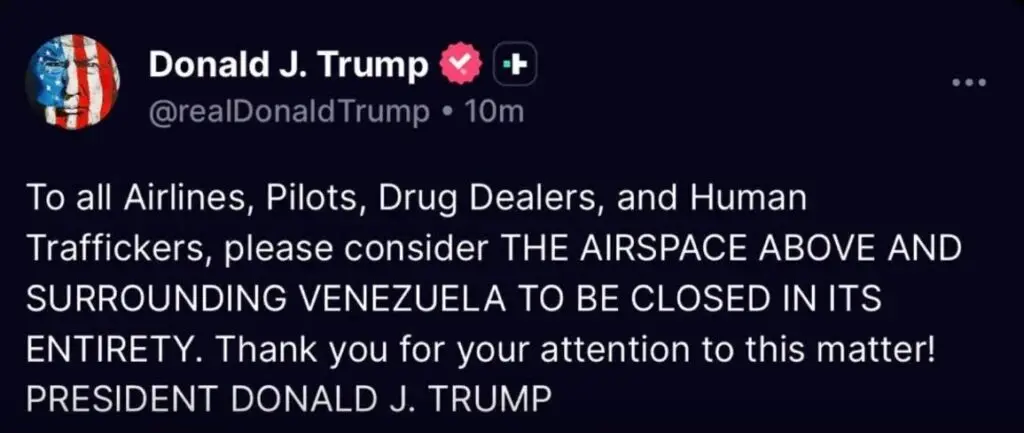
In a post on Truth Social, Donald Trump announced the “total closure” of Venezuelan airspace, urging all international airlines to treat the zone as “completely closed.” He cited combating drug trafficking and human smuggling as justification—yet notably, the U.S. government continues to request special permissions for its own repatriation flights into Caracas, a double standard that Venezuela has fiercely condemned.
“Washington tells the world not to fly to Venezuela while demanding exceptions for its own aircraft,” said a Venezuelan Foreign Ministry spokesperson. “This is not about safety—it’s about economic suffocation and political coercion.”
The move effectively strangles Venezuela’s already fragile civil aviation sector, cutting off international connectivity for thousands of passengers and isolating the country diplomatically. At a time when Venezuela is hosting major regional events and deepening ties with Global South nations, the airspace blockade serves as a non-kinetic barrier to reintegration.
Cuba and other ALBA-TCP nations argue that such actions violate international air law, particularly the Chicago Convention, which guarantees states’ sovereignty over their airspace while requiring transparent, multilateral coordination for any restrictions. Unilateral closures by foreign powers, they insist, set a dangerous precedent.
Geopolitical Context: The Caribbean as a Contested Zone of Influence
The U.S. electromagnetic interference Caribbean campaign must be understood within Washington’s long-standing strategy to maintain hegemony over its “near abroad.” Historically, the Caribbean has been treated as a U.S. sphere of influence, from the Monroe Doctrine to Cold War interventions. Today, that doctrine is being reasserted through hybrid means: sanctions, cyber operations, airspace control, and electronic warfare.
The recent actions target not only Venezuela but the broader anti-imperial alignment forming in Latin America and the Caribbean. With nations like Cuba, Nicaragua, Venezuela, and even progressive governments in the English-speaking Caribbean deepening South-South cooperation, the U.S. perceives a loss of strategic control.
Electromagnetic interference is particularly insidious because it is deniable, reversible, and difficult to attribute—making it ideal for coercive diplomacy without triggering open conflict. Yet its impact is profound: it paralyzes civilian infrastructure, fuels economic instability, and creates pretexts for further intervention.
For regional organizations like CARICOM and CELAC, this represents a direct challenge to sovereign autonomy. If a single power can unilaterally degrade navigation and communications across international waters and airspace, the very notion of multilateral order is undermined.
Author: JMVR
Source: Agencias
