


U.S. Interference in Venezuela: History, Strategies, and Resistance Against Imperialist Interventionism
August 25, 2025 Hour: 9:16 pm
In recent weeks, U.S. foreign policy has reiterated its clear intention to undermine the sovereignty and stability of the legitimate government of Nicolás Maduro in Venezuela.
With crescent maneuvers from the Pentagon and an increasingly aggressive discourse, Washington has revitalized a narrative that seeks to criminalize Venezuela, putting on the table an increased reward for Maduro’s capture and the public denunciation of his alleged ties to the so-called “Cartel of the Suns,” an organization that, according to the U.S. account, is dedicated to drug trafficking specifically targeting its territory.
The Resurgence of the Drug Trafficking Narrative as an Imperial Tool
This narrative of the “Cartel of the Suns” has become a pretext for the renewed U.S. campaign of the “war on drugs.” Despite the dramatic addiction crisis gripping American society, with devastating consequences caused by decades of mass consumption of fentanyl and cocaine, Washington has decided to focus this issue by using Venezuela as a scapegoat.
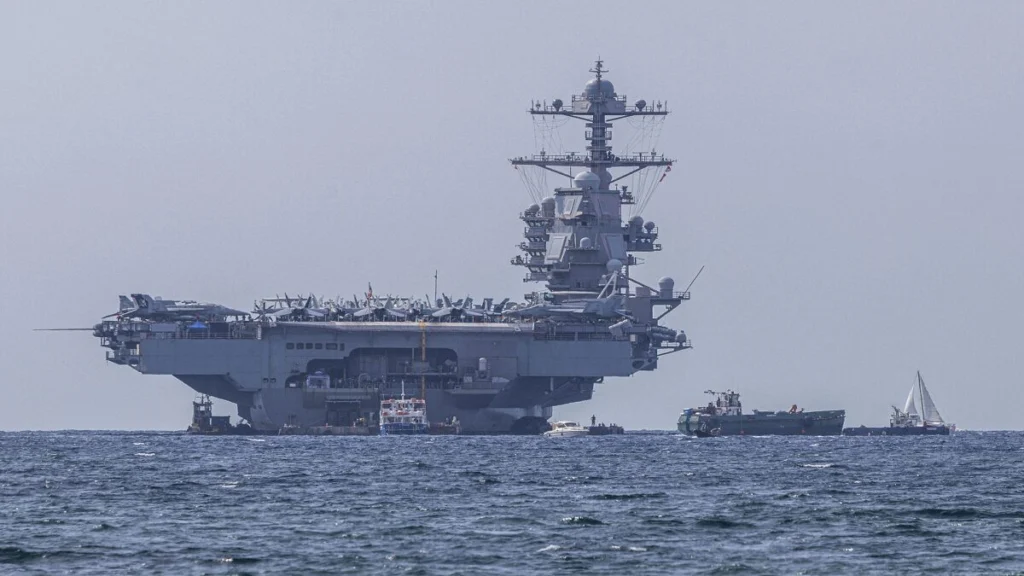
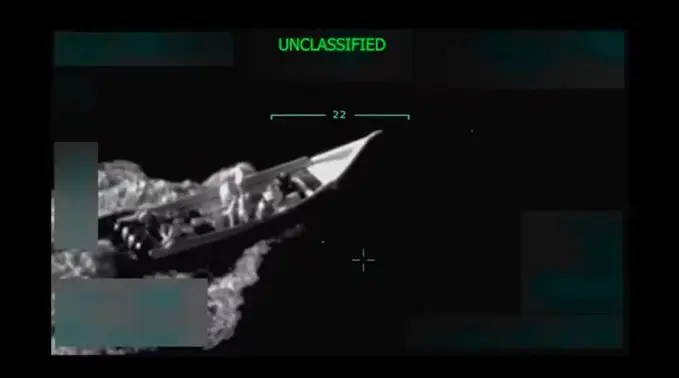
In the third week of August 2025, the United States deployed three warships to the Caribbean, specifically off the coast of Venezuela, under the official excuse of combating drug trafficking.
According to critical analysts, this operation is interpreted not only as an action against criminal networks but as a geopolitical maneuver to increase pressure on a country that challenges U.S. hegemony and has significant ties to emerging world powers and global counterweights, such as Russia and China.
The 2002 Coup and the Early Offensive Against the Bolivarian Revolution
To understand how we arrived at this situation, it is important to go back to one of the key moments in Venezuelan politics and U.S. interference: the April 2002 coup against Hugo Chávez.
Chávez’s rise to power in 1999 meant a radical change for Venezuela, a country with enormous oil revenue and the historical attention of international actors interested in its natural resources and its strategic position in Latin America.
Chávez not only openly questioned the unipolar world order led by the United States but also implemented a novel policy of South-South cooperation, strengthening alliances with countries that Washington considers adversaries, such as Iran, Libya, Russia, China, Cuba, and Nicaragua. This anti-imperialist turn within Venezuelan foreign policy alarmed the White House and its regional allies, triggering an agenda to curb what they labeled a “communist risk.”
The coup d’état of April 11, 2002, was the first concrete and bloody act of this agenda, with direct support from the Bush Administration and its covert power structures, such as the National Endowment for Democracy (NED) and the CIA.
Funding and technical assistance were key to the emergence and strengthening of anti-Chavista opposition sectors, such as the Center for the Dissemination of Economic Knowledge (CEDICE), the Venezuelan Workers’ Confederation (CTV), and numerous NGOs, which contributed to the narrative and execution of the coup.
During Chávez’s brief overthrow, U.S. representatives publicly expressed their support and stated that it was an action “orchestrated by the Venezuelan people,” a completely biased reading divorced from reality, given that the coup was neutralized by popular sectors and military forces loyal to the Bolivarian commander.
This media and diplomatic manipulation was fundamental to constructing the narrative that portrayed Chávez’s government as a “dictatorship” that needed to be ended.
Economic Warfare: Blockade and Sanctions, the Invisible Weapon to Strangle Venezuela
While direct military aggression failed to achieve its objectives, the United States resorted to economic warfare as the primary tool to overthrow Maduro’s government and punish the Venezuelan population.
Sanctions began timidly in 2005, but it was under the administration of Donald Trump that they were massively and systematically intensified, causing irreversible damage to Venezuela’s economy and social welfare.
Falsely labeled as “smart sanctions” to justify their application, these measures prohibited the purchase of Venezuelan debt and banned transactions related to PDVSA, the vital arm of the national economy through oil sales.
Furthermore, they sanctioned strategic economic sectors and key officials, preventing access to international markets and essential credit for importing food, medicine, and basic goods.
The immediate effect has been a brutal fall in oil production, the country’s main source of foreign currency, the destruction of national industry, and the worsening of the humanitarian crisis. International organizations, researchers, and NGOs have corroborated that the sanctions have caused an increase in extreme poverty, a massive emigration of over seven million Venezuelans, and the collapse of essential services like healthcare and education.
This collective punishment, far from incentivizing democratic change, has caused profound social damage and fueled the suffering of the population, especially the most vulnerable sectors, confirming that the official U.S. discourse, which seeks to “fight corruption” and promote democracy, is in reality a strategy for geopolitical and economic control over Venezuela.
The Role of Juan Guaidó: Media Strategy to Legitimize a Soft Coup
Parallel to the economic war, the Venezuelan opposition articulated a political strategy that had the explicit backing of the United States to try to displace the Bolivarian government.
Under the leadership of Juan Guaidó, a deputy of the Voluntad Popular party, the partially and illegally declared opposition-majority National Assembly rejected the legitimacy of Nicolás Maduro as president.
On January 5, 2019, the Assembly declared Maduro’s government a “usurpation,” and weeks later, on January 23, Guaidó proclaimed himself interim president in an act that was immediately recognized by the Trump administration and various allied countries.
This action was the main “soft coup” in the U.S. strategy to overthrow the Venezuelan constitutional regime without using direct military forces.
This recognition accelerated measures of political, financial, and media pressure against the legitimate government, seeking to isolate it internationally.
The White House stated that it maintained a commitment to use “the full weight of U.S. economic and diplomatic power” to restore what it called “democracy” in Venezuela, positioning Guaidó as the legitimate “new government” despite lacking effective territorial or institutional control.
This episode highlighted the geopolitical complicity of the United States and its allies in mediating and promoting a narrative that delegitimizes Venezuelan democracy, while privileging hegemonic interests and external intervention disguised as the defense of human rights.
“Operation Gideon”: Paramilitary and Mercenary Attempt to Overthrow the Government
The year 2020 brought a new dramatic episode: the so-called “Operation Gideon.” This was a paramilitary maritime incursion denounced by the Venezuelan government as a coup attempt and a setup to assassinate high-ranking officials. Organized by former U.S. military personnel and mercenaries hired by private companies like Silvercorp USA, the operation was quickly neutralized by the Bolivarian National Armed Forces (FANB).
In addition to Venezuelans, two former U.S. soldiers arrested on Venezuelan soil participated in this incursion. Investigations detailed that there was funding and planning from Colombia and the United States, and that one of the key operatives was Jordan Goudreau, a former U.S. Green Beret.
The Venezuelan government denounced that opposition leaders like Juan Guaidó and others signed contracts with Silvercorp for the development of this violent plan, thus revealing the coordination between internal and external elements willing to overthrow the Bolivarian government through irregular means.
This failed attempt evidenced the increasingly direct militarization of anti-Chavista politics, as well as the persistence of the United States in promoting destabilization through unconventional acts that threaten peace and stability in Venezuela.
The 2025 Naval Operation in the Caribbean: The “War on Drugs” as an Excuse for Aggression
In August 2025, the United States has carried out a naval deployment in the Caribbean again under the justification of the “fight against drug trafficking.” This operation brought with it aggressive rhetoric against Venezuela, labeling it a “narco-state” and presenting Nicolás Maduro as an international “fugitive” and criminal.
Military and political analysts warn that these actions go beyond combating organized crime. It is a multifaceted strategy that includes military, psychological, and diplomatic pressure to prepare the ground for potential military operations or more open interventions.
Declaring the “Cartel of the Suns” an international terrorist organization not only pursues the goal of criminalizing the Venezuelan government but also creates a legal framework that could justify military interventions in the name of “hemispheric security,” a clear violation of international law.
Faced with these threats, the Maduro government announced the massive mobilization of militias, defining a national strategy of “Popular War of Resistance” based on the unity between civilians and armed forces, reaffirming its commitment to the defense of sovereignty and self-determination.
Various countries around the world have strongly rejected the U.S. escalation. Mexico, Cuba, Russia, China, and Colombia have condemned the increase in military presence in the Caribbean and have called for peaceful paths for conflict resolution, reaffirming the principle of non-intervention.
Venezuela and the Struggle Against Imperialist Interference
The set of operations, sanctions, media campaigns, and military actions that the United States has deployed against Venezuela from 2002 to the present shows a clear pattern of interventionism that seeks to break independence and sovereign political projects in the region.
The construction of alarmist discourses about drug trafficking and dictatorships hides the instrumentalization of these issues to advance geopolitical and economic objectives.
Faced with this reality, Venezuela has maintained a firm stance of popular and military resistance, defending its right to exist and govern itself without external impositions.
International solidarity and the constant denunciation of interventionism are fundamental to counter these aggressions that affect not only Venezuela but all of Latin America and the Caribbean as a historical territory of anti-imperialist struggles.
The future of Venezuela cannot depend on foreign agendas or self-interested media campaigns, but on the full exercise of its sovereignty, with social justice, real democracy, and unrestricted respect for human rights.
This will only be possible when the international community recognizes and respects the inalienable right of peoples to self-determination, removing the structures of power and domination that still operate today under the masks of “democracy” and the “war on drugs.”
Author: Silvana Solano
Source: TeleSur