




Venezuela’s Acting President: No Kneeling to US Power
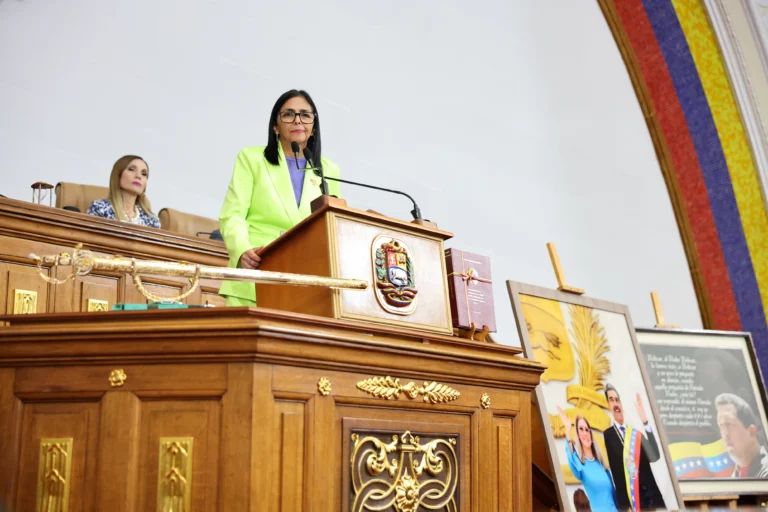
Photo: Presidential Press Office of Venezuela
January 15, 2026 Hour: 6:30 pm
In a powerful and unyielding address to the National Assembly this Thursday, Venezuela’s Acting President, Delcy Rodriguez, delivered a pivotal annual message that reverberated with the core tenets of the Bolivarian Revolution: an ardent commitment to nationalism and the steadfast defense of the nation’s sovereignty.
Rodriguez’s discourse underscored Venezuela’s resolute posture, particularly when confronting the recently intensified geopolitical friction with the United States.
She explicitly accused U.S. forces of orchestrating the “kidnapping” of President Nicolas Maduro and First Lady Cilia Flores on January 3rd, a grave accusation that set the stage for her comprehensive articulation of Venezuela’s approach to international relations and national dignity.
Her speech was not merely an update but a strategic declaration, designed to reinforce internal unity and project an image of unyielding resolve on the global stage.
Upholding the Pillars of Venezuelan Sovereignty
Acting President Rodriguez’s address served as a potent reaffirmation of Venezuela’s inherent right to self-determination, a principle deeply embedded in the ethos of the Bolivarian Revolution.
She meticulously detailed how the current administration, under the leadership often associated with President Maduro, consistently prioritizes the protection of its territorial integrity, political independence, and the autonomous decision-making processes that define a sovereign state.
Rodriguez emphasized that this potent nationalistic spirit transcends mere political rhetoric; it is, she asserted, the fundamental guiding force behind all governmental actions, domestic policies, and international engagements, specifically aimed at fortifying the nation against perceived external pressures and various forms of foreign intervention.
The Bolivarian government, since its inception, has consistently positioned itself as a vigilant bulwark against what it frequently describes as imperialistic ambitions, particularly from Western powers.
This historical context provides a crucial lens through which to understand the unwavering emphasis on sovereignty articulated by Rodriguez, a recurring theme in Venezuelan political discourse.
Accusations and Diplomatic Intent
A substantial portion of Rodriguez’s compelling address was dedicated to the acutely strained relationship between Caracas and Washington.
She pointedly referenced an incident of profound gravity: the alleged “kidnapping” of President Nicolás Maduro and First Lady Cilia Flores by U.S. forces, which she stated occurred on January 3rd.
This serious accusation, if substantiated, marks a dramatic escalation in an already tense bilateral relationship, moving beyond economic sanctions and political pressures to direct action against the head of state.
Rodriguez articulated a dual strategy for addressing this perceived aggression: while Venezuela is committed to confronting such challenges through robust diplomatic channels, she asserted unequivocally that the nation’s sovereignty remains an absolute, non-negotiable principle.
Her message was thus a nuanced blend of seeking peaceful resolution through dialogue, while simultaneously conveying an ironclad resolve against any form of subjugation or external imposition.
The mention of the January 3rd incident, presented as a clear act of hostility, underscores Venezuela’s perception of targeted and extreme measures from Washington, further complicating the already precarious diplomatic landscape between the two nations.
“Standing, Never Crawling”
Despite the severity of the accusations leveled against the United States and the stated intent for diplomatic engagement, Acting President Rodriguez left no ambiguity regarding the conditions under which Venezuela would participate in any potential dialogue with the U.S. government, specifically mentioning the administration of President Donald Trump.
She declared with profound conviction that any such interaction, even if it necessitated a journey to Washington D.C. for “conversations or contacts,” would transpire strictly on Venezuela’s terms and with an unyielding sense of national pride and dignity.
Her hypothetical description of such a visit was imbued with potent imagery and an unmistakable spirit of defiance.
In a moment of striking eloquence, Rodriguez’s resolve found its voice in a direct and powerful statement: “And I tell you, if one day I have to go to Washington as Acting President, I will do it standing, walking, not crawling; I will do it with the tricolor flag, I will do it with the glory of the brave people marking the rhythm of my heart”.
“It will be standing, never kneeling or crawling. It will be standing, which is what corresponds to a Venezuelan man or woman who stands tall.”
This quote serves as the definitive encapsulation of her broader message: an unwavering insistence on mutual respect, equality, and national honor in any and all diplomatic engagements.
It firmly reinforces Venezuela’s non-submissive posture in the face of perceived superpower arrogance, signaling that while dialogue is open, capitulation is not an option.
Such a stance is consistent with the Bolivarian government’s long-standing narrative of resisting external pressures and defending national dignity against perceived hegemony.
Author: MFD
Source: teleSUR English

