


Oscar Speeches Challenge the Politics of Fear
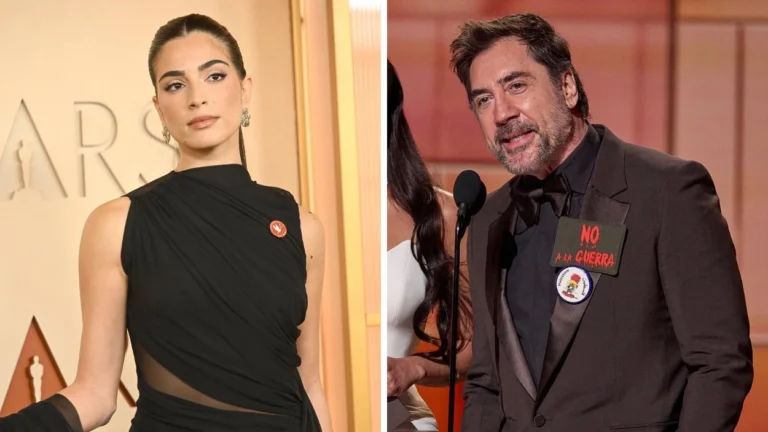
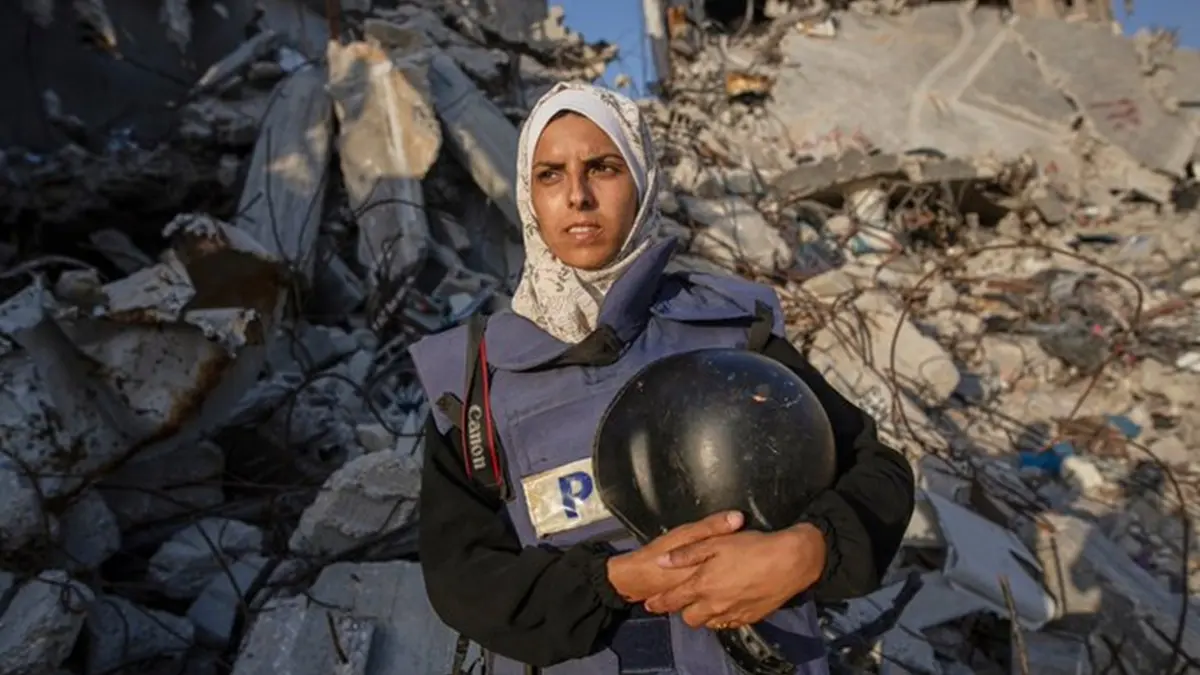
Saja Kilani, and Javier Bardem at the Oscars
March 16, 2026 Hour: 2:55 pm
Artists push back against censorship and the militarization of culture.
The 98th Academy Awards, held on March 15, 2026, will be remembered for the political moments that broke through the Hollywood façade. Inside the glowing Dolby Theatre, a familiar scene played out: gowns, spotlights, and rehearsed smiles.
RELATED:
Over 80 Artists Urge Berlinale to Take Stance on Gaza Genocide
Yet outside, and even within the ceremony’s speeches, a different reality pressed in: war in West Asia, a domestic crackdown on immigrants, and an administration showing growing intolerance toward dissent.
For many global viewers with a critical eye, the Oscars became more than entertainment. It was a stage where some artists used their spotlight to resist U.S. foreign policy and question state-backed violence, even under heavy security and quiet censorship.
The Architecture of Fear: Deconstructing the “Drone Threat”
The most striking image of the night was not found on the red carpet but in the skies above it. A massive security operation known as the “Iron Ring” turned Hollywood Boulevard into a fortified zone.
The escalation followed an FBI memo from March 11, 2026, warning of “unverified” intelligence about possible Iranian drone strikes on California.
The timing of that memo seemed suspicious. Released only days before the Oscars, its vague claim of a potential attack appeared to create a climate of fear, one that conveniently justified an extreme show of security.
This “drone threat” narrative served two key purposes:
- Justifying force: Authorities deployed more than 1,000 private guards, SWAT teams, and surveillance drones. A cultural event became a stage for domestic military display.
- Silencing dissent: The heavy perimeter kept anti-war demonstrators far from the venue, while officials invoked the “external enemy” narrative to pressure media outlets seen as too critical of U.S. policy.
Despite the militarized atmosphere, the truth behind America’s ongoing strikes in Iran still found its way into the ceremony. Artists repeatedly challenged the idea that “national security” can excuse endless war or domestic repression.
Breaking the Silence: Bardem, War, And Genocide
The most defiant moment of the evening came from Spanish actor Javier Bardem, who presented the award for Best International Feature. Pinned to his jacket was a black badge reading “No to war”, the same emblem he wore in 2003 against the U.S. invasion of Iraq.
Speaking to reporters, Bardem made clear why he revived that symbol: “I’m wearing this again, 23 years later, for another illegal war,” he said, directly comparing the Iraq invasion’s false claims to the current strikes on Iran.
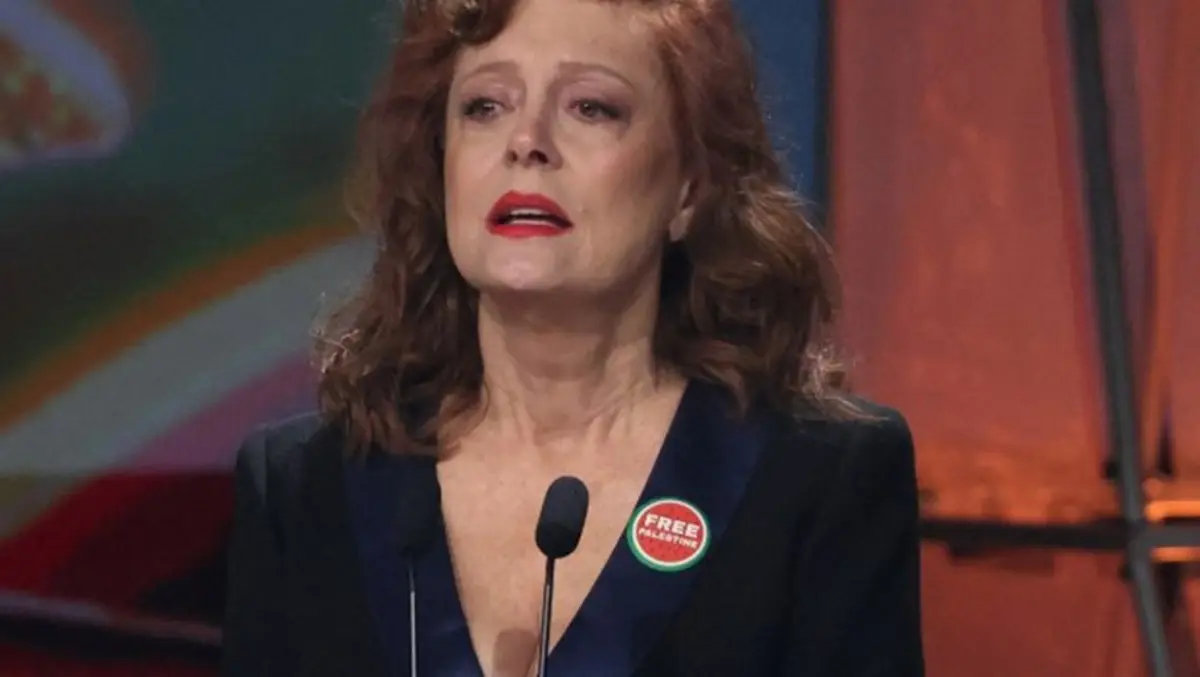
From the stage, his words carried the weight of conviction: “No to war. And free Palestine.” The Handala pin on his lapel, created by Palestinian cartoonist Naji al-Ali, underscored the connection between global struggles against occupation and the wars being justified today.
Bardem’s intervention broke through the enforced “neutrality” of the night, linking the war on Iran to the ongoing tragedy in Gaza as part of the same imperial logic.
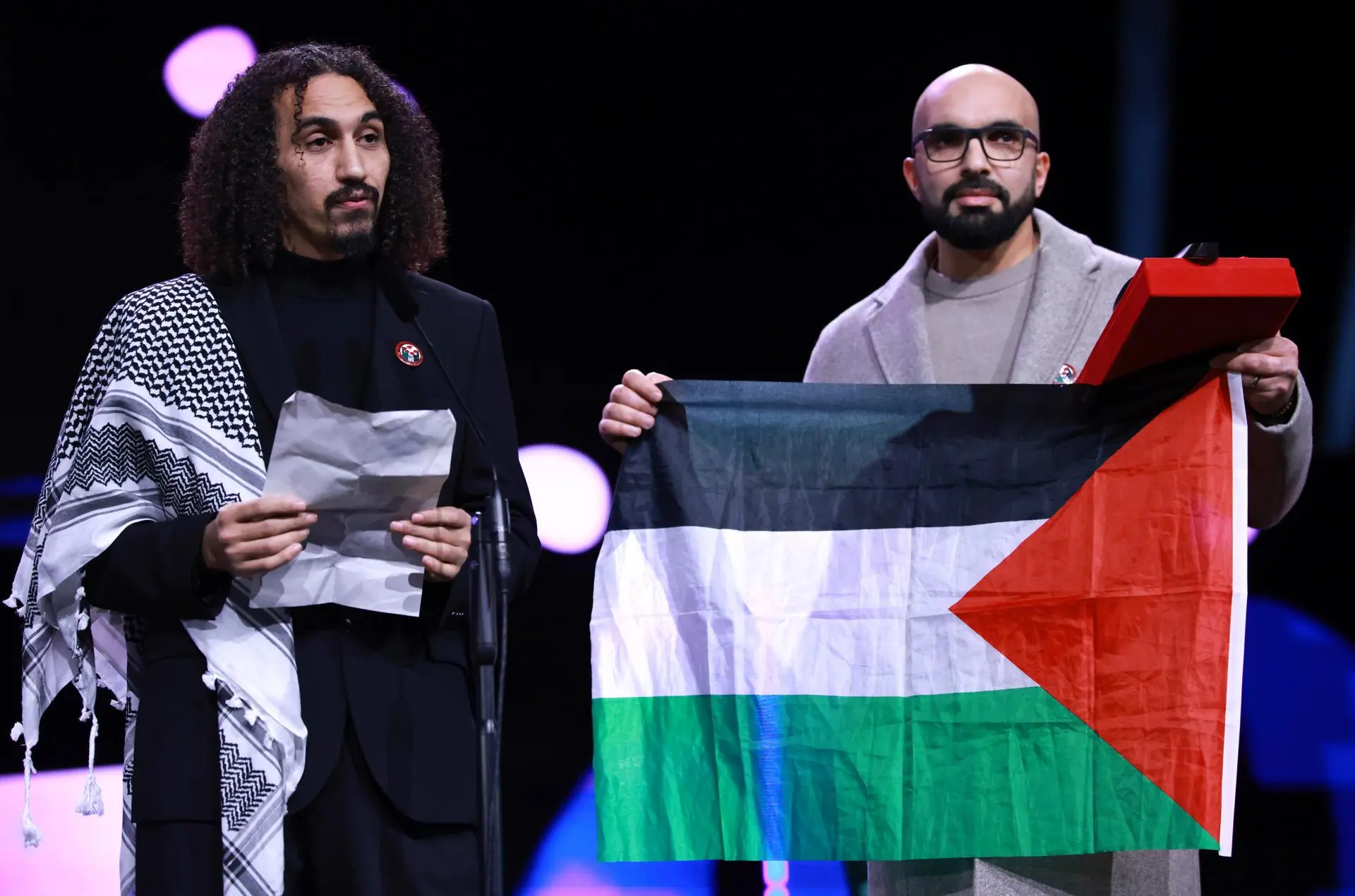
In addition to denouncing war, the team behind the Palestinian docudrama The Voice of Hind Rajab (nominated for Best International Feature) used the red carpet to draw attention to the global nature of these conflicts.
“Bombings are happening today in Palestine, Lebanon, Iran, and Venezuela. We demand a permanent ceasefire,” she said. One of the actresses said.
The red “Artists4Ceasefire” pins are a collaboration with the artist Shepherd Fairy. His art demands a permanent ceasefire because there is no ceasefire right now, said one of the actresses.
Joachim Trier and the Ethics of Accountability
Norwegian director Joachim Trier, accepting the Oscar for Best Original Score in Sentimental Value, used his historic win to push the conversation further.
Quoting James Baldwin, “All adults are responsible for all children”, Trier turned his moment in the spotlight into a challenge to his peers and to politicians.
His message was clear: moral responsibility extends beyond borders. In interviews backstage, Trier spoke openly about the suffering of children in Palestine, Sudan, and Ukraine, connecting their plight to the indifference of world powers.
He referenced his grandfather, a World War II resistance fighter, as a reminder that silence in the face of injustice is complicity.
He closed with a line that resonated far beyond the Dolby Theatre: “Let’s not vote for politicians who don’t take this seriously.” It was both a warning and a call for civic accountability, urging Americans and allies alike to confront the human cost of their governments’ actions.
Domestic Frontlines: “ICE OUT” and Cultural Censorship
While much of the discourse focused on global conflict, several artists turned attention to domestic repression.
On the red carpet, pins reading “ICE OUT” appeared on the clothes of figures like designer Malgosia Turzanska and musician Sara Bareilles.
Their gesture called out the administration’s recent immigration raids and the expansion of detention centers under a militarized policy shift.
The theme carried into the night’s documentary category. Mr. Nobody Against Putin, directed by David Borenstein and Pavel Talankin, won Best Documentary Feature.
In his speech, Borenstein warned of the “quiet erosion” of democracy, the way corporate media concentration and state violence slowly eat away at freedom.
His words drew a parallel between authoritarian tendencies abroad and growing repression within the United States.
Another silent but powerful statement came from an absence. Motaz Malhees, the Palestinian lead actor of The Voice of Hind Rajab, could not attend the Oscars due to expanded U.S. travel bans.
His empty seat symbolized the exclusionary nature of Western “liberal” culture at a moment when voices from Gaza are being deliberately silenced.
Host Jimmy Kimmel also used his monologue to touch on this contradiction, joking about the FCC’s warnings against “anti-regime” comedy.
Beneath the humor, the message was unmistakable: the shrinking space for dissent at home echoes the violence being projected abroad.
Satire as a Shield: Hosting and Dissent
Conan O’Brien, in his Oscars hosting debut, balanced humor with unease. His jokes about the “Iron Ring” and the government’s hypersensitivity to criticism landed somewhere between satire and subversion.
When he quipped about an “alternate Oscars at Dave & Buster’s for those who can not handle politics,” the laughter came tinged with discomfort, it was a reminder of how normalized apathy has become.
Even the night’s big winner, Paul Thomas Anderson’s One Battle After Another, captured the mood of rebellion. Its story of political struggle and moral fatigue, mirrored in the real world more than in fiction.
Despite efforts to maintain the ceremony’s celebratory tone, with nostalgia-driven moments like the Bridesmaids cast reunion, the show could not escape its political undercurrent.
The Cracks in the Hegemon
Despite attempts to sanitize it, the 2026 Oscars revealed the limits of Hollywood’s apolitical illusion. Even behind an “Iron Ring” of security and staged patriotism, voices of resistance broke through.
From Javier Bardem’s revived “No a la guerra” appeal to Joachim Trier’s call for moral accountability, the night exposed growing dissent within the cultural heart of the empire.
As U.S. strikes on Iran continue and Palestinian suffering remains visible, the ceremony showed that artists are no longer willing to stay silent while their governments wage war in their name.
Sources: The Guardian – Al Jazeera – Hackney Gazette – The Economic Time – Screen Daily – Iranian International
Author: Silvana Solano
Source: teleSUR