


Operation ‘Contenção’: The Massacre Exposing Rio de Janeiro Security Crisis
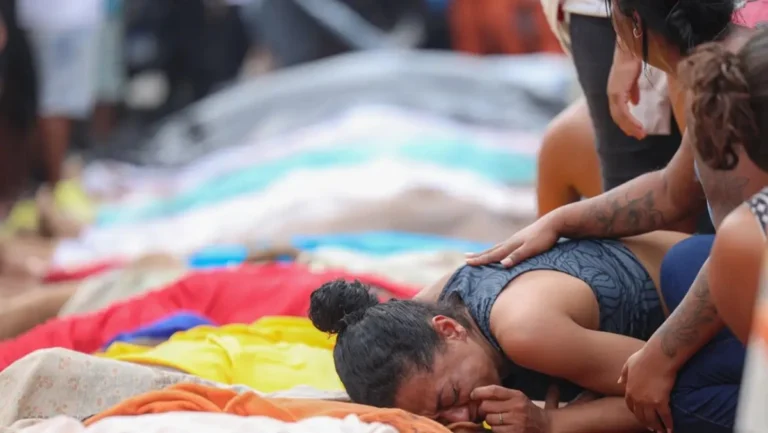
Brazilian woman mourns a loved one killed during the Containment Operation, Rio de Janeiro, Oct. 29, 2025. Photo: RadioAgencia
October 29, 2025 Hour: 3:14 pm
The so-called “Operação de Contenção” (Operation Containment) launched on October 28, 2025, in the Alemão and Penha complexes, was presented by the state government as the largest massacre and police incursion in Rio de Janeiro in fifteen years.
More than 2,500 civilian and military personnel participated with a declared objective: to stop the territorial expansion of the Comando Vermelho (CV), and capture its leaders.
However, what was announced as a surgical offensive ended up becoming the deadliest operation in the city’s recent history.
The Chronicle of a Foretold Massacre
The initial official report listed 64 deaths (60 alleged suspects and 4 officers), but the Public Defender’s Office and community organizations raised the figure to over 130.
Various groups denounced that the police omitted dozens of corpses found by residents themselves in wooded areas of the Complexo da Penha and Alemão.
Urban chaos was immediate. The Operations and Resilience Center raised the alert level to 2 out of 5, while the Comando Vermelho responded with coordinated attacks that paralyzed the Linha Amarela and Avenida Brasil. Schools, hospitals, and businesses closed: 48 educational centers were completely inactive for three days.
International and National Condemnation
The reactions were forceful. The UN Human Rights Council declared itself “horrified” by the extreme lethality and demanded swift and independent investigations.
Human Rights Watch denounced “a policy of extermination,” while Amnesty International warned about the structural impunity that shields police actions in the favelas of Rio.
The scenario, according to local observers, symbolizes the erosion of the Rule of Law in territories where the line separating the State from organized crime becomes blurred.
The Comando Vermelho: From Prison Myth to Narcoterrorism
To understand the background of this offensive, it is necessary to understand the history of the Comando Vermelho (Red Command). Founded in Rio’s prisons during the military dictatorship of the 1970s, the group emerged from contact between common prisoners and political prisoners, who transmitted principles of organization and discipline to them. This alliance gave rise to the narrative of “solidarity” that permeated its initial identity.
Over time, the CV abandoned any political or ideological pretense, consolidating itself as a criminal structure dedicated to drug trafficking, extortion, and territorial control.
During the 1980s, it migrated from bank robbery to international cocaine trafficking, adopting a decentralized structure where each local boss (the so-called “dono do morro” (owner of the hill)) acts with relative autonomy.
In Operation Containment, authorities reported the seizure of 93 rifles and several tons of drugs. But the most alarming aspect was the use of drones equipped with improvised explosives, an unprecedented tactic that Governor Cláudio Castro labeled as “narcoterrorism.” For analysts, this episode marked the first time a Brazilian faction applied techniques typical of asymmetric warfare.
A History Written in Blood: The Pattern of Police Lethality
The 2025 massacre is not an isolated event. It is part of a historical sequence that includes the Jacarezinho massacre (2021, 28 dead), the Vila Cruzeiro massacre (2022, 23 dead), and the Vigário Geral massacre (1993, 21 killed). Rio de Janeiro accumulates one of the highest rates of police lethality in the world.
The victims follow the same pattern: young, black, poor men with no criminal records. In these working-class neighborhoods, police presence translates to fear and death, not protection. The incursions are carried out under an “endless war” model, where officers “enter shooting.”
A former Civil Police officer, cited by the Security Observatories Network, explained that the tactics seek to push criminals into wooded areas, where confrontations are more lethal and less visible. Thus, the geography of the favela becomes an informal battlefield that facilitates covert executions.
The International Dispute Over the Narrative
Amid the shock, the Rio state government presented the administration of President Donald Trump with a report requesting that the Comando Vermelho be classified as a terrorist group with a presence in the United States.
The goal of this diplomatic maneuver is to attract military cooperation and the possible intervention of the Office of Foreign Assets Control (OFAC), which could impose sanctions on CV leaders and linked financial institutions.
However, the federal government of Luiz Inácio Lula da Silva rejected this interpretation. For the Minister of Justice, Ricardo Lewandowski, the CV does not qualify as a terrorist organization because its actions lack ideological, racial, or religious motivation, elements indispensable under Brazilian law for applying that category.
Behind this legal disagreement lies a deeper political conflict: the struggle for the narrative hegemony of public security.
Ideological Clash: Castro vs. Lula
The political confrontation between Governor Cláudio Castro and President Lula da Silva highlights the ideological divide separating Brazilian security approaches.
Castro, with a conservative profile and an ally of Bolsonarism, advocates a “hardline” strategy, qualifying police actions as a “defense of the State” against narcoterrorism. His discourse seeks to project him as a “war governor,” reinforcing the narrative of an internal enemy.
Lula, in contrast, defends a policy based on social reintegration, strengthening police intelligence, and reducing the use of lethal force. From his perspective, militarizing the favelas only perpetuates the cycle of violence.
The Brazilian Constitution assigns public security to the states, which leaves the Federation with a limited margin of interference.
This institutional division became a pretext for confrontation. When Castro asked for military support and federal armored vehicles, the Ministry of Justice denied having received a formal request. Lewandowski was blunt: “The constitutional responsibility lies with the local authorities.”
A Mirror of the Brazilian Crisis
Operation Containment exposes Brazil’s fracture on multiple levels: structural inequality, the crisis of legitimacy of institutions, and the militarization of politics. Every death in Alemão and Penha reflects not only an operational failure, but a strategic failure of the Brazilian state to provide security without sacrificing human rights.
The policy of permanent war, defended by Castro, does not eliminate organized crime; it strengthens it. In areas where the State intervenes only with bullets, the Comando Vermelho operates as a “parallel government,” replacing public power in the provision of order, justice, and even basic services.
In the words of a community advocate interviewed by O Globo, “the State only shows up to kill; the rest of the time, we are governed by the traffickers.” This phrase summarizes the moral labyrinth of Rio: between abandonment and repression, the favelas are trapped in a war they did not choose.
Public Security Beyond the Bullet
The debate left by Operation Containment transcends the limits of Rio de Janeiro. The central question for Brazil is whether it is possible to rebuild a security policy that does not depend on violence as an everyday instrument.
It becomes evident that the “war” and militarization strategy pushed by Governor Castro does not address the roots of the conflict, but rather perpetuates a vicious cycle. The Comando Vermelho thrives where the State is absent, exercising a “parallel government” in the favelas.
Author: Silvana Solano
Source: TeleSur