




Historic Steps: Mercosur-EU Trade Deal Signed in Paraguay After 25 Years of Negotiations
Foreign ministers of Mercosur nations and EU Trade Commissioner Maroš Šefčovič sign the long-awaited trade agreement in Asunción, Paraguay, on January 18, 2026.
January 17, 2026 Hour: 11:39 am
Mercosur-EU trade deal signed in Paraguay marks a landmark agreement after decades of talks. Lula’s diplomacy and European cooperation culminate in Asunción.
Related: French farmers escalate protests against EU–Mercosur trade deal
Mercosur-EU Trade Deal Signed in Paraguay After 25 Years of Negotiations
Mercosur-EU trade deal signed in Paraguay on Saturday, January 18, 2026, marking the culmination of nearly 25 years of negotiations and one of the most significant economic agreements between the Global South and the Global North in the 21st century. The signing ceremony took place at the Gran Teatro José Asunción Flores of the Central Bank of Paraguay—the very same hall where the Treaty of Asunción was signed on March 26, 1991, founding the Southern Common Market (Mercosur).
In a symbolic gesture honoring regional unity, the foreign ministers of Brazil, Argentina, Uruguay, and Paraguay signed the accord on behalf of the South American bloc, while Maroš Šefčovič, European Commissioner for Trade and Economic Security, signed for the European Union. The choice of venue was deliberate: returning to the birthplace of Mercosur to seal a deal that promises to reshape transatlantic commerce, environmental standards, and geopolitical alignment.
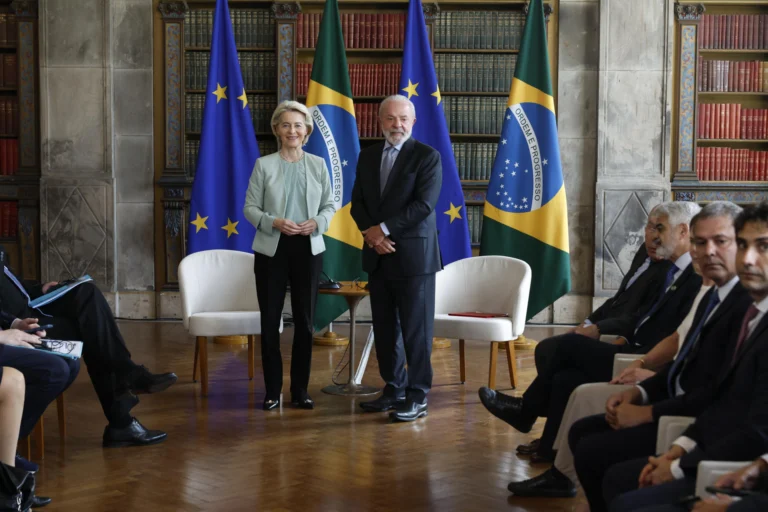
Though Brazilian President Luiz Inácio Lula da Silva—widely regarded as the chief architect of the revived negotiations—could not attend due to scheduling conflicts, his influence loomed large over the event. Just days earlier, Lula hosted European Commission President Ursula von der Leyen in Rio de Janeiro in a high-profile meeting framed as both a celebration and a gesture of gratitude for his relentless diplomatic push to finalize the agreement after years of stagnation under previous administrations.
Mercosur-EU Trade Deal Signed in Paraguay Amid Agricultural and Environmental Concerns
The agreement, once fully ratified, will create one of the world’s largest free trade zones, linking 780 million consumers across two continents and eliminating tariffs on over 90% of goods. For Mercosur, this opens unprecedented access to European markets for agricultural exports like beef, soy, sugar, and ethanol. For the EU, it secures stable supply chains for critical commodities and strengthens strategic ties with a region rich in lithium, rare earths, and renewable energy potential.
However, the deal has faced fierce opposition from multiple quarters. European farmers, particularly in France and Ireland, warn that cheaper South American agricultural products could undercut local producers. On Saturday, hundreds of tractors rolled into Paris in protest, echoing similar demonstrations in 2019 and 2023. “This isn’t free trade—it’s a race to the bottom,” declared Jean-Luc Mélenchon, French leftist leader, during a rally outside the National Assembly.
Conversely, environmental groups on both sides of the Atlantic have raised alarms about deforestation in the Amazon and Cerrado biomes. Critics argue that without enforceable sustainability clauses, the deal could incentivize further land clearing for agribusiness. In response, negotiators included a dedicated chapter on climate and environmental protection, binding both parties to the Paris Agreement and requiring compliance with labor and environmental standards as a condition of market access.
The European Commission insists the agreement contains “the most ambitious sustainability provisions ever included in an EU trade deal”. Meanwhile, Mercosur nations pledged to strengthen monitoring systems and increase penalties for illegal logging—a commitment Lula has championed since taking office in 2023.
Geopolitical Context: A Multipolar Trade Alliance in a Fragmenting World
The signing of the Mercosur-EU trade deal arrives at a pivotal moment in global economic realignment. As U.S.-China tensions escalate and protectionism rises, regional blocs are seeking new partnerships to reduce dependency on bipolar supply chains. For the EU, deepening ties with Latin America is part of its “de-risking” strategy—diversifying sources of food, energy, and minerals without full decoupling from major powers.
For South America, the deal represents more than economics—it’s a diplomatic reassertion of sovereignty. After years of political volatility and external interference, Mercosur’s unified stance signals that the region can negotiate as a bloc on equal footing with global powers. “This is not submission—it’s strategic autonomy through integration,” said Argentine Foreign Minister Diana Mondino ahead of the signing.
Critically, the agreement avoids the pitfalls of past U.S.-led trade pacts that prioritized corporate interests over social welfare. Instead, it includes mechanisms for small and medium enterprises (SMEs), public procurement transparency, and digital trade rules that protect data sovereignty. It also establishes a joint committee to monitor implementation, ensuring disputes are resolved through dialogue—not unilateral sanctions.
Moreover, the timing reinforces Latin America’s growing role in climate diplomacy. With the Amazon at a tipping point, the EU-Mercosur partnership could become a model for green trade: linking market access to verifiable ecological stewardship. If successful, it may inspire similar frameworks in Africa and Southeast Asia.
Lula’s Diplomatic Legacy and the Road to Ratification
Although absent from the ceremony, President Lula’s fingerprints are all over the final text. Upon returning to power in 2023, he prioritized reviving the stalled deal, which had been frozen since 2019 due to environmental concerns and political shifts in Brazil. His administration worked closely with EU counterparts to address deforestation fears, reinstated environmental enforcement agencies, and committed to zero illegal deforestation by 2030.
His recent meeting with von der Leyen in Rio underscored mutual respect. “President Lula didn’t just reopen negotiations—he rebuilt trust,” she said during a joint press conference. “This deal is a testament to what’s possible when leaders choose cooperation over confrontation.”
Yet the journey isn’t over. The agreement must now be ratified by all 27 EU member states and the national parliaments of Mercosur countries—a process that could take 18 to 24 months. Opposition remains strong in France, Austria, and among Indigenous communities in the Amazon basin, who fear increased land grabs.
Nevertheless, the symbolic weight of signing in Asunción—on the hallowed ground of Mercosur’s founding—cannot be overstated. It reaffirms that regional integration is not only possible but essential in an age of fragmentation.
Conclusion: A New Chapter in South-North Cooperation
The Mercosur-EU trade deal signed in Paraguay is more than a commercial treaty—it’s a declaration of interdependence. In a world drifting toward blocs and barriers, this agreement dares to imagine a different path: one where trade serves people, protects the planet, and respects sovereignty.
As the ink dries in the Gran Teatro José Asunción Flores, the message is clear: after decades of false starts, the Global South and Global North have chosen partnership over paternalism. Whether this vision endures will depend on implementation—but for now, history has been made in the heart of South America.
Author: JMVR
Source: Agencias
