




Honduran Feminists Fear Elimination of Equal Rights in Incoming Asfura’s Rule
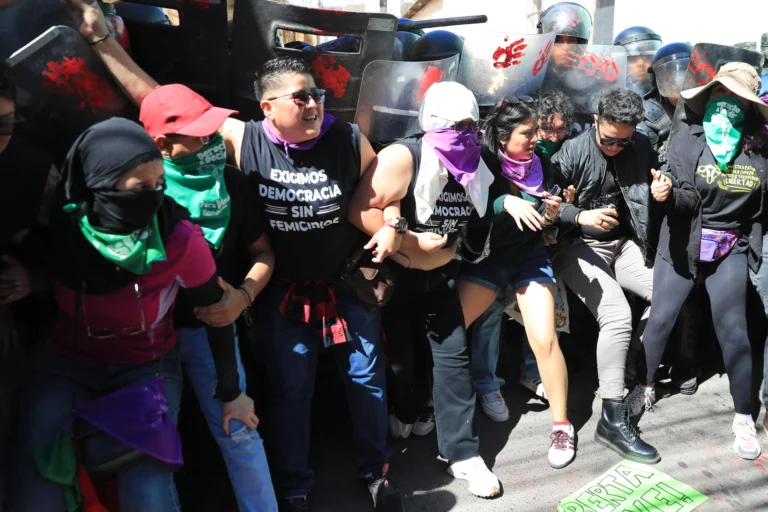
Members of the Honduran Military Police and members of feminist groups confront each other during a demonstration on ‘Honduran Women’s Day’ this Sunday in Tegucigalpa (Honduras). Photo: EFE/ Gustavo Amador
January 25, 2026 Hour: 4:24 pm
Feminist groups in Honduras expressed their fear this Sunday that the upcoming conservative government of President-elect Nasry Asfura will eliminate or weaken state entities dedicated to defending women’s rights, in a context marked by high rates of femicide.
RELATED:
Honduras pays tribute to women with Berta Cáceres’ image on the 200-lempira bill
Asfura will take office as president this Tuesday, ending four years of government under Xiomara Castro, the first woman to hold the presidency in Honduras, a country that recorded 262 femicides last year, according to data from the National Violence Observatory of the National Autonomous University of Honduras (UNAH).
Feminist organizations acknowledged this Sunday their skepticism about the arrival of the new conservative government, given the possibility that state institutions working on women’s rights will be merged or eliminated.
Central America, a region with high levels of sexist violence, has suffered cuts in public institutions dedicated to women’s care in recent years.
El Salvador, for example, banned the use of “inclusive language” in all public schools in the country, while in Panama the government has planned to eliminate the Ministry of Women as part of a restructuring of the State aimed at reducing public spending.
Thousands of feminists marched this Sunday with slight clashes with the military through the center of Tegucigalpa to demand more rights in favor of equality and the cessation of sexist violence with banners showing the faces of missing or murdered women, batucadas, and purple flares (the color of the movement).
Shouting “This day is not for celebration, it is for struggle and resistance,” the demonstration took place under tension due to the impossibility of advancing to the Parliament due to a strong military presence. The military and riot control units guarded the surroundings of the headquarters while the first parliamentary legislature was being installed inside the chamber.
Some of those present painted the shields of the military with their hands full of red paint, after which some were pushed by the security forces who also sprayed pepper spray on the faces of the demonstrators.
