




Greece Rules Out Intervention in The Strait of Hormuz
The Greek government reaffirmed that the European mission ‘Aspides’, under its operational command, is limited to the protection of maritime trade in the Red Sea and will not extend to the Strait of Hormuz.
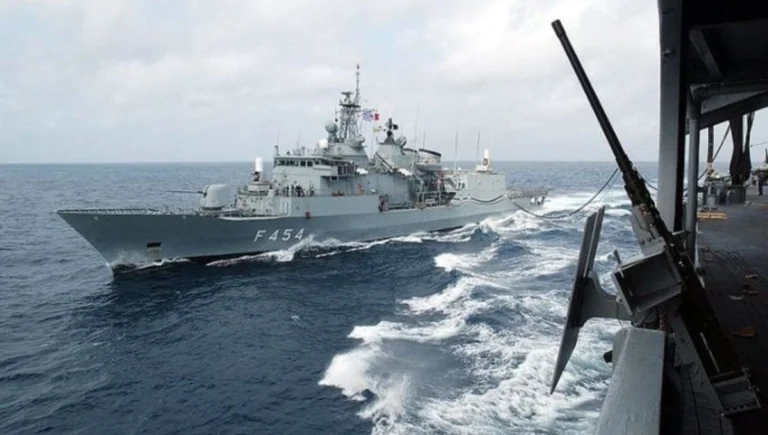
European frigates are participating in Operation Aspides to protect maritime traffic in the Red Sea. Photo EFE
March 16, 2026 Hour: 1:47 pm
Government spokesperson, “There is absolutely no possibility of our country’s involvement in a potential operation in the Strait of Hormuz.”
On Monday, Greece, which holds operational leadership of the European Union mission ‘Aspides’, ruled out any participation in operations aimed at opening the Strait of Hormuz, following Donald Trump’s request for cooperation to break the Iranian blockade after the U.S. and Israeli attacks.
RELATED:
U.S. Fails to Break Iran’s Strait of Hormuz Blockade
‘Aspides’, which Greece commands and in which an Italian and a Greek frigate currently participate, aims to escort ships crossing the strait and protect maritime trade in the Red Sea.
The spokesperson emphasized that the mission “is geographically limited” to this region and “has nothing to do with the Strait of Hormuz.”
Furthermore, he stated: “Under no circumstances do we intend to become involved in the war,” and added that Greece’s position regarding the situation in Iran is “a return to diplomacy.”
These statements come as EU foreign ministers meet in Brussels to discuss how to keep the Strait of Hormuz open, through which 20% of the world’s oil passes.
One of the points under discussion is the possible modification of the mandate of Operation Aspides, which currently has a purely defensive character: escorting merchant ships in the Persian Gulf, the Gulf of Oman, the Gulf of Aden, and the Red Sea, and intercepting any threat that jeopardizes the security of trade.
The EU High Representative for Foreign Affairs and Security Policy, Kaja Kallas, indicated that there are member states willing to contribute to facilitating navigation in the Strait of Hormuz, either through Operation Aspides itself or through a coalition of volunteers once the fighting ends.
However, the Greek position maintains that the scope of the European mission should not extend beyond its established area of operation, prioritizing the protection of maritime traffic in the already defined zones without expanding the mandate to include scenarios of military escalation.
Oil Surpasses $106 per barrel
The Strait of Hormuz is crucial not only as a vital transit route for oil but also as a key link in the global energy and food supply chain. Approximately 20% of the world’s LNG, primarily from Qatar, transits through this vital corridor.
However, following the recent escalation of tensions, this flow has slowed dramatically, forcing Asian economies like Japan and South Korea to make emergency energy purchases at record prices.
The facto closure poses a direct risk to the industrial and energy security of these nations. With shipping at a standstill, fertilizer prices have surged by 20%, hurting farmers in the Global South just as spring planting begins. This indirect crisis threatens to drive up global food prices until 2027.
Author: HGV
Source: Agencias
