Venezuela Faces Quake Doublet and Mobilizes Nationwide Rescue Effort
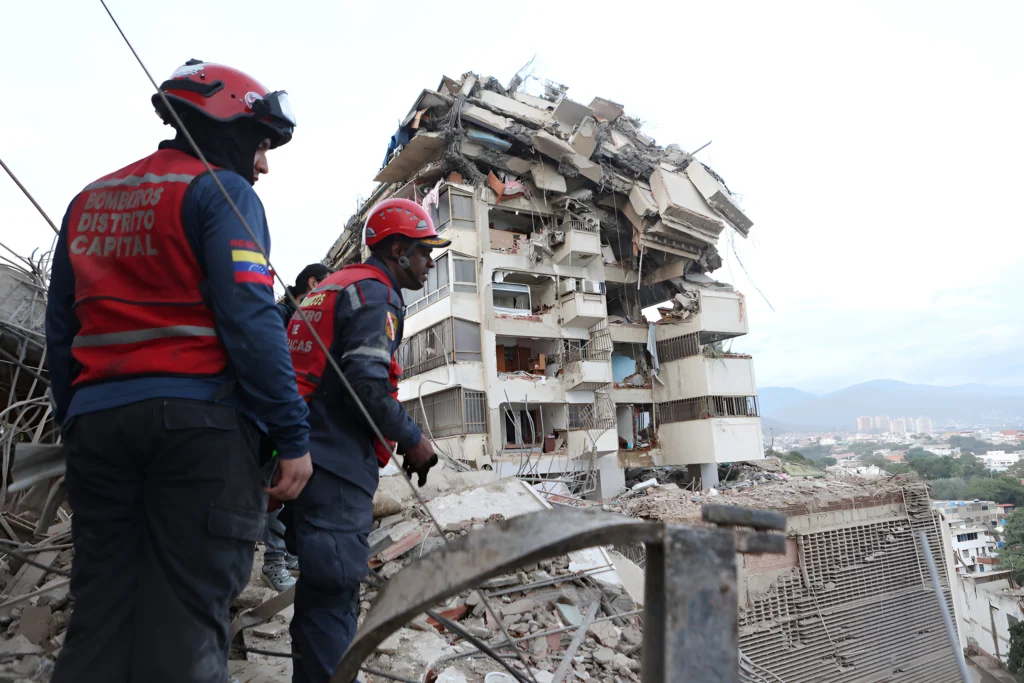
Report on the June 24 Yaracuy doublet, life-saving rescues, pediatric protocols, grassroots coordination, and the urgent challenges of transparent reconstruction.
On June 24, two massive earthquakes, with magnitudes of 7.2 and 7.5, struck northern Venezuela just 39 seconds apart, killing more than 2,200 people, reducing thousands of homes to rubble, and triggering the largest disaster response the country has mounted in more than a century.
RELATED: Venezuelan Government Mobilizes Resources as 50+ Camps Shelter Displaced
The twin ruptures, centered in Yaracuy state along the San Sebastian fault, unleashed their destructive force on the densely populated Capital District, Miranda and coastal La Guaira, where poorly reinforced residential buildings collapsed like houses of cards.
Within hours, more than 26,000 first national responders, backed by international rescue teams from 30 countries, were digging through debris as hundreds of aftershocks rattled the ruins and kept survivors and rescuers alike in constant fear.
But amid the chaos, a remarkable partnership emerged: State agencies and grassroots community networks joined forces, transforming neighborhood councils and communal kitchens into the backbone of a relief effort that would define Venezuela’s resilience in its darkest hour.
National and International Mobilization on the Frontline
Search-and-rescue became the top priority, led by the National Risk Management System. Official figures show more than 26,000 national personnel were deployed across the affected states.
These teams work in shifts to manage extreme physical strain while securing perimeters in the hardest-hit areas, including collapsed multi-story buildings in Altamira and Los Palos Grandes, and coastal sectors like Tanaguarena in La Guaira.
The human toll and the scale of structural collapse demand external help. As teams clear rubble, international solidarity arrived quickly: over 4,000 international search-and-rescue specialists coordinated with the Venezuelan Government.
Delegations included regional neighbors such as Cuba, Colombia, Chile, Panama, Ecuador, El Salvador, Mexico and the Dominican Republic, together with teams from Switzerland, Spain, France, Italy, Portugal, Qatar, China, Brazil and Russia. These international groups brought tactical USAR brigades, emergency medical personnel, heavy machinery, specialized engineers, and field surgical units.
K9 units played a central role in detection and were integrated into mixed domestic-international teams. Domestic dog squads paired with foreign canine brigades, around 148 units, forming a coordinated network that mapped voids and located trapped people amid ongoing seismic instability.
These canine teams helped focus limited heavy equipment where it was most needed and prevented unnecessary use of machinery in zones where sensitive manual extraction was safer.
Extraction From Urban Collapses
The seismic doublet caused massive damage in high-density residential zones, forcing complex extraction operations. In Altamira, Chacao, responders concentrated on a collapsed 22-story apartment building. Specialized crews used hydraulic jacks, pneumatic lifting bags, and listening devices to search for signs of life.
After 34 hours of continuous technical excavation, engineers breached a structural pocket and rescued a family of four who had sheltered beneath a reinforced beam. That success showed how patient, technical operations can save lives even after long entrapment.
Coastal La Guaira suffered intense ground acceleration, and Tanaguarena saw multiple apartment failures. Civil Protection units and international brigades used vertical shoring to stabilize nearby structures before entering danger zones, allowing teams to work without causing secondary collapses.
In one operation, crews cleared debris to free six people trapped in a subterranean parking level. Those rescues required close coordination between engineers, medics, and logisticians at the operational command center, which managed risks while aftershocks continued.
The urban nature of damage complicated every step. Narrow streets, high populations, and damaged infrastructure limited access for heavy machinery and required creative staging of equipment.
At times, teams had to shift from mechanical lifting to precise manual extractions because of the risk of destabilizing neighboring buildings. This mix of tactics, heavy equipment where possible, delicate manual work where necessary, defined the rescue phase across the affected zones.
Technical Safeguarding and Infant Extraction
Infants and very young children required distinct tactical protocols to protect them during extraction. Near Los Palos Grandes, a collapsed daycare and adjacent homes forced teams to avoid heavy machinery that could destabilize fragile debris. Instead, rescuers relied on manual tools and fiber-optic cameras to inspect voids without disturbing load-bearing elements.
To safeguard infants, response teams combined micro-tunneling stabilization via timber shoring with close microclimate monitoring and immediate neonatal care. Rescue crews built horizontal micro-tunnels to reach trapped infants safely, using timber shoring to hold fragile voids and instruments to monitor temperature and humidity.
Once reached, infants received direct deployment of neonatal field incubators and immediate thermal and hydration support before evacuation. In one case, the units rescued an 18-month-old baby 32 hours after the earthquake, and hours later they rescued his mother in La Guaira.
The Ministry of Health, Carlos Alvarado, confirmed that mobile hospitals, including pediatric care units, were deployed directly to rescue perimeters so rescued children could receive triage and specialist care before transfer to regional hospitals.
Canine Detection and Strategic Alerts
When electronic listening devices could not penetrate deep or irregular voids, canine teams became indispensable. Working across jagged concrete, glass, and rebar, trained search dogs detected scents that machines missed.
Handlers from Firefighters and Civil Protection rotated dogs every 20 minutes to prevent olfactory exhaustion and heat stress in the tropical climate, and to keep performance consistent across long operations.
These canine alerts often directed excavation precisely where human teams could safely work. In San Bernardino, a border collie named “Tsunami” repeatedly signaled a debris void under a collapsed building, managing to rescue more than 30 people.
Trusting the dog’s alert, rescuers dug a narrow, delicate shaft and found a 60-year-old man trapped for more than 48 hours. Tsunami marked, and 3 hours later, the team found the person under the remains.
Canine teams thus became a force multiplier, allowing responders to balance speed with safety by confirming where heavy machinery could be used and where careful manual extraction was necessary.
Logistics: Collection Centers, Healthcare and Shelters
As on-site rescues wound down, the response shifted to large-scale logistics and humanitarian care managed through collection centers. The Ministry of Foreign Affairs, grassroots communal organizations, and international relief agencies organized these hubs, which local community councils and volunteers managed to process more than 8,000 tons of incoming food, 3 million liters of clean water, and 81,589 families attended from international partners and domestic donors.
Emergency triage quickly filled public hospitals such as Domingo Luciani and Perez Carreño, which operated at maximum capacity with support from international field surgical units. Field hospitals eased immediate pressure, but the need for sustained trauma care and mental health services will continue.
For displaced families, the State converted secure public buildings into dignified shelters that provided not only temporary housing, hot meals, and clothing but also psychological first aid to begin the long process of recovery.
Some shelters, like the Headquarters of the National Sports Institute (IND) and the Miguel Antonio Caro School, are designed for the homeless after the earthquake. Logistics teams face the near-term task of balancing immediate relief with planning for durable solutions.
That means organizing shelter capacity, medical follow-up, and supply chains while preparing for mass engineering assessments and eventual reconstruction. These operations must be transparent and accountable, so aid reaches the most vulnerable rather than fueling opportunistic profiteering.
Challenges Ahead
More than 680 aftershocks have kept already damaged buildings unstable, complicating assessment and repair. Many multi-story residential buildings may be unsalvageable, requiring mass relocation and long-term housing plans. Field hospitals and international medical teams help immediately, but trauma care and mental health support will be needed for months.
The economic burden on a nation already under fiscal strain will be heavy, and recovery policies must center equity and community control to avoid reproducing pre-quake inequalities. The coming months will test political will, logistical skill, and the country’s ability to turn solidarity into a just and resilient rebuild.
National first responders and international specialists carried out high-risk extractions, canine teams located hidden survivors, and pediatric protocols saved infants who otherwise would not have survived. Community councils and grassroots relief networks moved supplies, sheltered the displaced, and provided vital local intelligence.
As Venezuela shifts from rescue to recovery, preserving this collaboration will be critical. Reconstruction must be transparent, prioritize the most vulnerable, and strengthen local disaster resilience rather than replicating pre-quake inequalities. The months ahead will reveal whether solidarity, technical skill, and community power can transform this tragedy into an opportunity for a fairer and more resilient future.
Sources: UN – La Radio del Sur – teleSUR – El Mazo Dando – El Nacional – Delcy Rodríguez – Yván Gil – Diosdado Cabello – El Universal – Agencia Venezolana de Noticias – Venezuelanalysis – La Iguana Tv – Madelein García