







Cuba Applies Lessons from COVID-19 to Arbovirus Outbreak
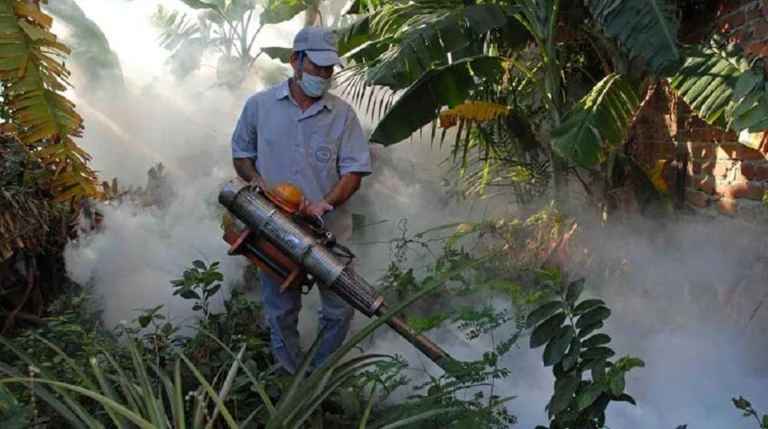
Fumigation against the Aedes aegypti mosquito in the Cuban province of Matanzas. Photo: OnCuba News
November 12, 2025 Hour: 1:09 pm
🔗 Comparte este artículo
In the last 21 days, health authorities recorded a 62% increase in dengue cases.
On Tuesday, Cuban President Miguel Diaz-Canel called for weekly meetings with scientists to propose solutions to the cases with Nonspecific Febrile Syndrome, caused primarily by arboviruses. The reunion at the Presidential Palace focused on the updated epidemiological situation on the island.
RELATED:
Cuba reports 3 deaths from dengue in 2025
Dr. Jose Raul De Armas announced that the past week marked the second consecutive week with a decrease in febrile syndromes, explaining that the change has occurred in eight provinces: Havana, Matanzas, Villa Clara, Cienfuegos, Ciego de Avila, Granma, Santiago de Cuba, and Guantanamo.
The cumulative number of suspected chikungunya cases has reached 21,681, distributed across 14 provinces, 93 municipalities, and 151 health areas. The provinces with the highest number of cases are Matanzas, Havana, Camagüey, Cienfuegos, Artemisa, and Villa Clara.
No confirmed or suspected cases of Oropouche (OROV) have been informed since September 26. “The fundamental objective is to ensure the admission of all patients with a febrile syndrome. Through home admission or on the criteria that has already been approved,” De Armas said.
The text reads, “Cuba bets on its technological sovereignty in the current treatment of arboviruses. As a consequence of the increase in arbovirus cases in Cuba, especially chikungunya, the island’s authorities are implementing a strategy that includes a clinical trial with the drug Jusvinza, created by the Center for Genetic Engineering and Biotechnology (CIGB).”
Primary Health Care Director Yagen Pomares referred to a protocol that is “already approved” in its second version, explaining that it stems from the lessons learned during the COVID-19 pandemic, “when we quickly put science and research to work addressing the problem.”
Pomares mentioned a challenge in primary health care, which is “getting our patients with Febrile Syndrome to self-isolate at home,” and is the first aspect that must be considered. The second aspect is the follow-up by the primary healthcare teams.
All children under two years old with febrile syndrome should be hospitalized. The same applies to pregnant women, who undergo more thorough monitoring, and adults who present prolonged fever, loss of consciousness, persistent abdominal pain, or other concerning symptoms.
Madelaine Rivera, the National Director of Surveillance and Vector Control, admitted that “we know that the main concern of our population today is adulticide treatment and fumigation, we haven’t been able to reach all the areas, as we did during all the years we’ve had epidemic outbreaks.”
teleSUR: JP
Source: Escambray